

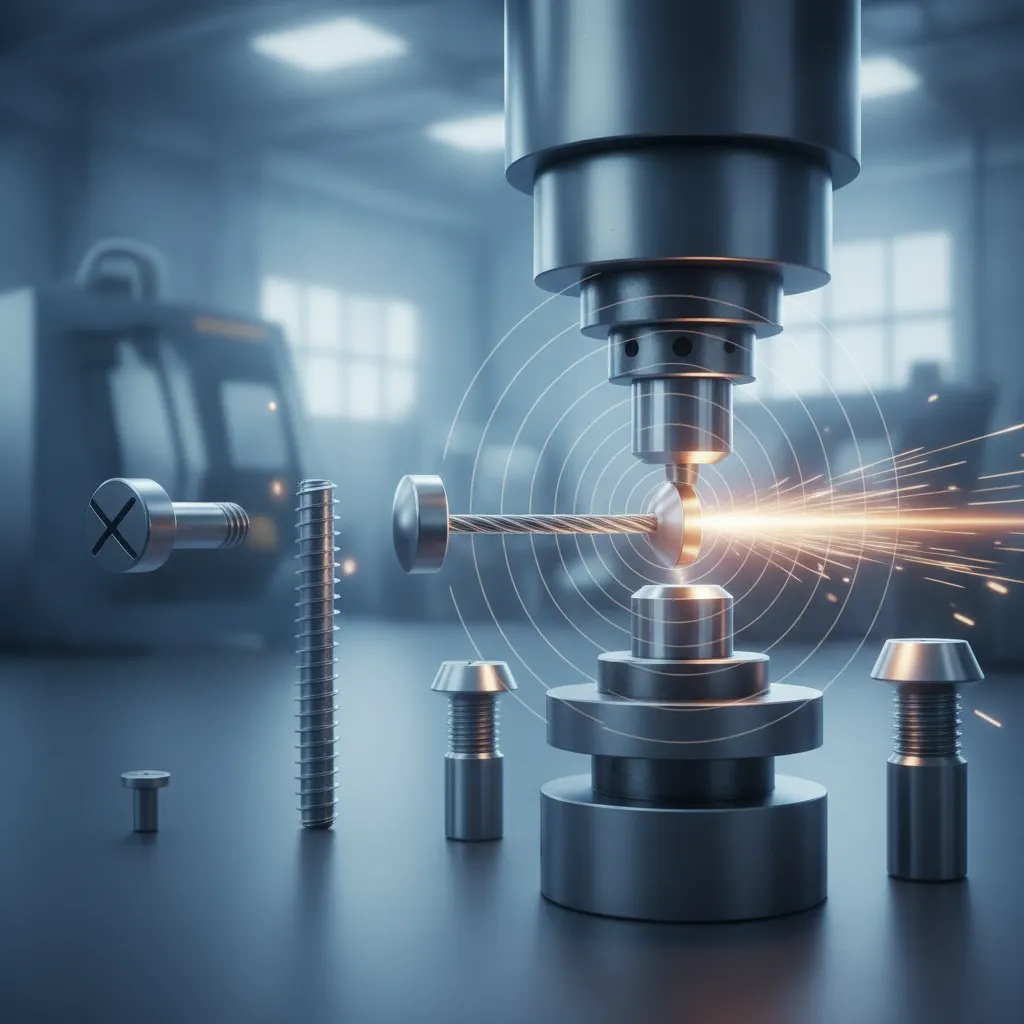
Cold heading is a cold-forming process that shapes metal wire or rod into fasteners and precision parts at room temperature using compressive force, no heat required. A series of dies strike the metal blank, displacing material rather than cutting it, which preserves grain structure and produces stronger, near-net-shape parts. It’s the dominant method for manufacturing bolts, screws, rivets, and similar high-volume components because it generates almost zero material waste and runs at speeds exceeding 400 parts per minute.
What Is Cold Heading and How Does It Work?
This forming process forces a metal blank into a die under high compressive force, displacing material to create a shape — no cutting, no heat, no wasted stock. According to Grandeur Fasteners, the technique is valued precisely because it produces near-net-shape parts with minimal secondary operations required.
The process is also called cold forging or impact extrusion depending on the application and industry context. In every case, the core mechanic is the same: a metal wire blank is struck with enough force that it flows into the cavity of a die, taking on the die’s geometry. The material goes nowhere — it simply moves.
“Cold forming at room temperature is not just about speed — it’s about preserving the integrity of the metal’s grain structure in a way that heat-based processes fundamentally cannot.” — Dr. Thomas Altan, Professor Emeritus of Manufacturing Engineering, Ohio State University
What Does ‘Cold Headed’ Mean for a Finished Part?
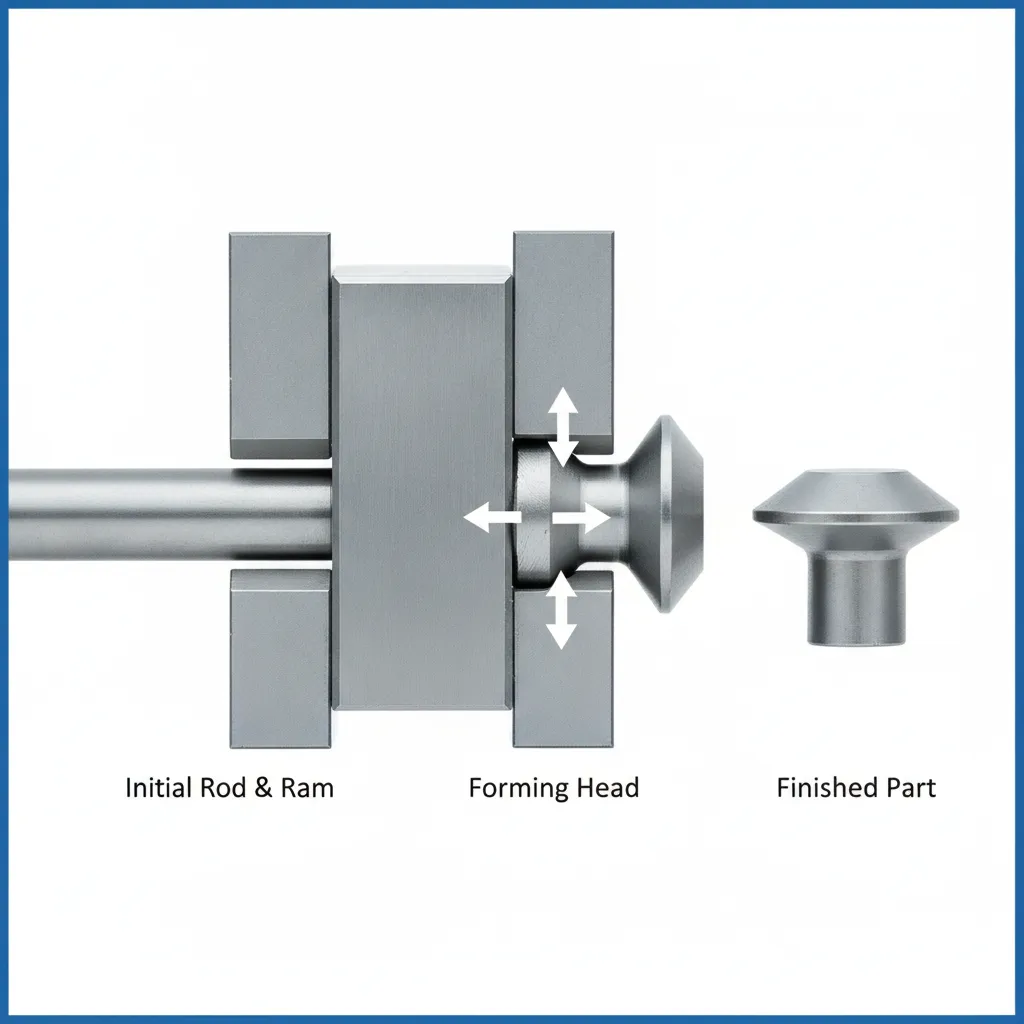
A cold headed part is one whose head geometry was formed by impact rather than machining or casting. That distinction matters because impact-formed heads carry a continuous, unbroken grain structure — the metal’s internal fiber follows the contour of the head rather than being severed by a cutting tool.
The word “cold” refers to forming at or near room temperature, below the metal’s recrystallization temperature. Keeping the metal cold preserves the work-hardened grain structure built up during forming. The result is a tensile strength increase of 20–30% compared to a machined equivalent, a meaningful advantage in fastener and structural applications where fatigue resistance matters.
The Progressive Die Stages: Step-by-Step
Cold heading machines run through a defined sequence of stations to convert raw wire into a finished part. Each stage builds on the last:
- Wire feed and cut-off: The machine draws wire from a coil and cuts a precise blank, called a “slug”, at the correct length for the target part weight.
- First blow (pre-form): A punch strikes the slug, beginning to upset the head end and establish the rough geometry.
- Second blow (finish form): A second die strike drives the material into its final head shape with dimensional accuracy.
- Optional trimming or pointing: Some parts require a trimming station to clean up the shank or a pointing station to form a lead-in chamfer on threaded fasteners.
Production speeds across this sequence typically run from 100 to 400+ parts per minute, depending on part complexity and machine size. A simple rivet runs near the top of that range; a multi-diameter shoulder bolt with a hex head runs closer to the bottom. For a visual overview of the process in action, see this cold heading demonstration video on YouTube.
Cold Heading vs. Cold Forming: What’s the Difference?
Cold forming is the broad category; the heading process is a subset that specifically shapes the head or end geometry of a part from wire or rod stock.
All cold heading is cold forming, but not all cold forming is cold heading. Cold forming covers any room-temperature metal displacement process — rolling, extrusion, drawing, and heading alike. The heading operation refers specifically to upsetting one end of a blank to create a head shape, which is why fasteners dominate its output.
Cold heading vs. machining: Machining is subtractive — it removes material to reach a shape. The heading process displaces metal, producing a near-net-shape part with virtually no scrap. That displacement also aligns the grain flow along the part’s contour, which improves fatigue strength compared to a machined equivalent. Cycle times are faster, and material yield is higher.
Cold heading vs. hot forging: Hot forging heats metal above its recrystallization temperature, which makes forming easier but introduces trade-offs. Parts require descaling after forging, tolerances run around ±0.010 in., roughly 10 times looser than the ±0.001 in. achievable with this cold process, and the operation consumes significantly more energy per part.
Cold heading vs. stamping: Stamping uses sheet metal as its feedstock and excels at flat or shallow geometries. The cold heading approach starts with wire or rod stock and produces three-dimensional, axially symmetric shapes that stamping cannot replicate.
When Should You Choose Cold Heading Over Other Processes?
This method delivers its strongest advantage on high-volume runs — typically 10,000 pieces or more — where per-part tooling cost amortizes quickly. It suits parts where the head-to-shank volume ratio would waste significant bar stock if machined, and it requires materials with enough ductility to withstand cold work without cracking, such as low-carbon steel, aluminum alloys, or copper.
The following scenarios are ideal candidates for this forming approach:
- High-volume fastener production exceeding 10,000 pieces per run
- Parts requiring improved fatigue strength without secondary heat treatment
- Components where material waste must be minimized for cost or sustainability reasons
- Axially symmetric geometries such as bolts, pins, rivets, and ball studs
- Applications demanding tight dimensional tolerances of ±0.001 inch or better
What Steel and Materials Work Best for Cold Heading?
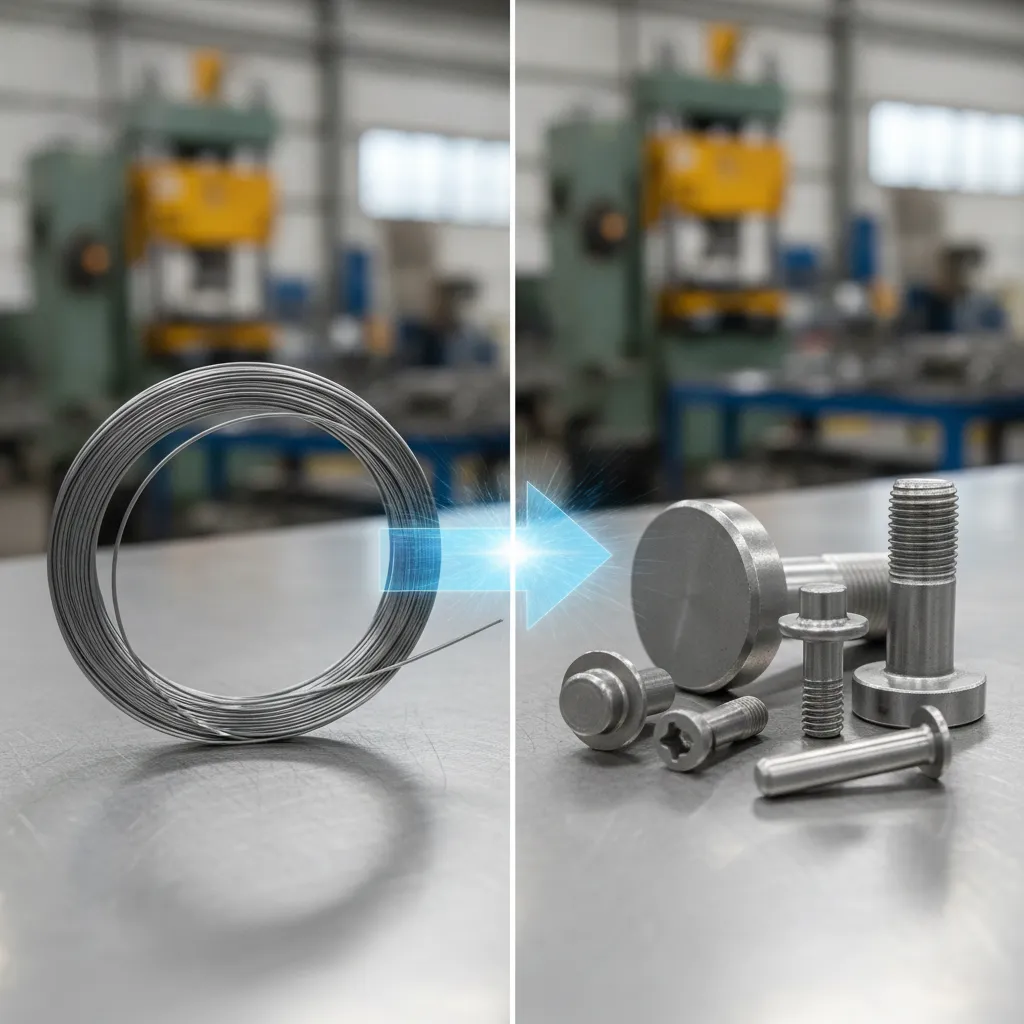
Low-carbon steels in the SAE 1006–1022 range are the most common materials used in this process, chosen for their high ductility and predictable cold-work behavior.
Medium-carbon grades, SAE 1035 through 1045, suit applications requiring greater strength in the finished fastener, such as bolts and structural pins. Stainless steels 304, 316, and 410 are widely headed for corrosion-resistant fasteners, though they work-harden faster than plain carbon grades and demand tighter process control. Aluminum alloys 1100 and 6061, copper, and titanium grades with sufficient ductility round out the standard material list for these forming operations.
The decisive selection criterion is reduction of area (RA), a measure of how much a wire cross-section can deform before fracturing. Wire used in this process typically requires RA of 60–70% or higher. To reach that threshold, wire is spheroidize-annealed to soften carbide structures, then drawn to precise diameter tolerances before it ever reaches the heading machine.
Before heading, wire receives a zinc phosphate coating combined with a lubricant, commonly sold under the Bonderite trade name. This coating reduces die wear and prevents galling between wire and tooling, which directly affects tool life and part surface quality.
“Material preparation is half the battle in cold forming. Wire that hasn’t been properly annealed and coated will crack at the head, waste tooling, and cost you far more than the savings you expected.” — James R. Keske, Senior Process Engineer, National Machinery LLC
Which Alloys Are Unsuitable for Cold Heading and Why?
High-carbon steels above roughly 0.55% carbon are too brittle to absorb cold work without cracking. Fully hardened tool steels, cast iron, and certain high-strength aerospace alloys that lack the ductility to deform plastically will fracture at the head, producing scrap and risking die damage.
Material Limitations to Check Before You Start
Seams, laps, or non-metallic inclusions in wire stock concentrate stress during heading and cause head cracking. Precision cold heading shops use ultrasonic or eddy current testing on incoming wire to catch these defects before production begins — catching a bad coil at receiving costs far less than scrapping a full production run.
Cost and Efficiency: Cold Heading vs. Hot Heading
This cold-forming method consistently delivers lower per-part costs than hot heading or machining, primarily through near-zero scrap rates and eliminated energy inputs.
Material utilization is where the gap is most visible. The process achieves 90–98% material utilization by displacing metal rather than cutting it away. Machining from bar stock recovers only 60–75% of input material. On steel wire priced at $0.80–$1.20 per pound, that 20–35% utilization gap compounds fast at production volumes above one million pieces.
Hot forging adds a direct energy line item that cold forming eliminates entirely. Furnace or induction heating adds $0.05–$0.15 per part depending on alloy and section size. At 10 million parts per year, that figure alone represents $500,000–$1,500,000 in avoidable energy spend.
Tooling costs are real but manageable. Carbide-lined die sets run $500–$5,000 per set and survive 500,000–2,000,000 hits before replacement. Amortized across those volumes, tooling cost per part drops to fractions of a cent, well below the savings on material and energy.
Work hardening during the forming process also raises tensile strength 20–30% above annealed equivalents. That strength gain can justify downgauging — specifying a smaller, lighter part that meets load requirements — which cuts material consumption and part weight simultaneously.
Real Production Metrics and Industry Case Studies
The automotive fastener market offers the clearest benchmark. A standard M8 hex bolt produced by this method runs at 300+ parts per minute with a per-piece cost of $0.03–$0.08. The same bolt machined from bar stock at equivalent volume costs 3–5× more per piece. The Cold Heading Company, founded in 1912 and supplying powertrain, braking, and safety system applications for over a century, built its entire business model on exactly this cost structure — high-volume, near-net-shape production where per-part economics favor cold forming decisively over any alternative.
“The economics of cold forming only improve as volume scales. At a million parts, the per-piece cost advantage over machining is not marginal — it’s transformative for a manufacturer’s bottom line.” — Editorial Team, Cold Heading Company, Industry Overview
Cold Heading Equipment: Machine Types and Specifications
this strategy machines fall into three main categories — single-stroke, double-stroke, and progressive transfer headers — each suited to different part complexity and production volume.
Machine Types, Specifications, and Supplier Recommendations
Single-stroke headers use one die and one blow, making them the right choice for simple parts like rivets and short blanks. Double-stroke machines deliver two blows, which is the standard configuration for bolts and screws. Progressive transfer headers run 3–6 stations and handle complex geometries such as socket-head cap screws or multi-diameter shafts — parts that require sequential forming to reach final shape.
When evaluating equipment, the key specifications are wire diameter capacity (typically 1mm–25mm), number of stations, stroke rate in parts per minute, shut height, and tonnage. A 4-station progressive header forming M10 bolts typically requires 50–150 tons of forming force. Stroke rate determines your output ceiling, while shut height governs the maximum part length the machine can accommodate.
Tooling drives per-piece cost as much as machine selection does. The three core components are the punch, die, and knockout pin. Carbide-lined dies are standard for steel wire; tool steel punches work well for softer materials like aluminum or copper. Die life and punch replacement frequency are the two variables that most directly affect cost per part at volume.
Major machine manufacturers include National Machinery (USA), Hatebur (Switzerland), Sacma (Italy), and Nakashimada (Japan). Each builder has different strengths across part complexity, wire diameter range, and stroke speed, so matching the supplier to your specific geometry matters.
Modern this approach lines integrate wire straighteners, feeders, part transfer conveyors, and vision inspection systems into a single automated cell. A well-configured line can run lights-out for 4–8 hours between operator checks, which is where high-volume production delivers its strongest cost-per-piece advantage over machining. The American Society of Mechanical Engineers (ASME) provides standards and technical resources that govern equipment design and process validation for cold forming operations.
Frequently Asked Questions
What tolerances can cold heading achieve?
the practice routinely holds dimensional tolerances of ±0.001 inch (±0.025 mm) on headed features, with some precision tooling reaching ±0.0005 inch. Because the process forms metal rather than cuts it, die wear is the primary variable affecting repeatability. High-volume runs on well-maintained tooling typically stay within the tighter end of that range across millions of parts. Secondary operations like thread rolling can achieve tolerances tighter still on specific features.
Can cold heading produce parts other than fasteners?
Yes, this process produces a broad range of non-fastener components, including electrical contacts, ball studs, valve stems, pins, and cold-formed blanks for bearing races. Any part that requires a near-net-shape upset, flange, or head geometry is a candidate. The process is material-agnostic across steel, aluminum, copper, and titanium alloys, which widens its application across automotive, aerospace, and medical device manufacturing.
How does cold heading affect the surface finish of a part?
this practice produces a smooth, burnished surface on formed faces because the die compresses and flows the metal rather than cutting it. Typical Ra values on headed surfaces fall between 32 and 63 microinches without secondary finishing. The process also leaves a work-hardened skin that resists wear. Sheared cut-off surfaces are rougher and often require a secondary coining or trimming step if a consistent finish is needed across the entire part.
What is the minimum viable production volume to justify cold heading tooling costs?
Most this method operations become cost-effective at production runs of 10,000 parts or more, with the tooling investment typically amortized fully by 50,000–100,000 pieces depending on part complexity. Simple single-die tools cost less and break even faster; multi-station progressive dies for complex geometries carry higher upfront costs that require larger volumes to recover. Below 10,000 pieces, machining or screw-machine production often delivers a lower total cost per part despite higher per-piece rates.
How does cold heading compare to thread rolling for fastener production?
this strategy and thread rolling are complementary, not competing, processes. Heading forms the head and shank geometry of a fastener, while thread rolling forms the thread profile on the shank after heading. Thread rolling, like heading, displaces rather than cuts metal, producing threads with better fatigue resistance and surface finish than cut threads. Most high-volume fastener production lines combine both operations sequentially — heading first, thread rolling second — to maximize both strength and dimensional consistency across the finished part.
Conclusion
this approach’s core advantage is material efficiency — the process converts wire stock into a finished near-net-shape part with virtually no scrap, while simultaneously strengthening the part through work hardening. That combination of low waste and improved mechanical properties is difficult to match at high volumes with any cutting-based process.
Three takeaways worth acting on: first, verify your production volume clears the 10,000-piece threshold before committing to tooling; second, specify grain-flow requirements on your drawing so your supplier’s metallurgical review confirms the heading direction aligns with your load path; third, request a material certificate confirming wire chemistry — feedstock consistency is the single biggest variable in dimensional repeatability.
If you are sourcing cold-headed components, request a Design for Manufacturability review from your cold forging supplier before finalizing part geometry — changes made at the drawing stage cost far less than die modifications after first-article inspection.
Recommended Articles
Explore more from our content library:
- <a href="https://gcnov.com/metal-polishing-finishing-techniques-compared/" title="A Complete Guide to Metal Polishing and Finishing Techniques“>A Complete Guide to Metal Polishing and Finishing Techniques
- <a href="https://gcnov.com/cold-heading-vs-machining-for-fasteners-which-to-choose/" title="How to Choose Between Cold Heading and Machining“>How to Choose Between Cold Heading and Machining
- <a href="https://gcnov.com/swiss-machining-what-it-is-and-when-to-use-it/" title="Swiss Machining: What It Is and How It Works“>Swiss Machining: What It Is and How It Works
- <a href="https://gcnov.com/what-is-sheet-metal-fabrication-core-processes-and-industria/" title="Sheet Metal Fabrication Process: Core Techniques and Steps“>Sheet Metal Fabrication Process: Core Techniques and Steps
- Gaming PC vs Console: Which Should You Buy in 2026?
