

Steel forging is a manufacturing process that shapes steel by applying compressive force, through hammering, pressing, or rolling, while the metal is heated to between 1,900°F and 2,300°F. This controlled deformation aligns the steel’s grain structure, producing parts that are significantly stronger, tougher, and more fatigue-resistant than those made by casting or machining. Forged steel components are the default choice wherever structural failure is not an option: aerospace landing gear, automotive crankshafts, oil and gas valves, and heavy industrial tooling.
“Forging is one of the oldest metalworking processes known to humanity, and it remains unmatched for producing parts with superior grain structure and mechanical integrity.” — Dr. Taylan Altan, Professor Emeritus of Engineering, Ohio State University Center for Precision Forming
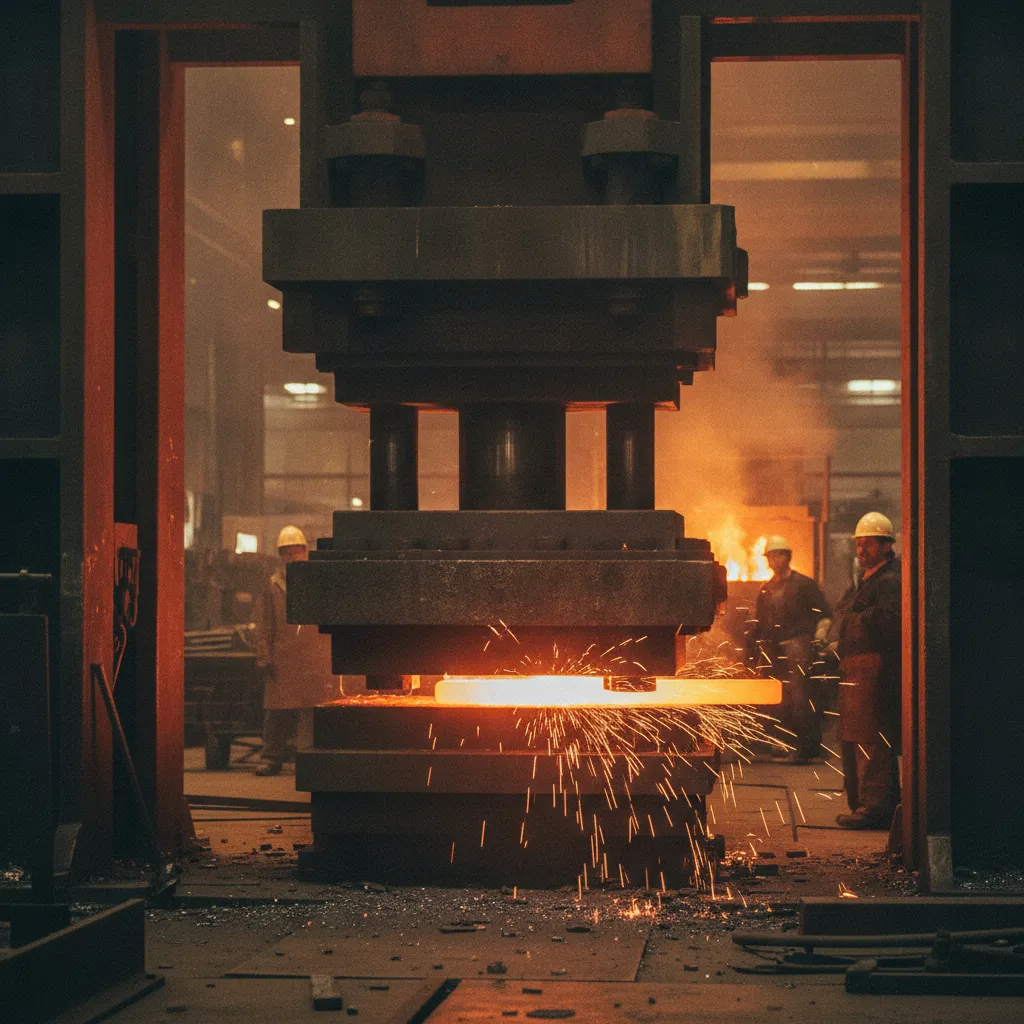
What Is Steel Forging and How Does the Process Work?
Steel forging shapes metal by applying compressive force to a heated billet, realigning its grain structure to produce parts stronger than cast equivalents. According to Wikipedia’s overview of forging, the process dates back thousands of years and remains one of the most reliable methods for producing high-integrity metal components.
The process begins with billet selection, choosing a steel grade matched to the part’s load requirements. The billet enters a furnace and reaches 1,900–2,300°F, the working range for most carbon and alloy steels. At that temperature, the steel becomes plastic enough to deform without cracking. A press or hammer then shapes it, followed by trimming to remove flash, heat treatment to set mechanical properties, and dimensional inspection before shipment.
The critical physics happen at the grain level. Compressive force elongates and realigns steel’s crystalline grain structure along the part’s contour. That continuous grain flow, rather than the interrupted structure left by casting or machining, is the direct reason forged parts carry higher tensile strength, better fatigue resistance, and superior impact toughness.
One limit worth naming: metals with very low ductility at working temperatures, including certain cast irons and brittle tool steels, crack under compressive force rather than deforming. Those materials are not candidates for forging.
Open-Die vs. Closed-Die vs. Ring Rolling: Choosing the Right Method
Each forging method suits a different geometry and production volume, so matching method to part geometry is the first engineering decision.
- Open-die forging presses steel between flat or simple-profile dies without enclosing the workpiece, best for large, simple shapes like shafts, bars, and discs, and for low-volume custom runs where tooling cost must stay low.
- Closed-die (impression-die) forging confines the billet inside a matched die set that defines the final shape precisely, suited to complex, near-net-shape parts like connecting rods, flanges, and gear blanks produced in medium-to-high volumes.
- Seamless rolled ring forging punches a hole in a preformed disc and rolls it outward under radial pressure, the standard method for rings, bearing races, and flanged couplings where a seamless hoop geometry is required.
For a visual demonstration of how these processes work in practice, this steel forging process video provides an excellent walkthrough of industrial forging operations.
What Equipment and Machinery Does Steel Forging Require?
The equipment category determines both the force available and the economic sweet spot for a given run size.
Hydraulic presses deliver sustained, controllable force, up to 50,000 tons on the largest industrial units, making them the preferred tool for closed-die work and large structural parts where precise penetration depth matters. Mechanical hammers deliver rapid, high-impact blows and excel at open-die operations and smaller impression-die runs where cycle speed drives unit cost. Ring-rolling mills use a driven mandrel and outer roll to expand a preform radially, producing seamless rings from a few inches to over 25 feet in diameter.
High-volume closed-die production favors hydraulic or mechanical press lines with automated billet handling. Custom, low-volume, or oversized work, think large aerospace forgings or pressure vessel components, typically runs on open-die hydraulic presses where flexibility outweighs throughput.
Which Steel Grades Work Best for Forging Applications?
Low-carbon steels forge most easily, medium-carbon and alloy steels dominate structural applications, and high-carbon grades demand the tightest process control.
Steel grades split into three broad tiers by forgeability. Low-carbon steels, 1018 and 1020 are the standard references, deform readily at wide temperature ranges and rarely crack during the forging stroke. They suit high-volume, lower-stress parts where machineability matters more than ultimate strength.
Medium-carbon grades like 1045 handle the bulk of structural steel forging work. Alloy steels 4140 (chromium-molybdenum) and 4340 (nickel-chromium-molybdenum) sit in the same tier and dominate high-stress applications, gears, crankshafts, axle shafts, because their alloying elements improve hardenability and allow heat treatment to tensile strengths above 150,000 psi. High-carbon and tool steels are the hardest to forge; they require temperature windows as tight as ±25°F and crack if the billet cools even slightly before the die closes.
Stainless steel forging adds another layer of trade-offs. 300-series austenitic grades, 304 and 316 are the most common, are forgeable, but they work-harden quickly and require 20–40% higher press forces than equivalent carbon steel billets. That translates directly to a 20–40% cost premium per part before you account for material price.
How Steel Grade Affects Forging Cost and Lead Time
Grade selection compounds cost at every stage: raw material price, forging temperature, die wear rate, and post-forge heat treatment all stack. A 4340 part at the same geometry as a 1045 part can cost 2–3× more by the time it leaves the heat-treat oven, harder alloys accelerate die wear and require longer thermal cycles.
Steel’s density of approximately 0.284 lb/in³ is a real penalty in weight-sensitive designs. Aluminum and titanium forgings cut part weight by 65% and 40% respectively at comparable geometries, which is why aerospace and EV applications increasingly specify those materials despite their higher per-pound cost.
The following summarizes how common steel grades compare for forging suitability:
- 1018 / 1020 (low-carbon): Easiest to forge, wide temperature range, best for high-volume low-stress parts.
- 1045 (medium-carbon): Workhorse grade for structural applications, good balance of forgeability and strength.
- 4140 (Cr-Mo alloy): High hardenability, excellent for gears and shafts, moderate forging difficulty.
- 4340 (Ni-Cr-Mo alloy): Premium strength above 150,000 psi, tightest process control required, highest die wear.
- 304 / 316 (austenitic stainless): Forgeable but work-hardens quickly, requires 20–40% higher press forces.
- 17-4 PH (precipitation-hardened stainless): Excellent corrosion resistance and strength, used in aerospace and valve applications.
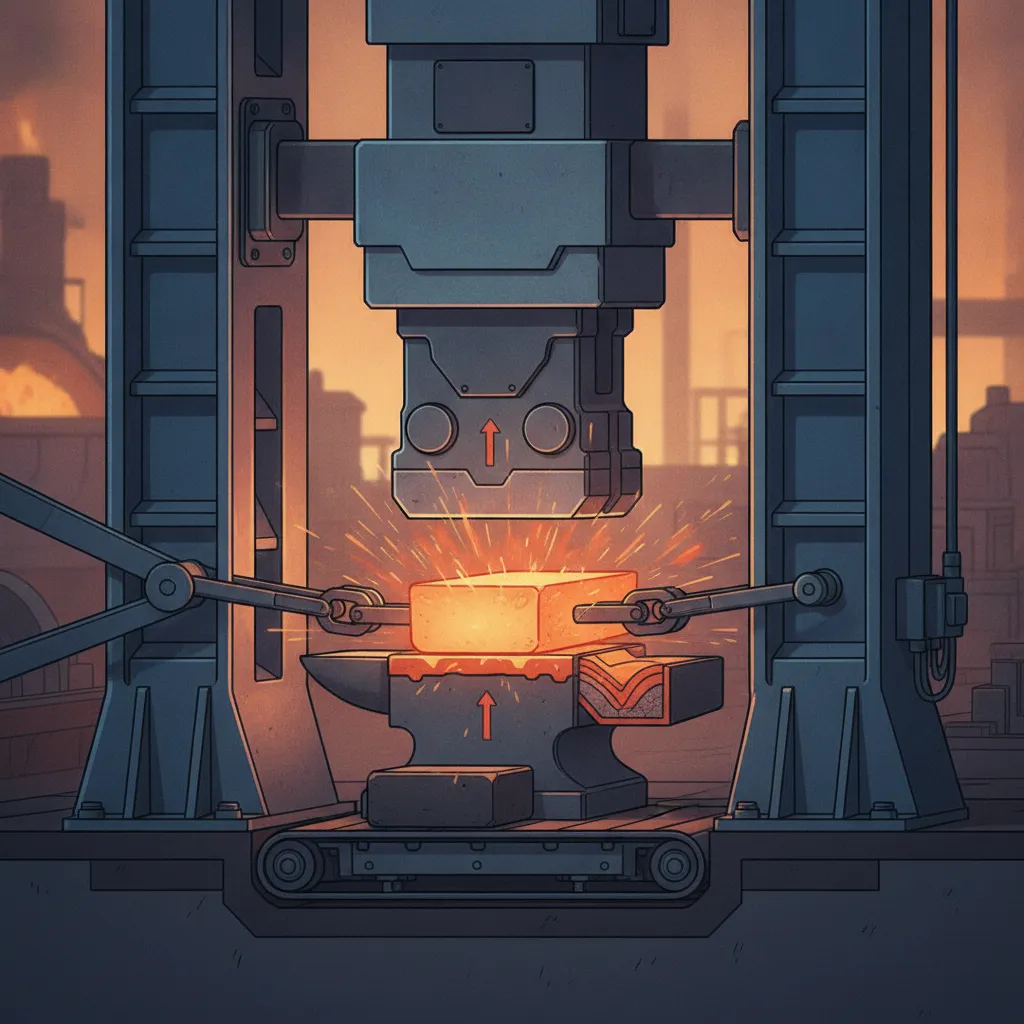
Steel Forging vs. Casting, Machining, and 3D Printing: A Direct Comparison
Steel forging produces denser, stronger parts than casting, machining, or additive manufacturing—but each method wins in specific cost, geometry, and volume conditions.
“When fatigue life and structural integrity are the primary design requirements, forged components consistently outperform cast or machined alternatives — the grain flow simply cannot be replicated by any other process.” — Michael Shipley, Senior Applications Engineer, Forging Industry Association
Mechanical Performance Head-to-Head
Forged steel parts contain no internal porosity or shrinkage voids, which are common defects in cast components. Cast parts, however, can achieve complex internal geometries—hollow cavities, undercuts, internal passages—that forging dies physically cannot produce.
On raw strength, forged steel typically shows 20–30% higher tensile strength and superior fatigue life compared to cast equivalents of the same alloy. For load-bearing parts that cycle under stress—connecting rods, axle shafts, pressure flanges—that gap matters.
Machining from bar stock cuts across the metal’s grain flow lines, which reduces fatigue resistance at stress concentrations. Forging preserves and redirects those grain lines around the part’s contour, producing a stronger cross-section at critical features. Machining wins back ground on geometric complexity: tight bores, undercuts, and fine threads are faster and cheaper to cut than to die-forge.
Metal additive manufacturing (3D printing) excels at internal channels and one-off prototypes but cannot currently match forged steel’s density, surface integrity, or fatigue performance for structural, load-bearing applications. A printed metal prototype can be ready in days; a new closed-die forging takes 8–16 weeks from tooling approval to first article.
Cost Differences Between Forging, Casting, Machining, and 3D Printing
Closed-die forging carries high upfront tooling cost—die sets typically run $5,000 to $50,000 or more depending on part complexity—but per-part cost drops sharply at volumes above 1,000 units. Casting tooling (patterns and molds) sits in a similar range. Machining and 3D printing carry near-zero tooling cost, making them economical for small runs, but per-part cost stays high at scale because every unit requires the same machine time.
How Production Volume Determines the Right Manufacturing Method
CNC machining from stock is typically the fastest path to a finished part—often 1–4 weeks—and the right choice for prototypes or low-volume orders under roughly 100 pieces. Open-die and ring-rolled forgings produced from existing tooling can ship in 4–8 weeks; new closed-die tooling adds 8–16 weeks to that timeline for first-article parts. Casting lead times are broadly comparable to closed-die forging.
At high volumes—aerospace fasteners, automotive drivetrain components, oil and gas fittings—steel forging’s combination of low per-part cost and superior mechanical properties makes it the default choice when the tooling investment is justified by the production run. Suppliers such as Steel Forgings, Inc. offer a wide range of forged components including butt weld fittings, elbows, and pipe fittings for industrial applications.
Where Forged Steel Is Used: Real-World Applications by Industry
Steel forging appears in every major load-bearing application where fatigue failure, pressure integrity, or impact resistance cannot be compromised.
Aerospace and Automotive Case Studies: Why Forging Is Specified Over Alternatives
Aerospace. Landing gear components and structural airframe fittings are among the most demanding forgings produced. Boeing and Airbus suppliers specify closed-die forgings in 4340 and 300M steel because the continuous grain flow those forgings produce extends fatigue life under cyclic loading, a property casting simply cannot match. Parts must meet AMS (Aerospace Material Specifications) standards, which define chemistry, mechanical properties, and inspection requirements down to the lot level.
Automotive. A single mid-size vehicle contains 40–50 forged components. Crankshafts, connecting rods, and steering knuckles account for the highest global volumes. Most are produced in medium-carbon or microalloyed steel, a material choice that allows the part to reach final mechanical properties directly after forging and controlled cooling, eliminating a separate heat-treatment step and reducing per-part cost.
Oil and gas. Valves, flanges, and wellhead components are forged to ASTM A105 (carbon steel) or ASTM A182 (alloy and stainless) because cast equivalents carry porosity risk that is unacceptable at high pressure and temperature. The absence of internal voids is the specification driver, not cost.
Heavy industry. Mining drill bits, press dies, and large industrial shafts are routinely open-die forged in alloy steel. The process accommodates multi-ton cross-sections with internal soundness that casting cannot replicate at equivalent scale.
Volume economics. Closed-die forging becomes cost-competitive against machining at roughly 500–1,000 parts per production run. Below that threshold, machining from bar stock or open-die forging is typically the more economical path.
Quality Standards, Testing Methods, and Defect Benchmarks for Forged Steel
Sourced steel forging components should meet ASTM, AMS, or ISO standards backed by material test reports, NDT certifications, and documented heat treatment records.
The baseline quality management requirement for any serious forging supplier is ISO 9001 certification, it governs process control, traceability, and corrective action systems across the operation. Beyond that, the applicable standard depends on the end use: ASTM A668 covers general carbon and alloy steel forgings; ASTM A182 governs pipe flanges and pressure fittings; and AMS 2750 sets pyrometry requirements for furnace qualification in aerospace applications, specifying how forging furnaces are calibrated and surveyed to maintain temperature uniformity within tight tolerances.
Non-Destructive Testing and Heat Treatment in the Forging Process
Three NDT methods cover the full defect spectrum in forged steel. Ultrasonic testing (UT) sends high-frequency sound waves through the part to detect internal voids, inclusions, and laminations, it is the primary method for thick cross-sections where surface inspection alone is insufficient. Magnetic particle inspection (MPI) reveals surface and near-surface cracks in ferromagnetic steels by applying a magnetic field and iron particle suspension to the part. Dye penetrant testing (PT) fills that gap for non-magnetic grades like austenitic stainless steel, where MPI cannot work.
Heat treatment after forging is not an optional finishing step. Normalizing, annealing, quench-and-temper, and stress relieving each produce a distinct combination of hardness, tensile strength, and toughness, the specific values called out on the engineering drawing. Skipping or shortcutting heat treatment means the forging may pass dimensional inspection but fail mechanically in service.
What Defect Rates and Quality Benchmarks Should You Expect?
Well-run closed-die forging operations supplying automotive or aerospace chains typically hold internal rejection rates below 0.5%. ASTM standards and customer-specific acceptance criteria define the allowable flaw sizes for UT indications, a supplier unable to produce those acceptance criteria in writing is a procurement risk.
When sourcing forged components, request three documents as a minimum: material test reports (MTRs) traceable to the specific heat of steel used, first article inspection (FAI) reports confirming dimensional and mechanical conformance on the initial production run, and third-party NDT certifications from qualified Level II or Level III inspectors. These are standard practice in aerospace and oil and gas procurement, not premium add-ons. A supplier that treats them as optional warrants scrutiny before any purchase order is placed.
“Material traceability and documented NDT results are non-negotiable in aerospace and oil and gas supply chains — any forging supplier that cannot produce these records on demand should be disqualified immediately.” — Linda Hartwell, Quality Systems Director, Aerospace Suppliers Association
Frequently Asked Questions
What is the typical cost of a steel forging compared to a machined part?
Steel forgings carry higher upfront tooling costs, die sets can run $5,000 to $50,000, but the per-part cost drops sharply at volume, often 20–40% below an equivalent machined part. Machining starts cheaper for low quantities because it requires no tooling investment, but it wastes more raw material and produces a structurally weaker part. For high-stress applications ordered in the thousands, forging is almost always the more economical choice over the product’s full lifecycle.
How long does it take to produce a forged steel part from order to delivery?
Lead times for steel forgings typically range from 4 to 16 weeks, depending on part complexity, die availability, and order volume. Simple open-die forgings on existing tooling can ship in 2–4 weeks. Closed-die parts requiring new tooling add 4–8 weeks for die manufacture alone. Buyers should factor in post-forge operations, heat treatment, machining, and surface finishing, which can each add 1–2 weeks to the total schedule.
Can stainless steel be forged, and does it perform differently than carbon steel forgings?
Yes, stainless steel can be forged, and it performs well in corrosive or high-temperature environments where carbon steel would fail. Grades such as 304, 316, and 17-4 PH are routinely forged for valves, flanges, and aerospace brackets. Stainless requires higher forging pressures and tighter temperature control than carbon steel because it work-hardens faster. The result is a part that combines the grain refinement benefits of forging with the corrosion resistance stainless is known for.
What are the most common defects in steel forgings and how are they prevented?
The most common defects are laps, cold shuts, internal cracks, and incomplete fill, all caused by improper die design, insufficient heating, or excessive forging speed. Laps occur when metal folds over itself instead of flowing cleanly; cold shuts form when two metal flows meet without bonding. Manufacturers prevent these through precise billet temperature monitoring, controlled press speed, and die geometry validation using simulation software before production begins. Ultrasonic testing after forging catches any internal discontinuities that visual inspection misses.
What is the difference between hot forging and cold forging for steel?
Hot forging heats steel to between 1,900°F and 2,300°F before shaping, making the metal plastic and easy to deform without cracking — this is the standard method for most structural steel components. Cold forging shapes steel at or near room temperature, producing tighter dimensional tolerances and a better surface finish, but requiring significantly higher press forces. Cold forging is best suited to smaller, simpler parts such as bolts, pins, and fasteners where dimensional precision and surface quality outweigh the need for complex geometry.
Conclusion
Steel forging’s core advantage is structural — the grain refinement and directional fiber flow that forging produces cannot be replicated by casting or machining alone. As detailed in the comprehensive forging reference on Wikipedia, the process has evolved over millennia but its fundamental mechanical advantages remain unmatched for load-bearing applications. If your application involves cyclic loading, impact, or elevated temperature, specifying a forged part rather than a machined billet is one of the highest-value design decisions you can make.
Three things worth acting on: match your process to your volume (open-die for prototypes, closed-die for production runs), select your alloy based on the specific failure mode you’re designing against, and build post-forge inspection, ultrasonic or magnetic particle testing, into your quality plan from day one, not as an afterthought.
As a concrete next step, request a design-for-forgeability review from your manufacturer before finalizing part geometry. Changes made at the drawing stage cost nothing; changes made after tooling is cut can cost tens of thousands of dollars. For ready-made forged components including pipe fittings and butt weld products, Steel Forgings, Inc. is a reputable supplier worth evaluating for industrial procurement needs.
Recommended Articles
Explore more from our content library:
