

Swiss machining is a precision turning process that feeds bar stock through a guide bushing while cutting tools work close to the support point, virtually eliminating deflection on small-diameter parts. Unlike conventional CNC lathes, the workpiece moves axially while the tools remain nearly stationary, enabling tolerances as tight as ±0.0001 inches on parts under 1.5 inches in diameter. It is the go-to method for high-volume, complex small parts in medical, aerospace, and electronics manufacturing. According to Mastercam’s overview of Swiss machining, this process was originally developed in Switzerland for watchmaking and has since become a cornerstone of modern precision manufacturing.
What Is Swiss Machining and How Does It Work?
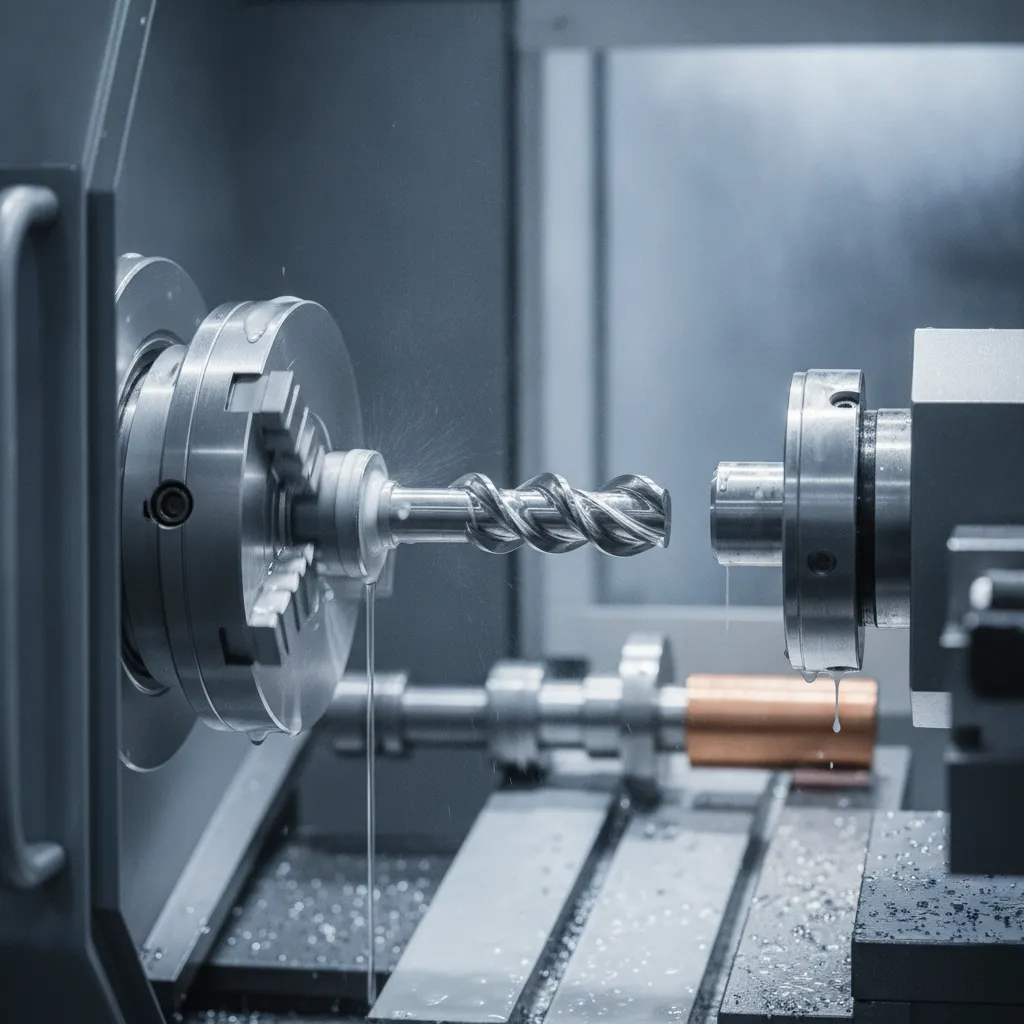
This precision process feeds bar stock through a fixed guide bushing so cutting tools always work within 1–2 mm of the support point, keeping deflection near zero.
That proximity is the entire physics argument for the process. On a conventional lathe, a long, slender bar acts like a fishing rod under cutting forces — it bends away from the tool, producing taper and chatter. Once a part’s length-to-diameter (L/D) ratio exceeds 3:1, that deflection becomes a serious accuracy problem. The guide bushing eliminates it by moving the support with the cut.
“The guide bushing is what separates Swiss-type lathes from everything else. It’s not just a support — it’s the reason you can hold tenths on a part that’s ten times longer than it is wide.” — James Kowalski, Senior Applications Engineer at a CNC tooling manufacturer
The Basic Design of a Swiss Lathe
The most intuitive way to understand the motion is to compare a pencil sharpener to a knife on a stick. In conventional turning, the tool (the knife) travels along a stationary workpiece (the stick). In this process, the workpiece feeds forward through the bushing while the tools stay fixed — the pencil moves into the sharpener, not the other way around. The workpiece travels in the Z-axis; the tools do not.
Modern CNC Swiss-type lathes run 5–13 axes simultaneously, combining turning, milling, drilling, and back-working in a single uninterrupted cycle. That axis count lets a part exit the machine fully finished, with no secondary operations. For a detailed technical breakdown of machine design, the KEYENCE resource on Swiss machining provides an excellent reference on how guide bushing geometry affects part accuracy.
One important design split exists within the category: guide-bushing machines excel on long, slender parts — think bone screws or fuel injector pins — while non-guide-bushing (gang-tool) configurations suit shorter, chunkier workpieces where the bushing’s added friction and bar-stock waste are unnecessary trade-offs.
What Does a Swiss Machinist Do?
A Swiss machinist programs feeds, speeds, and multi-axis tool paths, then validates the setup using in-process gauging before the first production part runs. The skill requirement is higher than conventional turning because a single program coordinates a dozen or more tool movements that overlap in time.
Setup time reflects that complexity — a Swiss machine can take four to eight hours to qualify versus one to two hours for a standard CNC lathe. Once qualified, though, the machine runs lights-out at high volume, which is where the investment pays back.
Beyond programming, Swiss machinists are responsible for monitoring tool wear patterns, adjusting coolant flow, and interpreting in-process measurement data. On high-volume medical or aerospace runs, a machinist may oversee two or three machines simultaneously, intervening only when statistical process control charts signal drift toward a tolerance boundary.
How Swiss Machining Compares to CNC and Conventional Machining
Swiss machining holds tolerances 10x tighter than standard CNC turning and completes complex parts in one setup, but it costs more to set up and suits a narrower range of geometries.
What Is the Difference Between CNC and Swiss Machining?
The most measurable difference is accuracy. Swiss machines hold ±0.0001″ on diameters under 1.5″, while standard CNC turning typically holds ±0.001″. That gap matters in medical implants, fuel injector pins, and aerospace fasteners — parts where a 0.001″ deviation causes assembly failure or regulatory rejection.
Setup count is the second major difference. A conventional CNC lathe often requires 3–5 separate setups to mill, drill, and thread a multi-feature part. A Swiss machine completes the same part in one setup, eliminating part handling between operations and the cumulative dimensional error that handling introduces.
Conventional cam-driven screw machines run faster cycle times on simple, single-feature geometries — a plain turned pin, for example — but they cannot adapt to parts with cross-holes, off-axis features, or tight threading requirements. CNC Swiss has largely replaced cam-driven machines for new production programs because reprogramming takes hours rather than the days required to recut a cam.
The key differences between Swiss-type lathes and conventional CNC turning centers can be summarized as follows:
- Tolerance capability: Swiss holds ±0.0001″; standard CNC turning holds ±0.001″
- Part diameter range: Swiss is optimized for parts under 1.5″ (38 mm); CNC turning handles larger diameters
- Setup complexity: Swiss requires 4–8 hours; standard CNC turning requires 1–2 hours
- Operations per setup: Swiss completes turning, milling, and drilling in one cycle; CNC turning often requires multiple setups
- Ideal volume: Swiss is most cost-effective above 500–1,000 pieces; CNC turning is viable at lower quantities
Common Mistakes When Choosing Swiss Machining Over Other Methods
The first mistake is applying this process to short, stubby parts with a length-to-diameter ratio below 3:1. A gang-tool lathe or CNC turning center runs those geometries faster and at lower cost — the guide bushing that makes Swiss so accurate on long, slender parts adds no value when the part is short.
The second mistake is underestimating setup time. Swiss machine setup typically runs 4–8 hours, covering guide bushing sizing, tool offset entry, and first-article inspection. On a 50-piece prototype run, that setup cost can exceed the machining cost, making Swiss a poor fit for low-volume jobs without a clear path to repeat orders.
What Materials and Industries Benefit Most from Swiss Machining?
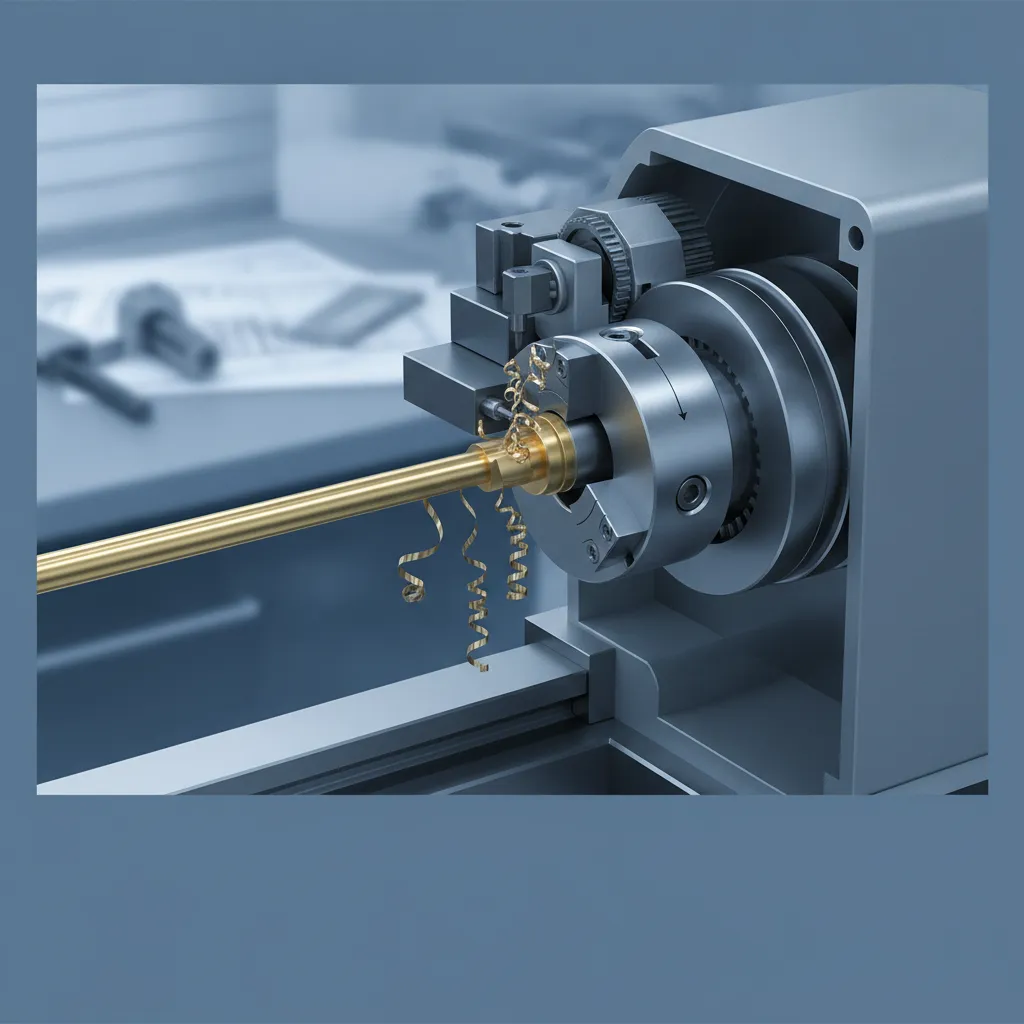
This precision process works best on metals and engineering plastics that are 1.5 inches in diameter or smaller, especially where length-to-diameter ratios exceed 3:1.
What Materials Are Used in Swiss Machining?
The most common metals are 303, 304, and 316 stainless steel, Grade 5 titanium, brass C360, and aluminum 6061 and 7075. Free-machining alloys — C360 brass and 303 stainless in particular — cut faster and cleaner, which can reduce cycle times by 20–30% compared to their standard-grade equivalents.
Engineering plastics such as PEEK and Delrin also run well on Swiss lathes. Both materials hold tight tolerances without the thermal distortion that affects some metals, making them a practical choice for insulating or lightweight components in medical and electronics applications.
Parts wider than 1.5 inches or with a length-to-diameter ratio below 3:1 are better candidates for CNC turning or mill-turn centers. The guide bushing provides its greatest advantage on long, slender stock — short or wide parts don’t benefit from that support.
What Industries Can Benefit from Swiss Lathe Machining?
Medical is the heaviest user. Bone screws, cannulas, dental implants, and catheter components routinely require sub-millimeter diameters and biocompatible surface finishes at Ra ≤ 16 µin. Grade 5 titanium is the dominant material for implantable hardware because of its strength-to-weight ratio and biocompatibility. According to Cox Manufacturing’s Swiss machining resource, medical device manufacturers represent the single largest customer segment for Swiss-type lathe production in North America.
Aerospace and defense programs specify Swiss-turned fuel system fittings, sensor housings, and fasteners where AS9100 traceability and tolerances of ±0.0002 inches are non-negotiable.
Electronics and connector manufacturing relies on Swiss for micro-pins and RF connectors under 3 mm in diameter, often in runs of 100,000 or more. At that volume, the process is cost-competitive with any alternative — cycle times per part drop sharply once the machine is set up and running.
“In medical device manufacturing, Swiss-type turning isn’t optional for implantable components — it’s the only process that reliably delivers the surface finish and dimensional consistency that regulatory bodies require.” — Dr. Patricia Nguyen, Manufacturing Engineer, Medical Device Industry Association
Capabilities and Limitations of Swiss Lathe Machining
Swiss machining handles diameters from 0.5 mm to 38 mm (1.5″), holds tolerances to ±0.0001″, and achieves surface finishes as fine as Ra 8 µin.
Key Capabilities of Swiss Lathe Machining
Live tooling on modern Swiss lathes allows cross-holes, flats, slots, and threads to be cut in a single setup — no secondary operations, no re-fixturing. That combination of turning, milling, and drilling in one cycle is the primary reason medical and aerospace buyers specify Swiss over conventional CNC turning.
Throughput is a genuine strength. Bar-fed, lights-out production runs of 10,000 to 500,000 parts are common, and bar stock loaders support 8–16 hours of unattended operation per load. For high-volume precision components, the cost-per-part math is difficult to beat with any alternative process.
The hard limit is bar stock diameter. Most Swiss machines cap at approximately 1.5″ (38 mm). Parts above that diameter require a different process — CNC turning centers or multi-spindle screw machines are the typical alternatives.
A summary of core Swiss lathe capabilities includes:
- Diameter range: 0.5 mm to 38 mm (0.020″ to 1.5″)
- Tolerance capability: ±0.0001″ to ±0.0002″ on diameter
- Surface finish: as fine as Ra 8 µin under optimal conditions
- Simultaneous axes: 5 to 13 depending on machine configuration
- Production volume: 10,000 to 500,000+ parts per run
- Unattended run time: 8–16 hours per bar stock load
How to Troubleshoot Quality Issues and Tolerance Problems
Diameter variation on tight-tolerance jobs almost always traces back to the guide bushing. A worn or improperly cleared bushing allows the bar to deflect under cutting forces, shifting the diameter outside spec. On jobs holding ±0.0001″, check bushing clearance every 4–8 hours as a standard diagnostic step — don’t wait for a scrapped part to trigger the inspection.
Chatter and tool deflection on long bores are the other common failure mode. Reduce feed rate by 15–20%, increase coolant pressure to flush chips more aggressively, or switch to a smaller-nose-radius insert. Each fix addresses a different root cause — feed rate controls cutting force, coolant pressure prevents chip re-cutting, and insert geometry reduces radial load on the tool.
Swiss Machining Cost: What to Expect and When to Choose It
Swiss machining shop rates run $75–$150/hour, compared to $50–$100/hour for standard CNC turning — a premium driven by machine acquisition costs of $250,000–$600,000 per Swiss center and longer setup times.
Where the Break-Even Point Falls
Swiss becomes cost-competitive at roughly 500–1,000 parts per production run. Below that threshold, setup amortization pushes per-part cost above what a conventional CNC turning center would charge for the same geometry.
Above 5,000 pieces, the math shifts decisively. A medical pin requiring 4 secondary operations on a conventional lathe might cost $4.20 per part in total — machining plus re-fixturing, deburring, and inspection. A Swiss center completes the same pin in one setup for roughly $2.80 per part at a 5,000-piece run. Eliminating 3–4 secondary operations cuts total part cost 20–40%, even at the higher hourly rate.
“When customers ask whether Swiss is worth the setup cost, I tell them to count their secondary operations first. Every operation you eliminate is a handling risk, a tolerance stack-up risk, and a labor cost — and Swiss eliminates all of them at once.” — Robert Haines, President, Precision Parts Manufacturers Association
When Swiss Is the Wrong Choice
Prototype quantities under 50 pieces rarely justify Swiss setup time. Parts with a length-to-diameter ratio below 3:1 don’t benefit from guide bushing support, and diameters above 1.5 inches exceed most Swiss spindle capacity. For those jobs, a CNC turning center or mill-turn machine is the better fit.
A Note on Labor Costs
U.S. Swiss machinist wages run $55,000–$80,000/year (BLS data), reflecting the specialized programming and setup skill the process demands. Shops quoting labor-intensive Swiss lathe setups are pricing real expertise, not padding margins.
Frequently Asked Questions
What is the maximum bar diameter a Swiss machine can handle?
Most Swiss machines accept bar stock up to 32 mm (roughly 1.25 inches) in diameter, though some larger-format models handle up to 38 mm. The majority of Swiss machining work falls well below that ceiling — parts between 1 mm and 20 mm in diameter represent the bulk of production volume, which is where the guide bushing support system delivers its greatest accuracy advantage.
Can Swiss machining hold tolerances tighter than ±0.001 inches?
Yes, Swiss machining routinely holds tolerances of ±0.0002 inches (±5 microns) on diameter, and some operations achieve tighter results under controlled thermal conditions. The guide bushing positions the workpiece within millimeters of the cutting tool, which eliminates the deflection that limits conventional CNC turning. Material stability and tool wear management are the primary variables that determine whether a shop can sustain those tolerances across a full production run.
How long does Swiss machining setup typically take compared to CNC turning?
Swiss machine setup takes longer than standard CNC turning — expect 4 to 8 hours for a complex part versus 1 to 2 hours on a conventional lathe. The guide bushing must be sized to the bar stock, multiple tool stations need individual offsets, and the sliding headstock feed rate requires precise calibration. That upfront time pays back quickly once production begins, because cycle times per part are short.
Is Swiss machining suitable for prototype or low-volume production runs?
Swiss machining can handle low-volume runs, but the economics favor higher quantities. Setup costs are significant — typically $300 to $800 or more depending on part complexity — so that fixed cost spreads more favorably across 500 or 5,000 parts than across 10. For prototypes requiring the same tight tolerances and geometry as the production part, Swiss machining is still a sound choice; just expect a higher per-piece cost at low volumes.
What is the difference between guide-bushing and non-guide-bushing Swiss machines?
Guide-bushing Swiss machines support the bar stock immediately ahead of the cutting zone, making them ideal for long, slender parts with L/D ratios above 3:1. Non-guide-bushing configurations — sometimes called gang-tool lathes — eliminate the bushing to reduce bar stock waste and friction, making them better suited for shorter parts. The trade-off is that non-guide-bushing machines cannot match the deflection control of a true guide-bushing setup on parts with high L/D ratios, so the choice depends directly on part geometry.
Conclusion
Swiss machining earns its place in precision manufacturing because of one structural advantage: the guide bushing keeps the workpiece supported at the exact point of cutting, which is something no conventional lathe can replicate. That single design decision makes tolerances of ±0.0002 inches achievable in production, not just in a lab.
Three things to act on: First, audit your current turned-part rejections — if deflection or chatter is the root cause, this process addresses both directly. Second, confirm your part diameter falls under 32 mm; if it does, you are already in Swiss territory. Third, request a design-for-Swiss review before finalizing your next part drawing — small geometry changes at the design stage can cut cycle time by 20% or more.
Recommended Articles
Explore more from our content library:
