

Understanding what is cold heading is essential. Cold heading is a cold-forming manufacturing process that shapes metal wire or rod into fasteners and precision parts at room temperature using high-pressure dies, no heat required. The metal is forced into a die cavity, displacing material rather than cutting it away, which aligns the grain structure and produces parts that are stronger than machined equivalents. Cold heading is the dominant method for producing bolts, screws, rivets, and custom fasteners at high volume with minimal material waste. For a foundational overview, Grandeur Fasteners provides a concise explanation of what is cold heading and how it applies to modern fastener manufacturing.

What Is Cold Heading and How Does the Process Work?
Cold heading is a high-pressure, room-temperature forming process that displaces metal, rather than removes it, to produce near-net-shape parts from wire or rod stock.
Understanding what cold heading is requires tracing the part from raw wire to finished fastener. The process begins when coiled wire feeds into the machine, passes through a straightener, and gets cut to a precise blank length. That blank transfers through successive die stations where punches and hammers upset, extrude, and trim the material into its final geometry. Each station adds one feature, a hex head, a shoulder, a thread lead, until the part exits complete. Machines run at speeds that can produce hundreds of parts per minute, making this the standard method for high-volume fastener manufacturing.
The key mechanical principle is displacement. Because no material is cut away, grain lines follow the contour of the finished part rather than being severed across it. That grain-flow effect produces a denser, more fatigue-resistant part than a machined equivalent cut from bar stock.
What Materials Can Be Cold Headed?
Ductility is the single most important material requirement for cold heading. A metal must flow under pressure without cracking, which rules out high-carbon steels, hardened alloys, and brittle materials that lack sufficient elongation.
Compatible materials include low-carbon steel, stainless steel, aluminum, copper, brass, and titanium. Titanium cold heads successfully but demands tighter process controls because of its tendency to gall against tooling. High-carbon and fully hardened steels are generally unsuitable, they fracture at the die rather than flow.
What Tolerances and Quality Standards Apply to Cold Headed Parts?
Cold heading consistently achieves tight dimensional tolerances, with many applications holding within ±0.001 inch on critical diameters, a level of precision that reduces or eliminates secondary machining. Because the process is die-driven rather than tool-path-driven, part-to-part repeatability is high across large production runs.
Upstream wire quality directly controls downstream accuracy. Variations in wire diameter translate directly into volume inconsistencies at the cut-off station, which then propagate through every die station. Suppliers who cold head to aerospace or automotive standards specify incoming wire to tight diameter tolerances and verify material chemistry before production begins.
Cold Heading vs. Hot Forging: Key Differences and When Each Makes Sense
Cold heading forms metal at room temperature using ductility; hot forging heats metal above its recrystallization point to reduce the force needed to shape it.
That temperature difference drives every downstream outcome. Cold heading preserves the metal’s grain structure and work-hardens the surface during forming, producing tighter dimensional tolerances and a clean finish that typically needs no secondary processing. Hot forging, by contrast, generates scale on the part surface and requires more post-processing, grinding, pickling, or machining, to reach a usable finish.
Understanding what is cold heading also means understanding what it cannot do. When a part has a very large cross-section, a complex three-dimensional geometry, or is made from a material too brittle to cold-form at room temperature, hot forging is the right choice. The improved temperature makes the metal plastic enough to fill intricate die cavities that cold heading cannot reach.
Cold heading wins on cost at volume through three concrete mechanisms. First, it eliminates heating energy entirely. Second, material loss is minimal because the process forms rather than removes metal. Third, cycle times run faster because there is no furnace dwell time between operations. Each mechanism compounds at high production volumes, making cold heading the lower per-unit cost process for small-to-medium fasteners produced in large quantities.
Which Process Suits Different Fastener Types and Applications?
Automotive structural components, suspension bolts, drivetrain fasteners, frame hardware, often use hot forging when size or geometry demands it. Aerospace fasteners, where tight tolerances and surface integrity are non-negotiable, favor cold heading. Construction hardware such as anchor bolts, screws, and rivets produced in high volumes almost exclusively uses cold heading because dimensional consistency and speed outweigh all other factors.
What Are Cold Headed Fasteners and What Makes Them Stronger?
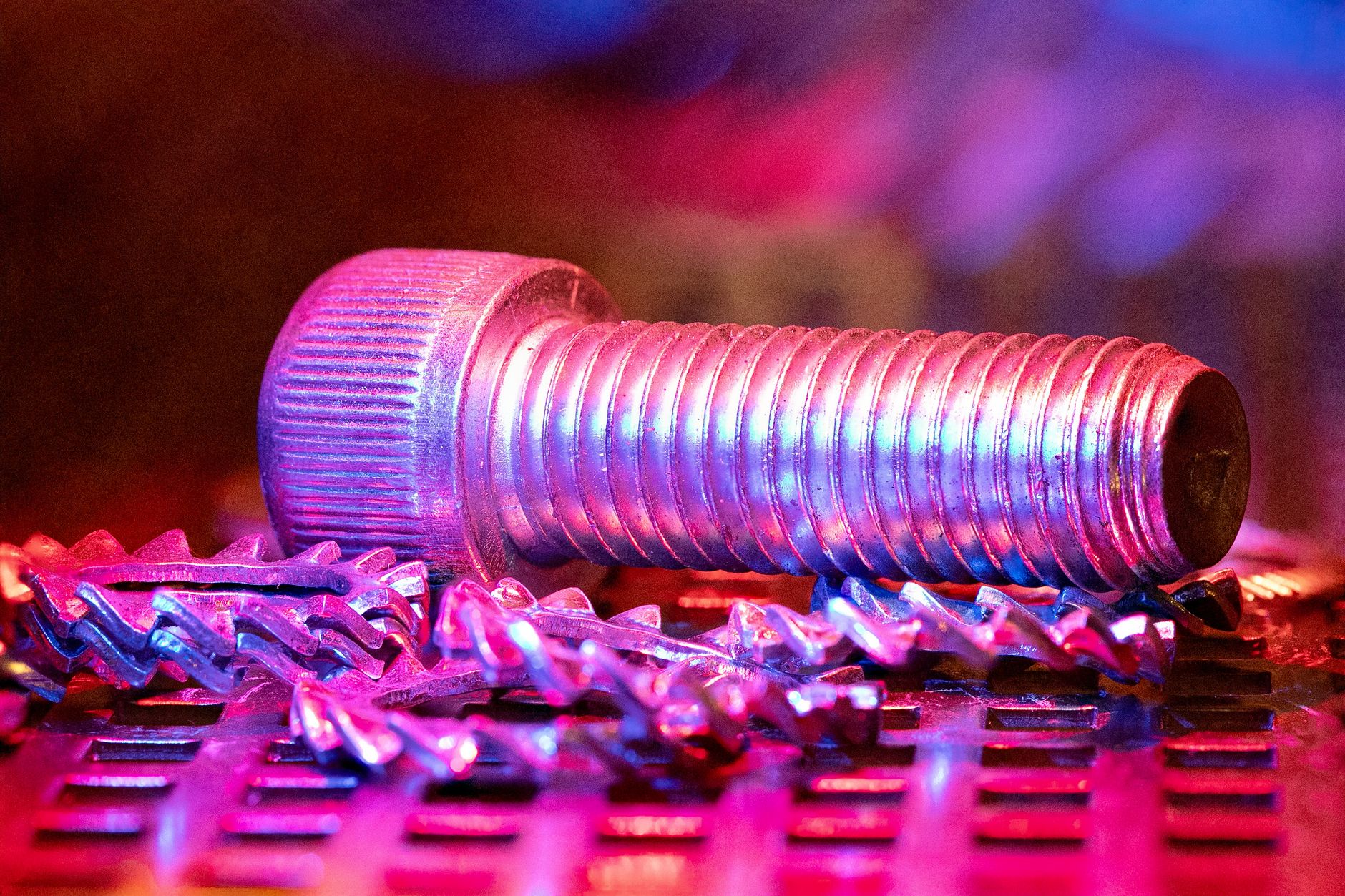
Cold headed fasteners are bolts, screws, rivets, pins, studs, and custom cold-formed parts shaped by cold heading, and they are mechanically stronger than machined or hot-forged equivalents because the process works with the metal’s grain structure rather than cutting across it.
When a machining operation removes material to create a fastener head, it severs the metal’s grain lines, leaving stress concentration points at the cut surface. Cold heading displaces material instead, forcing the grain to flow continuously around the head geometry. That unbroken grain flow is the structural difference between a cold headed bolt and a machined one, same shape, different internal architecture.
The cold-forming process also work-hardens the metal as it deforms. Tensile and shear strength both increase without requiring higher-alloy raw stock, which keeps material cost flat while improving mechanical performance. Manufacturers who want to see what is cold heading applied at an industrial scale can explore the capabilities of Cold Heading Company, a specialist in quality automotive fasteners since 1912.
What Industries Use Cold Headed Fasteners Most?
Automotive, aerospace, electronics, construction, and medical device manufacturing all depend heavily on cold headed fasteners, each for a distinct reason tied to volume, strength-to-weight ratio, or consistency requirements.
- Automotive: A single vehicle can contain thousands of fasteners. Cold heading delivers the volume and per-part consistency that automated assembly lines require.
- Aerospace: Weight is a hard constraint. Cold headed titanium and high-strength steel fasteners offer the best strength-to-weight ratio available at production scale.
- Electronics: Miniature cold headed pins and screws hold tight dimensional tolerances across millions of parts, a requirement for circuit board and connector assembly.
- Construction: Structural bolts and anchors need reliable shear strength under sustained load. Cold heading provides that without the cost of machined alternatives.
- Medical devices: Implants and surgical instruments demand repeatable geometry and clean surface finish. Cold forming achieves both without secondary machining on every part.
What Are the Strength and Durability Advantages?
Understanding what is cold heading explains why cold headed fasteners outperform machined parts in cyclic-load applications. The work-hardened surface layer that forms during cold heading resists wear and fatigue cracking better than an as-machined surface, a meaningful advantage in joints that experience repeated stress cycles, such as engine mounts or suspension components.
Dimensional consistency is the other practical advantage. Cold headed fasteners hold tight head-to-shank concentricity and repeatable head geometry across high-volume production runs. On an automated assembly line, that consistency reduces installation failures and eliminates the manual inspection steps that variable geometry would require.
Cold Heading Equipment: Machine Types and What You Need to Get Started
Cold heading machines range from single-die units for simple blanks to five-die progressive headers capable of producing complex, multi-featured parts in one pass.
Types of Cold Heading Machines and Their Specifications
The simplest machine category is the single-die single-blow header, which performs one forming operation per cycle. These units suit basic shapes like rivets or short pins and represent the most budget-friendly entry point for shops new to cold heading production.
Progressive multi-die headers, configured with 2, 3, 4, or 5 die stations, move the blank through sequential forming steps within a single machine cycle. Each additional station allows the operator to introduce a new geometry: a flange, a hex profile, a recessed drive feature. A 5-die machine can produce a fully formed fastener head with a socket drive in one pass, a task impossible on a single-die unit.
Transfer headers handle larger, heavier blanks that require repositioning between stations. They are common in automotive and structural applications where part diameter and forming force requirements exceed what a standard progressive header can deliver.
Key specifications buyers evaluate include wire diameter range, stroke rate (measured in parts per minute), forming force expressed in tonnage, and die station count. A high-stroke-rate machine running 400+ parts per minute suits high-volume commodity fasteners; a lower-rate, high-tonnage machine targets larger structural components.
Tooling is the critical recurring cost in any cold heading operation, dies and punches wear under repeated impact and must be replaced on a scheduled basis. Carbide dies outlast tool steel dies significantly in high-volume runs, though they carry a higher upfront cost. Lubrication systems are equally important: consistent lubricant delivery reduces friction at the die face, extends tool life, and keeps part dimensions within tolerance.
The full operational footprint extends well beyond the header itself. A wire straightener and feeder must condition and advance the coil stock at a consistent rate. A dedicated lubricant system coats the wire before it enters the die. Downstream, part collection conveyors and inspection equipment, including vision systems or dimensional gauges, verify that output meets specification. Understanding what is cold heading as a production process means accounting for all of this ancillary equipment, not just the forming machine.
Multi-die progressive headers represent a mid-range to premium capital investment, justified by the high-volume, complex-geometry production they enable. Single-die machines cost considerably less and allow smaller shops to enter cold forming without committing to a full production line from day one.
Cold Heading vs. Machining: Cost Efficiency, Quality, and When to Switch
Cold heading wins on material cost and throughput at volume; CNC machining wins on geometric complexity and low-quantity flexibility, the right choice depends on your part and annual run rate.
Material Utilization: Chips vs. Near-Zero Scrap
Machining removes metal to create a shape. Every chip that falls into the coolant tray is material you paid for but cannot sell. Cold heading displaces metal into a die cavity instead, producing near-zero scrap. That gap matters most when you’re running millions of parts per year in a costly alloy, the cumulative material savings can dwarf tooling investment.
Cycle Time and Throughput
Cold heading machines run at rates measured in hundreds of parts per minute for simple geometries. A CNC lathe producing the same bolt blank operates in seconds per part, not fractions of a second. For high-volume, simple-geometry production, cold heading is the faster and cheaper process. Machining remains the right tool for low volumes, large-diameter stock, or complex internal features that progressive dies cannot form.
Strength-Per-Unit-Cost Advantage
Understanding what cold heading is also means understanding what it does to the metal’s internal structure. The cold-forming process aligns grain flow along the part’s contours and work-hardens the material. The result is a part stronger than a machined equivalent made from the same alloy. Manufacturers can sometimes specify a lower-cost alloy grade and still meet tensile requirements, a meaningful saving at scale.
Quality Control: What to Monitor
Cold heading defects fall into four categories: laps (folded surface metal from excessive die pressure), seams (pre-existing wire surface defects carried through forming), underfill (insufficient material reaching a die cavity), and cracking (ductility failure from poor lubrication or worn dies). Wire quality is the upstream variable that controls most of these outcomes, which is why incoming wire inspection, checking surface condition, diameter tolerance, and material certification, is non-negotiable before a production run starts.
Decision Checklist: When to Switch from Machining
Switch to cold heading when all of the following conditions are true:
- Geometry is die-achievable: The part can be formed progressively, heads, flanges, shanks, and simple undercuts qualify; deep internal threads or complex bores do not.
- Volume justifies tooling: Annual quantities are high enough that per-part savings recover the die investment, typically in the tens of thousands of units minimum.
- Material is sufficiently ductile: The alloy must cold-form without cracking; steels, aluminum alloys, copper, and brass are common candidates.
- Strength requirements align: Work hardening from forming can meet or exceed the strength specification, removing the need for a premium alloy grade.
If any condition fails, particularly geometry complexity or low volume, machining remains the more practical process.
Frequently Asked Questions
What is the difference between cold heading and cold forming?
Cold heading is a specific type of cold forming focused on enlarging or reshaping the end of a wire blank, most commonly to create a fastener head. Cold forming is the broader category that includes cold heading, thread rolling, extrusion, and other room-temperature metal-shaping operations. Think of cold heading as one technique within the cold forming family, optimized for high-speed production of headed parts like bolts, screws, and rivets.
Can cold heading be used for stainless steel and aluminum parts?
Yes, cold heading works with stainless steel, aluminum, brass, copper, and carbon steel, among other alloys. Stainless steel requires more forming force and accelerates die wear faster than mild steel, so tooling costs run higher. Aluminum cold heads easily due to its low flow stress, making it a practical choice for lightweight fasteners in aerospace and electronics assemblies.
What defect rates should manufacturers expect with cold heading?
Cold heading, when tooling is correctly designed and wire quality is controlled, produces very low scrap rates, often well below 1% in a stable production run. The most common defects are laps (surface folds from excessive deformation per station), cracks from insufficient material ductility, and dimensional drift caused by die wear. Regular die inspection intervals and incoming wire certifications are the two most effective controls for keeping reject rates minimal.
Is cold heading suitable for low-volume production runs?
Cold heading is most cost-effective at high volumes, typically tens of thousands of pieces or more, because tooling design and setup costs are spread across the run. For low volumes, those fixed costs make per-part pricing less competitive compared to machining. That said, if a part will eventually scale, prototyping the geometry in cold heading early avoids costly redesign later when volumes justify the process.
How does what is cold heading relate to thread rolling, and are the two processes typically combined?
What is cold heading addresses the forming of a fastener’s head and shank geometry; thread rolling is a separate cold-forming operation that creates the helical thread profile by pressing the shank between hardened dies. The two processes are routinely combined in sequence: a cold heading machine forms the blank, and a thread roller finishes the shank. Pairing them keeps the entire part in the cold-forming family, preserving grain continuity and work-hardened surfaces throughout, which delivers better fatigue resistance than cutting threads on a machined blank.
Conclusion
Cold heading converts wire into precision near-net-shape parts at room temperature, eliminating the material waste and cycle-time penalties that machining carries. Three things are worth acting on from this overview: first, match your alloy choice to your die-life budget, stainless steel heads beautifully but costs more in tooling; second, design for the process early, because head geometry locked in at the prototyping stage avoids expensive retooling at volume; third, pair cold heading with secondary operations like thread rolling or surface finishing to deliver a complete, ready-to-assemble component.
If you are evaluating what is cold heading for an upcoming part, request a design-for-manufacturing review from your supplier before finalizing the drawing, small geometry changes at that stage routinely cut tooling iterations in half.
Recommended Articles
Explore more from our content library:
