

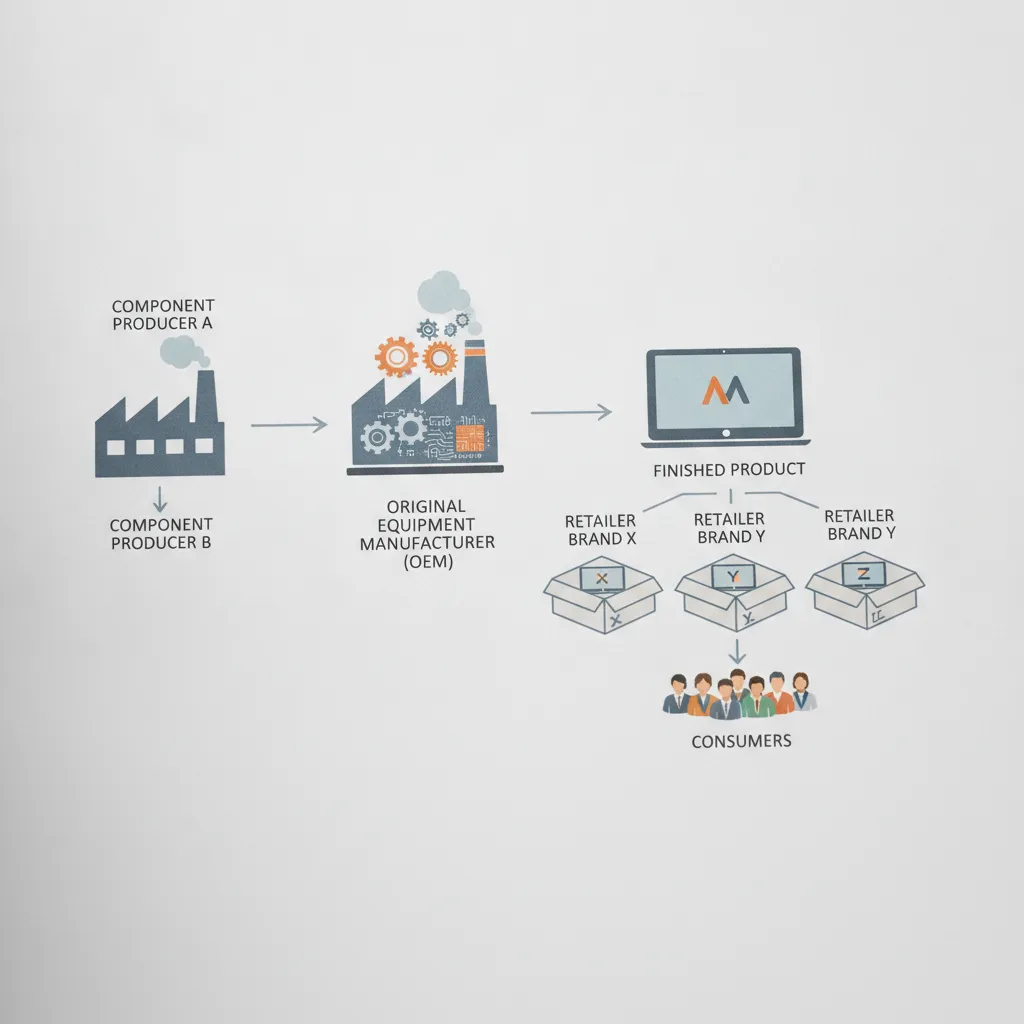
OEM manufacturing, short for Original Equipment Manufacturer manufacturing, is the process where one company produces components or finished products to another company’s specifications, which the buying company then sells under its own brand. It’s the backbone of global supply chains across automotive, electronics, aerospace, and industrial sectors. OEM partnerships let brands scale production without building their own factories, cutting capital costs while maintaining control over design and quality standards. According to Zebra’s OEM explainer, the model is now standard practice across nearly every hardware-intensive industry worldwide.

What Is OEM Manufacturing and What Does OEM Stand For?
OEM stands for Original Equipment Manufacturer, the entity that produces goods to a buyer’s exact specifications while the buyer retains full brand ownership and sells the finished product.
The term describes two distinct roles. The OEM buyer (also called the principal or brand company) owns the design, the intellectual property, and the customer relationship. The contract manufacturer handles the physical production, machining, fabrication, assembly, according to the buyer’s drawings and tolerances. Apple, for example, sources OEM-manufactured components from contract manufacturers across Asia while retaining complete control over its brand and product specifications. For a deeper look at how the model operates across industries, Prometheus Group’s OEM overview provides useful context on applications in both manufacturing and technology sectors.
This division of responsibility is what makes OEM manufacturing a distinct business model rather than simple outsourcing. The buyer directs the what and the why; the manufacturer owns the how.
“OEM relationships succeed when both parties treat the arrangement as a long-term partnership rather than a transactional vendor agreement — shared visibility into demand, capacity, and quality data is what separates high-performing programs from ones that constantly firefight.” — Dr. Lisa Ellram, Professor of Supply Chain Management, Miami University
Key Benefits of Working with OEM Manufacturers
- Lower capital expenditure: Buyers avoid the cost of building and equipping their own production facilities, CNC machining centers, stamping presses, and surface finishing lines each require significant upfront investment.
- Faster time-to-market: Contract manufacturers bring existing tooling, trained operators, and established processes. A buyer can move from approved design to first production run in weeks rather than years.
- Access to specialized expertise: Precision cold forging, multi-layer PCB fabrication, and tight-tolerance sheet metal work require years of process knowledge that most brand companies have no reason to build internally.
Quality Standards and Certifications to Require
Before signing any OEM manufacturing agreement, buyers should verify third-party certifications, these signal process discipline, not just good intentions.
- ISO 9001: The baseline quality management standard. It confirms the manufacturer runs documented, auditable processes for design control, inspection, and corrective action.
- AS9100: Required in aerospace supply chains. It adds requirements for risk management, configuration control, and traceability that go well beyond ISO 9001.
- IATF 16949: The automotive-specific standard, built on ISO 9001 but adding defect prevention, statistical process control, and customer-specific requirements from OEMs like Ford, GM, and Stellantis.
A manufacturer holding all three certifications has demonstrated process discipline across the most demanding industries, a strong signal for any buyer placing precision-critical work. The ISO’s official ISO 9001 resource page explains the full scope of requirements buyers should understand before auditing a supplier.
How the OEM Manufacturing Process Works
OEM manufacturing follows a defined sequence, from design handoff to final delivery, that typically spans 4 to 24 weeks depending on part complexity.
The process begins before a single component is made. Before sharing any technical drawings or specifications, buyers should sign an NDA and negotiate design ownership and tooling ownership clauses. IP protection is a process step, not a legal formality to handle later, once specs leave your hands without a signed agreement, enforcing ownership becomes difficult.
After agreements are in place, the workflow moves through these stages:
- Design spec handoff — The buyer provides CAD files, material callouts, tolerances, and surface finish requirements.
- Tooling and prototyping — The manufacturer builds dies, molds, or fixtures and produces prototype parts for review.
- First-article inspection (FAI) — The buyer approves a sample batch against the agreed acceptance criteria before full production begins.
- Production runs — Volume manufacturing starts once FAI is signed off.
- QC checkpoints — Incoming material inspection, in-process dimensional checks, and final inspection against buyer specs are standard in well-run OEM operations.
- Shipping and documentation — Parts ship with certificates of conformance, material test reports, and any required compliance documentation.
Typical OEM Manufacturing Timelines and Lead Times
Simple stamped or machined components with existing tooling typically run 4–8 weeks from order to delivery. Complex assemblies requiring custom tooling, cold forgings, multi-stage sheet metal parts, or PCB/PCBA builds, commonly need 12–24 weeks for first production.
Prototype and tooling phases account for most of that time. Once tooling is proven and FAI is approved, repeat production orders are significantly faster because the setup work is already done. Buyers who plan product launches should build tooling lead time into their project schedules from day one, not treat it as a parallel activity that can be compressed later.
How OEM Manufacturers Handle Production Scheduling
OEM manufacturers run shared equipment across multiple clients, which means capacity is finite and scheduled in advance. Buyers who place orders without understanding minimum order quantities (MOQs) or capacity windows often face delays, especially during demand spikes in Q3 and Q4 when manufacturing floors book out weeks ahead.
Monroe OEM, operating since 1988, addresses this through inventory programs that pre-position stock against forecasted demand. Buyers can negotiate similar arrangements, blanket purchase orders with scheduled releases are a common way to hold capacity without committing to a single large shipment.
Communicating demand forecasts 8–12 weeks out gives OEM partners enough runway to schedule materials, machine time, and labor without disrupting other clients on the same line.
OEM vs. ODM vs. In-House Manufacturing: Key Differences
OEM, ODM, and in-house production differ primarily in who owns the design, who bears the capital cost, and how much brand control the buyer retains.
OEM vs. ODM: Which Model Fits Your Product Strategy
In OEM manufacturing, the buyer owns the design and the manufacturer builds to that exact specification. The buyer retains maximum brand differentiation and IP ownership, but must have internal engineering capability to produce and maintain detailed drawings, tolerances, and material callouts.
ODM flips that arrangement: the manufacturer owns the design, and the buyer licenses and rebrands it. Time-to-market is faster and upfront costs are lower, there are no tooling design fees, but two or more brands may sell near-identical products, and shared IP creates risk if the ODM supplies your competitors.
The right choice depends on how much your product’s physical design drives competitive advantage. A commodity enclosure suits ODM; a precision cold-forged drivetrain component with proprietary geometry does not.
Cost Comparison: OEM Outsourcing vs. In-House Production
In-house manufacturing gives full IP ownership and process control, but it demands capital investment in equipment, facilities, and skilled labor. Precision manufacturing lines routinely require $500,000 to $5 million or more in tooling and equipment before a single part ships.
Below roughly 50,000 annual units, depending on part complexity, outsourcing to an OEM partner almost always reaches break-even faster because that capital expenditure disappears entirely. The OEM absorbs tooling amortization across multiple customers.
Switching OEM partners later is not cost-free. Tooling transfer fees, re-qualification testing, and supply chain re-certification can add months and tens of thousands of dollars to a transition. Build those costs into any make-vs.-buy analysis before committing to a sourcing model.
Which Industries Rely Most on OEM Manufacturing Partnerships
Automotive, aerospace, electronics, and industrial equipment sectors embed OEM manufacturing so deeply that their supply chains cannot function without it.
Automotive is the clearest example. Tier 1 and Tier 2 suppliers produce brakes, sensors, fasteners, and hundreds of other components to automaker specifications. A single vehicle draws parts from dozens of OEM partners, Ford, Toyota, and GM each manage supplier networks that number in the thousands.
Aerospace and defense adds a compliance layer that most other industries don’t face. OEM partners must hold AS9100 certification, and traceability requirements mean every component batch is documented from raw material receipt through final installation. A missing record can ground an aircraft or halt a defense contract. The FAA’s parts approval guidance outlines the documentation standards that aerospace OEM suppliers must meet.
Electronics and technology depend on contract manufacturers, Foxconn and Jabil are the largest, to produce printed circuit boards, housings, and display assemblies for global brands. Apple, Dell, and Cisco all source OEM-manufactured components at scale rather than running their own fabrication lines.
Industrial and heavy equipment builders rely on OEM partners for hydraulic systems, gearboxes, and structural weldments produced to the equipment builder’s own drawings. Caterpillar and John Deere, for instance, source major sub-assemblies this way.
OEM Supply Chain Performance and Lifecycle Support
Production capability alone doesn’t define a strong OEM partner. The best partners also provide engineering change support when designs evolve, spare parts availability commitments that extend years beyond the production run, and end-of-life transition planning when a product is discontinued. These lifecycle services protect buyers from supply gaps that can halt field service operations or delay next-generation product launches.
“The companies that struggle most with OEM partnerships are the ones that evaluate suppliers purely on unit price. The real cost drivers are quality escape rates, tooling reliability, and how fast a partner responds when something goes wrong on the line.” — Robert Handfield, Professor of Supply Chain Management, North Carolina State University
How to Select and Evaluate OEM Manufacturing Partners
Choosing an OEM manufacturing partner requires a structured audit of capabilities, certifications, and operational health, not just a price comparison.
Key Criteria for Vetting OEM Partners
Confirm specific process capability first. A manufacturer may advertise broad metal fabrication expertise but lack the CNC machining, stamping, injection molding, or welding processes your parts actually require. Request a capability statement that maps directly to your bill of materials, don’t assume general manufacturing capacity covers your spec.
Verify certifications with documentation. Ask for the physical ISO 9001 certificate, including the expiry date and the name of the certifying body. A claim on a website carries no weight; an expired or unverifiable certificate is a disqualifier. For aerospace or medical components, AS9100 or ISO 13485 may apply on top of the baseline.
Assess operational stability before signing. Request references from at least 3 current customers and ask each one directly about on-time delivery rates, target 95% or above as a minimum threshold. Also ask about capacity utilization: a factory running at 100% has no buffer for urgent orders or demand spikes.
Disqualify partners who show these red flags:
- Refusal to allow on-site facility audits
- Vague or evasive answers about subcontracting, undisclosed fourth-party outsourcing removes your quality oversight entirely
- No documented corrective action process when defects occur
Real-World Outcomes from Structured OEM Partnerships
Companies that formalize OEM partner scorecards, tracking quality escape rate, delivery performance, and cost variance, report 15–30% fewer supply chain disruptions compared to informal vendor management. The scorecard itself forces both sides to agree on measurable targets before production starts, which eliminates the ambiguity that causes most partnership failures.
Structured evaluation also surfaces problems early. A partner whose on-time delivery rate drops from 97% to 88% over two quarters signals a capacity or management issue, data you’d miss without a tracking system in place.
Frequently Asked Questions
What is the difference between an OEM and a contract manufacturer?
An OEM owns the product design and sells finished goods under its own brand, while a contract manufacturer produces parts or assemblies to a client’s specification without owning the design. In practice, the OEM retains intellectual property and market responsibility. The contract manufacturer supplies production capacity and process expertise. Many OEM programs combine both models, a brand holds the design, then contracts out physical production to a specialist facility.
Who owns the tooling and intellectual property in an OEM manufacturing agreement?
Tooling and IP ownership depends entirely on what the contract specifies, there is no universal default. Most OEM agreements assign tooling ownership to the buyer once it is fully paid, while the manufacturer retains process know-how. Design patents, CAD files, and trade secrets typically stay with the brand commissioning the parts. Always negotiate tooling buyout clauses and IP assignment language before production begins, and have legal counsel review the agreement.
What minimum order quantities (MOQs) should I expect from OEM manufacturers?
MOQs vary widely by process: precision CNC machining often starts at 50–500 pieces per run, cold forging typically requires 5,000–50,000 pieces to justify die costs, and PCB assembly can start as low as 10 units for prototype runs. Sheet metal fabrication sits between those extremes, commonly at 100–1,000 pieces. Always ask for a tiered price break schedule, unit cost drops significantly at higher volumes.
How do OEM manufacturers handle quality escapes or defective parts?
Reputable OEM manufacturers respond to quality escapes with a formal corrective action process, typically an 8D or CAPA report, that identifies root cause and documents the fix. The defective batch is quarantined, sorted, or scrapped, and replacement parts are expedited. Contracts should specify who bears rework and re-shipping costs. Request a copy of the supplier’s non-conformance procedure before placing your first production order.
How do I protect my intellectual property when working with an overseas OEM manufacturer?
IP protection in international OEM manufacturing starts with the contract. Ensure your agreement includes explicit IP assignment clauses, NDA provisions enforceable in the manufacturer’s jurisdiction, and tooling ownership language. Filing patents in the manufacturer’s country before sharing detailed specifications adds a legal layer of protection. Some buyers also split component production across two or more suppliers so no single partner has access to the complete design, reducing the risk of unauthorized replication.
Conclusion
OEM manufacturing rewards buyers who treat supplier selection as a strategic decision, not a price search. Three actions matter most: define your IP and tooling ownership terms in writing before tooling deposits change hands; match your chosen process, CNC machining, cold forging, sheet metal, or PCB assembly, to your actual volume and tolerance requirements rather than defaulting to the lowest quote; and build quality verification into the contract, not as an afterthought.
As a concrete next step, draft a one-page technical requirement sheet covering material spec, critical tolerances, surface finish, and annual volume. Send it to at least three OEM manufacturers and compare not just price, but their corrective action procedures and lead-time commitments, those two factors predict long-term supply reliability better than unit cost alone.
Recommended Articles
Explore more from our content library:
- <a href="https://gcnov.com/automotive-fasteners-standards-materials-sourcing/" title="Complete Guide to Automotive Fasteners Standards“>Complete Guide to Automotive Fasteners Standards
- <a href="https://gcnov.com/industrial-fasteners-types-grades-selection-guide/" title="Complete Guide to Industrial Fasteners Types“>Complete Guide to Industrial Fasteners Types
- <a href="https://gcnov.com/how-to-choose-a-fastener-supplier-7-key-criteria/" title="7 Key Criteria for Choosing the Best Fasteners Suppliers“>7 Key Criteria for Choosing the Best Fasteners Suppliers
- Swiss Lathe vs. Conventional CNC Turning
- Essential Guidelines for PCBA Design for Manufacturability
