

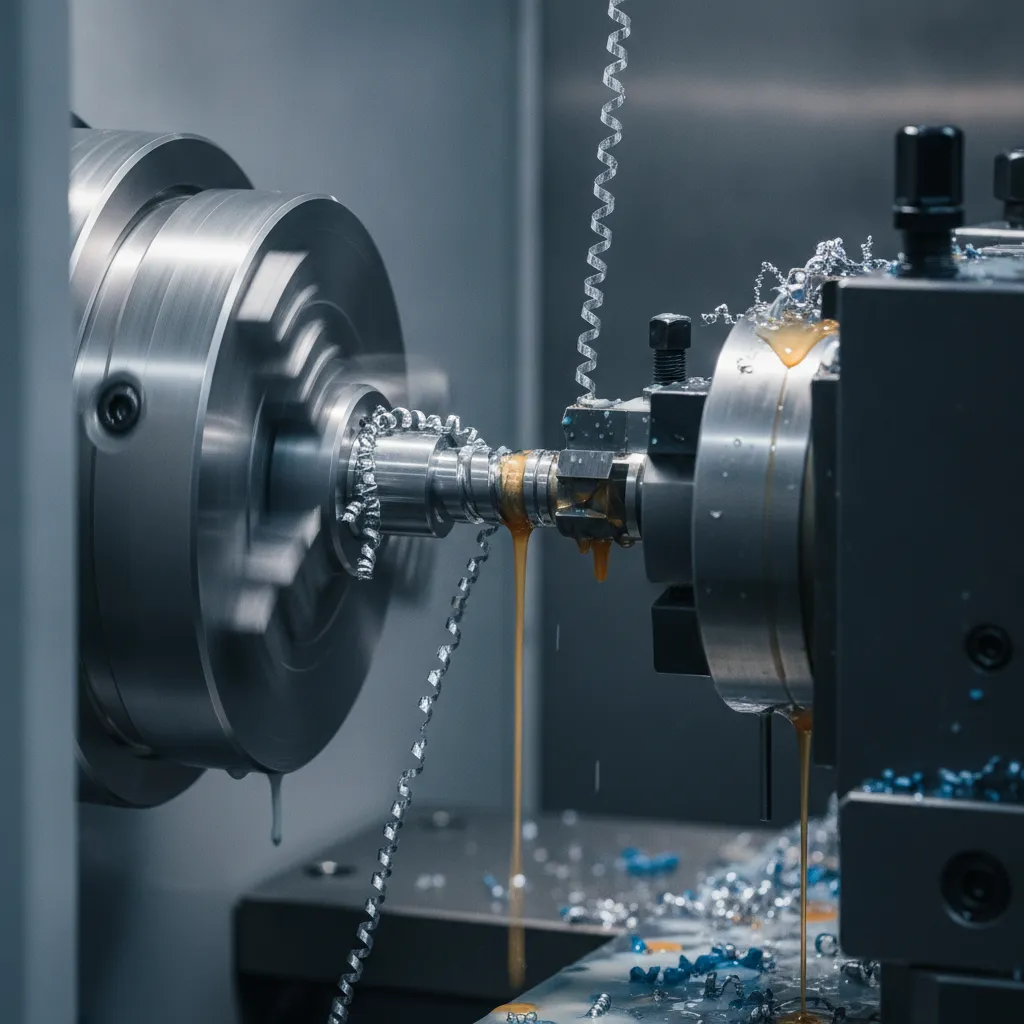
A Swiss lathe (also called a Swiss-type automatic lathe or Swiss screw machine) is a precision CNC turning machine that feeds bar stock through a guide bushing, keeping the cutting tool within fractions of a millimeter of the support point. This design eliminates workpiece deflection, enabling tolerances as tight as ±0.0001 inches on long, slender parts. The name traces to 19th-century Swiss watchmakers who needed consistent, high-volume production of tiny watch components.
What Is a Swiss Lathe and How Does It Work?
A Swiss lathe feeds bar stock through a guide bushing so the cutting tool contacts the workpiece within fractions of a millimeter of its support point, eliminating deflection on small-diameter parts.
The design originated in 1870s Switzerland, credited to watchmaker Jakob Schweizer, who needed a machine capable of producing identical watch components at volume. U.S. screw machine shops adopted the technology in the early 20th century, and it became the standard for any high-volume, small-diameter turned part requiring tight tolerances. According to the American Society of Mechanical Engineers, sliding-headstock turning technology remains one of the most significant innovations in precision manufacturing history.
Bar stock diameter on a Swiss-type machine typically spans 1 mm to 32 mm (roughly 1.25 inches). That range makes these machines purpose-built for small, slender work — not a limitation, but a deliberate design choice that concentrates every mechanical advantage on that specific class of part.
“The guide bushing is the defining innovation of Swiss-type turning. Without it, you simply cannot hold sub-tenth tolerances on slender parts at production volumes.” — Dr. Richard Lemaster, Professor of Manufacturing Engineering, North Carolina State University
How the Guide Bushing and Sliding Headstock Work Together
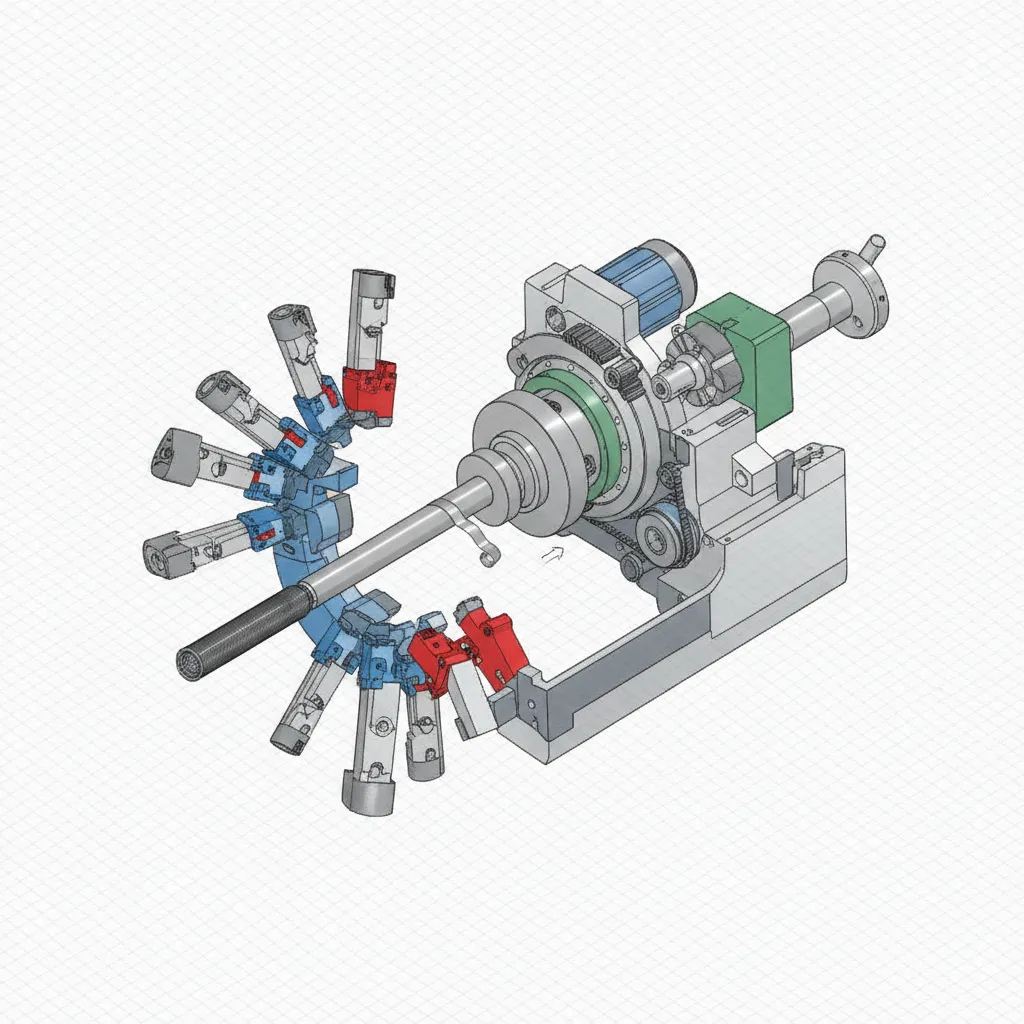
On a conventional lathe, the spindle holds the workpiece at one end while the tool moves along it. A Swiss-type machine inverts that relationship: the headstock slides axially, feeding the workpiece through a fixed guide bushing while the cutting tools remain nearly stationary.
The guide bushing supports the bar stock at the exact point of the cut, not at the chuck, which may sit several inches away. That reduces the unsupported length to near zero, which is why these machines can hold tolerances of ±0.0001 inches on parts with length-to-diameter ratios exceeding 10:1.
Modern CNC Swiss lathes add live tooling, sub-spindles, and Y-axis movement to this core mechanism. Turning, milling, drilling, and threading all happen in a single setup — the part exits the machine complete, without a second operation. For a visual demonstration of how this process works in practice, see this detailed video walkthrough of Swiss-type CNC turning in action.
Swiss Lathe vs. Conventional Lathe: Key Differences That Matter
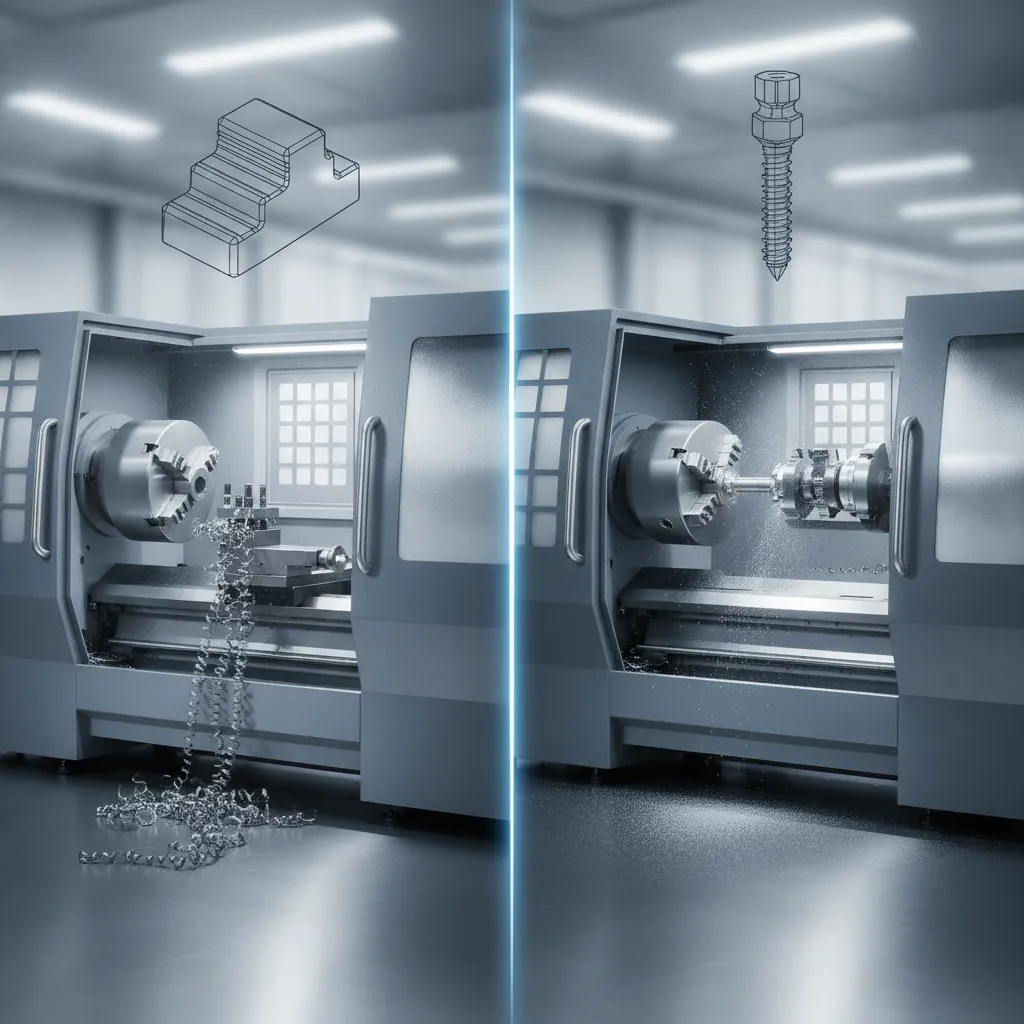
A Swiss lathe holds tolerances ten times tighter than a conventional CNC lathe on slender parts, and runs multiple operations in parallel to cut cycle times by up to 60%.
Precision and Speed: A Side-by-Side Comparison
Conventional lathes chuck the workpiece at one end and leave long sections unsupported. On slender parts, that unsupported span flexes under cutting forces, limiting practical tolerances to roughly ±0.001 inches. A Swiss-type machine feeds the bar stock through a guide bushing that supports the material just millimeters from the cutting tool, holding ±0.0001 inches on the same geometry.
The speed advantage is just as significant. A conventional lathe runs operations sequentially: turn the diameter, index, drill the hole, index again, cut the thread. A Swiss lathe runs turning, drilling, and threading in parallel across its multiple tool stations. For complex small parts, that simultaneous execution cuts cycle times by 30–60% compared to sequential conventional machining.
Conventional lathes remain the better choice for parts above 2 inches in diameter or jobs with simple geometries. Swiss-type machines dominate parts under 1.25 inches that carry tight tolerances or complex features — medical pins, hydraulic fittings, miniature fasteners.
Cost-Benefit Analysis by Production Volume
Setup costs are higher on the Swiss side. Tooling selection, guide bushing configuration, and programming complexity push setup time to 4–8 hours. A straightforward conventional job typically takes 1–2 hours. That gap makes Swiss machining economically viable only above roughly 500–1,000 parts per production run.
Capital cost reflects the same gap. A mid-range CNC Swiss lathe runs $150,000–$400,000; a comparable conventional CNC lathe costs $30,000–$150,000. At high volumes, however, the per-part cost on a Swiss machine often comes out lower — faster cycle times and fewer secondary operations reduce total labor hours per piece, offsetting the machine premium over a full production run.
Industries and Parts That Rely on Swiss Lathes
Swiss lathes dominate production of small, tight-tolerance parts across medical, automotive, electronics, and aerospace manufacturing.
Medical, Automotive, and Electronics: Application Deep Dive
Medical device manufacturing depends on Swiss turning more than any other machining method. Bone screws, dental implants, catheter components, and surgical instrument shafts routinely require tolerances under ±0.0002 inches in biocompatible materials like titanium grade 5, 316L stainless steel, and PEEK — a combination that these machines handle in a single setup. The U.S. Food and Drug Administration sets strict dimensional and surface finish requirements for implantable components, and Swiss-type turning is one of the few processes capable of meeting those standards consistently at production volumes.
“In medical device manufacturing, Swiss-type turning is not optional for many implant components — it is the only process that reliably delivers the dimensional consistency the FDA requires.” — James Doyle, Senior Manufacturing Engineer, Medical Device Industry Association
Automotive applications are high-volume by nature. Fuel injector pins, ABS sensor shafts, and transmission valve spools run on Swiss machines lights-out at 500–2,000 parts per hour, holding the tight dimensional tolerances that fuel system and braking components demand. The economics only work because cycle times stay short and scrap rates stay low.
Electronics and connector work pushes part dimensions even smaller. Micro-pins, RF connector bodies, and semiconductor test probes in brass, beryllium copper, or aluminum regularly include features as small as 0.3 mm — geometries that would be nearly impossible to hold on a conventional lathe without workpiece deflection.
Aerospace and defense parts add a material hardness challenge. Hydraulic fittings, actuator pins, and gyroscope shafts in Inconel or titanium require both tight tolerances and the ability to cut difficult alloys without chatter. The guide bushing keeps the cutting zone rigid regardless of part length, which is exactly what those materials demand.
Materials and Part Geometries Best Suited for Swiss Turning
The process favors materials that machine cleanly at high spindle speeds without generating excessive tool pressure. Free-machining stainless grades 303, 304, and 316 are workhorses, alongside brass, aluminum 6061 and 7075, titanium grade 5, and engineering plastics like Delrin. These materials produce predictable chip control, a practical requirement when running unattended overnight production cycles.
Part geometry matters as much as material. Swiss turning is the right choice when a part is long relative to its diameter (typically a length-to-diameter ratio above 3:1), features multiple turned diameters, cross-holes, or threads, and requires finished dimensions in a single operation rather than multiple setups.
The following part types are consistently well-suited to Swiss-type turning across industries:
- Bone screws, dental implants, and catheter shafts in titanium or stainless steel
- Fuel injector pins and ABS sensor shafts for automotive fuel and braking systems
- Micro-pins and RF connector bodies for electronics and semiconductor applications
- Hydraulic fittings and actuator pins in Inconel or high-strength titanium alloys
- Miniature fasteners and precision shafts with length-to-diameter ratios above 3:1
How Much Does a Swiss Lathe Cost? Pricing and Total Ownership
A Swiss lathe purchase price ranges from $80,000 for entry-level machines to over $600,000 for high-axis production systems, but the machine price is only part of the investment.
Entry-level CNC Swiss lathes from brands like Tsugami and Hanwha run $80,000–$150,000. Mid-range machines from Citizen and Star, the workhorses of most precision shops, fall between $150,000 and $300,000. High-end multi-axis configurations from Tornos, or Tsugami models with a sub-spindle and Y-axis, push $300,000–$600,000 or more.
Total Cost of Ownership: Beyond the Purchase Price
Initial tooling adds $5,000–$20,000 at setup, depending on how many tool stations the machine carries and the complexity of the part program. Guide bushings wear based on material hardness and bar stock surface finish — expect replacement every 500–2,000 hours at $50–$300 per bushing.
Preventive maintenance — spindle bearing inspection, coolant system service, and guide bushing replacement — runs approximately $8,000–$15,000 per year for a single machine operating two shifts. That figure climbs if the machine runs abrasive materials like stainless or titanium.
Operator and programmer training adds $3,000–$10,000 upfront. Swiss CNC programming on Fanuc or Mitsubishi controls, with gang tooling logic and synchronized spindle timing, carries a steeper learning curve than standard turning center work.
The break-even math is instructive: at a loaded shop rate of $120/hour, a $200,000 Swiss lathe producing 800 parts/hour at a $0.15/part margin needs roughly 1.7 million parts to recover capital. For a dedicated medical or automotive contract, shops typically hit that threshold in 2–3 years.
How to Select and Maintain a Swiss Lathe for Your Shop
Match your bar stock diameter, axis count, and production volume to the part family before purchasing a Swiss lathe — those three factors determine whether the investment pays off.
Choosing the Right Model Based on Part Complexity and Volume
Start with bar capacity. Most shops standardize on either a 20 mm machine for small medical and electronic components or a 32 mm machine for larger hydraulic and automotive parts. Mixing part families across a single machine erodes the setup efficiency that Swiss turning delivers.
Axis count follows part complexity. A 7-axis Swiss lathe handles the majority of complex turned parts — simultaneous OD turning, threading, cross-drilling, and front-face milling. A 9-axis configuration adds a Y-axis on the sub-spindle, which enables full back-working operations without a second setup. Only specify 9-axis if your part family genuinely requires it; the additional cost and programming time are real.
Guide bushing mode is a material cost decision. Modern machines such as the Citizen L-series and Star SR run in non-guide-bushing (non-GB) mode for parts shorter than 3× their diameter, cutting bar remnant waste by up to 40%. For titanium or Inconel runs, that reduction in remnant directly affects job profitability.
Production volume sets the economic floor. Swiss lathes justify their setup overhead at 300 or more parts per run for complex components. Below that threshold, a conventional CNC lathe or mill-turn center is usually more economical — the per-part setup amortization simply doesn’t work at low quantities.
A medical device contract shop that switched from conventional CNC turning to a Citizen M32 for a stainless bone screw reduced per-part cycle time from 4.2 minutes to 1.1 minutes and scrap rate from 3.2% to 0.4%, recovering the machine cost in 26 months. That result came from matching the machine to the part, not from the machine alone.
“Shops that struggle with Swiss-type machines almost always made the same mistake: they bought the machine before fully characterizing their part family. The machine is only as effective as the process built around it.” — Carol Bartz, Director of Advanced Manufacturing Programs, Society of Manufacturing Engineers
Maintenance Schedule and Tooling Best Practices
Consistent maintenance is what separates a Swiss lathe running at rated accuracy from one that drifts out of tolerance mid-run. Follow a tiered schedule tied to spindle hours:
- Every 200 hours: Check guide bushing clearance. Worn clearance is the single most common cause of diameter drift on long, slender parts.
- Every 500 hours: Replace coolant and filter. Contaminated coolant accelerates tool wear and introduces thermal variation that shows up as dimensional scatter.
- Every 1,000 hours: Inspect gang tooling holders for wear and fretting. A holder that has moved even 0.002 mm from its registered position will produce repeatable but incorrect dimensions — the hardest type of defect to catch.
- Annually: Schedule a spindle bearing inspection with your machine supplier. Bearing degradation on a Swiss machine is gradual; catching it before failure avoids both unplanned downtime and a scrapped production run.
Document every service event in a machine log tied to the spindle hour counter, not the calendar. Calendar-based intervals miss the reality that a high-volume shop accumulates 200 hours in three weeks, while a job shop may take three months. Hour-based tracking keeps the schedule honest.
Frequently Asked Questions
Can a Swiss lathe machine parts larger than 1.25 inches in diameter?
Most Swiss lathes top out at 1.25 inches (32 mm) bar stock diameter, but larger-capacity machines accept stock up to 2 inches (51 mm). Citizen, Star, and Tsugami all offer models in that extended range. For diameters beyond 2 inches, a conventional CNC turning center is typically the better choice — Swiss-type machines sacrifice rigidity at larger diameters because the guide bushing geometry is optimized for slender workpieces.
What is the difference between a Swiss lathe and a screw machine?
A screw machine is the older, cam-driven predecessor to the Swiss lathe; a Swiss lathe is a CNC evolution of the same sliding-headstock concept. Traditional screw machines, both Brown & Sharpe-style and Davenport multi-spindle types, use mechanical cams to control tool movement, making changeovers slow and expensive. Swiss CNC lathes replace those cams with servo-driven axes and G-code programs, cutting changeover time from hours to under an hour on repeat jobs.
Do Swiss lathes require special bar stock preparation?
Yes, bar stock for this practices must meet tighter straightness and diameter tolerance specs than standard turning stock. Most machine builders specify straightness within 0.010 inches per foot and diameter tolerance within ±0.0005 inches. Out-of-tolerance bar causes guide bushing wear and chatter, which directly degrades part finish. Cold-drawn or precision-ground bar stock is the standard choice; hot-rolled bar is generally unsuitable without additional straightening.
How long does it take to program a Swiss lathe for a new part?
A straightforward this method program for a new part typically takes 4 to 8 hours for an experienced programmer. Complex parts with back-working operations, thread whirling, or live tooling can push programming time to 16–24 hours. CAM software packages purpose-built for Swiss-type machines, such as Esprit or PartMaker, cut that time significantly by automating tool-path synchronization across the main and sub-spindles.
What coolant systems work best with Swiss-type turning machines?
High-pressure coolant systems delivering 500–1,000 PSI are strongly recommended for Swiss-type turning, particularly when machining titanium, Inconel, or stainless steel. High-pressure delivery improves chip evacuation in deep-hole drilling and cross-drilling operations, reduces tool wear, and helps maintain dimensional consistency across long production runs. Most machine builders offer integrated high-pressure coolant as a factory option, and retrofitting an aftermarket system is a common upgrade for shops running abrasive materials regularly.
Conclusion
this strategys earn their place in precision manufacturing through one defining capability: machining long, slender parts in a single setup without the deflection that defeats conventional lathes. If your parts run under 1.25 inches in diameter, require tolerances tighter than ±0.001 inches, or demand multiple operations completed in one cycle, a Swiss-type machine is worth serious consideration over a standard CNC turning center.
Three things to act on now: audit your current turned-parts portfolio for candidates that exceed three-to-one length-to-diameter ratios, confirm your bar stock meets Swiss-grade straightness specs before quoting a job, and request a cycle-time comparison from your machining partner — ask them to run the same part on both a this approach and a conventional lathe so the data speaks for itself.
Recommended Articles
Explore more from our content library:
