
PCBA rework and repair means correcting or fixing defects on an assembled circuit board rather than scrapping it, reflowing a cold joint, replacing a failed component, or repairing a lifted trace so the board meets spec. It matters because catching and fixing defects post-assembly costs far less than scrapping finished boards, and it prevents field failures from reaching customers. Manufacturers rely on it as a standard quality-control step, done either with an in-house rework station or through a specialized outsourced service, depending on defect complexity and volume.

What Is PCBA Rework and Repair, and Why Does It Matter in Manufacturing?
A PCBA (printed circuit board assembly) is a bare PCB populated with components, resistors, connectors, microcontrollers, solder joints, that make it functional. Rework fixes defects introduced during assembly, like a misaligned chip or a bad solder joint; repair addresses failures that show up later, in field returns or after burn-in testing.
Both fall under the umbrella of PCBA rework and repair, and the distinction matters for how a defect gets routed. A board flagged right off the assembly line goes to a rework station for correction before it ever ships. A board that comes back from a customer or fails at final test goes through a repair process that often starts with root-cause diagnosis rather than a known defect location.
Can a Damaged PCB Board Actually Be Repaired, or Do You Always Need to Replace It?
Most damaged boards can be repaired as long as the substrate and copper pads are still intact, replacement only becomes necessary when trace damage is severe or the laminate is burnt.
A lifted trace, a cracked pad, or a corroded via can usually be repaired by hand: technicians add wire jumpers, patch etches, or rebuild pads using techniques standardized under IPC-7711/7721. Severe damage changes the calculus. If heat has delaminated the board or a trace has burned through multiple layers, the cost and risk of repair can exceed the cost of scrapping the assembly and starting over. The decision usually comes down to whether the base material can still hold a reliable solder joint.
How Does PCBA Rework Fit Into Quality Assurance and Waste Reduction?
Rework sits directly inside the quality assurance loop, automated optical inspection (AOI), X-ray inspection, and functional test all feed defect data straight into rework decisions.
When AOI flags a solder bridge or X-ray reveals a hidden void under a ball grid array package, that finding doesn’t just get logged, it routes the board to a rework station for correction, then back through test to confirm the fix held. This closed loop is what keeps defect rates from compounding across a production run.
The waste-reduction case is straightforward. A board that fails test has already absorbed the cost of its components, solder, and labor. Scrapping it throws away all of that sunk cost, while reworking it recovers most of the value with only incremental rework labor added. For manufacturers running tight margins on complex assemblies, that difference adds up fast across a production lot.
What Are the Most Common Defects That Require PCBA Rework and Repair?
Five defect types account for most rework tickets on a production floor: cold solder joints, component damage, trace lifting, solder bridging, and voiding. Each has a distinct root cause, and misreading that cause is how a board ends up back on the rework bench twice.
What Are the Most Common Rework Failures to Watch For, Like Cold Joints, Component Damage, and Trace Lifting?
A cold solder joint forms when the reflow process delivers insufficient heat, or when flux residue and oxidation contaminate the pad before the solder sets. Instead of a smooth, shiny fillet, the joint looks dull and grainy, often with visible cracks around the lead. It may pass a continuity check on day one and still fail weeks later once vibration or thermal cycling works the crack open, a classic field-return scenario that traces back to a reflow profile problem, not a component defect.
Component damage shows up in a few forms. Misaligned placement happens when a part shifts during reflow or the pick-and-place step drifts out of tolerance. Tombstoning, where one end of a passive component lifts off the pad while the other stays soldered, usually points to uneven heating across the pads or an imbalance in solder paste volume. Ironically, rework itself introduces a secondary risk: repeated heating cycles during desoldering and reattachment stress the component and surrounding laminate, sometimes degrading a part that was functioning fine before the repair touched it.
Trace lifting is a rework-induced defect more often than an assembly-line one. Excessive heat from a soldering iron or hot air rework station, especially across repeated desoldering attempts on the same pad, weakens the adhesive bond between copper and substrate. The trace or pad separates and lifts, sometimes taking a section of copper with it. This is one reason skilled PCBA rework and repair technicians limit how many times a single pad can be reworked before recommending a jumper wire or board replacement.
Solder bridging and voiding round out the common list. Bridging, unwanted solder connecting two adjacent pads, is typically caught through automated optical inspection (AOI) or a trained visual check under magnification. Voiding, where gas pockets form inside a solder joint during reflow, is invisible to the eye and requires X-ray inspection to confirm, particularly on BGA and QFN packages where the joint sits underneath the component.
Identifying root cause before rework begins matters because a board that returns for the same defect repeatedly is signaling a process problem, not an isolated board problem. A reflow profile that’s slightly off, a stencil with worn apertures, or a rework station running hotter than its display suggests will keep producing the same failure across an entire lot until someone traces the defect back to its source.
Should You Repair PCBAs In-House or Outsource to a Service Provider?
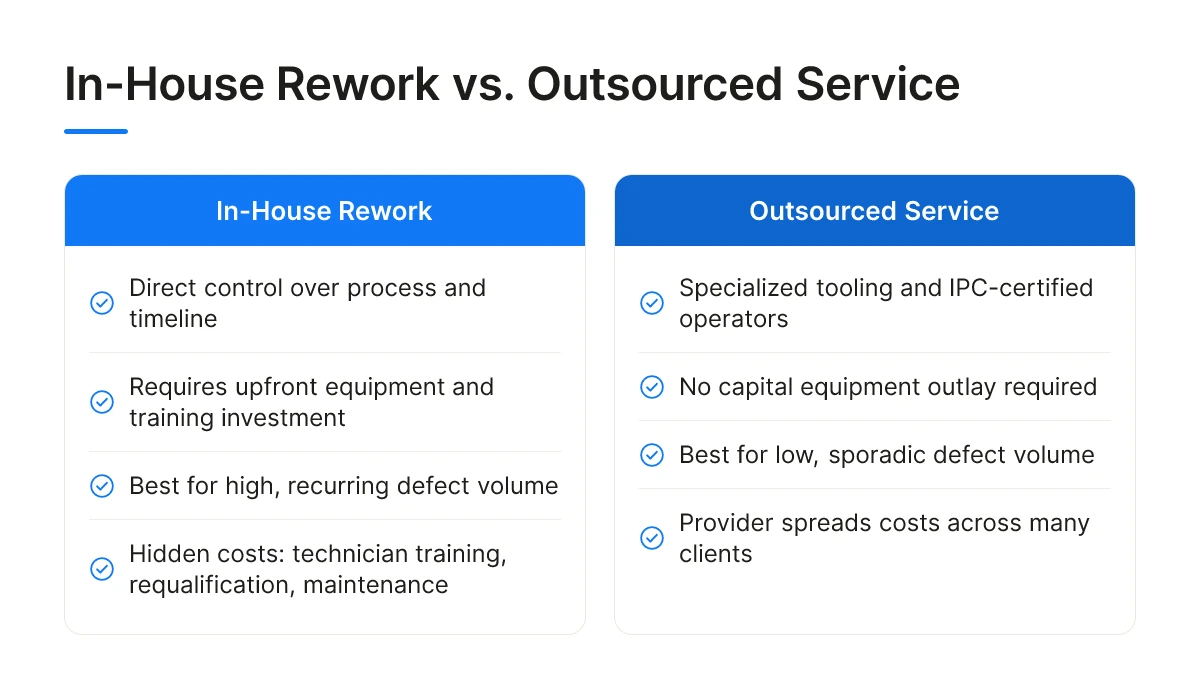
The choice comes down to volume and defect complexity: sporadic, low-volume repairs favor outsourcing, while high, recurring rework loads justify building an internal line.
What’s the Cost-Benefit of In-House Rework Versus Outsourcing to Specialized Providers?
In-house PCBA rework and repair gives you control over scheduling and turnaround, a board never has to leave the building, and engineers can inspect a failure the moment it’s flagged. That control costs money upfront: hot air rework stations, BGA reballing equipment, microscopes, and IPC-certified training for every technician who touches a board.
Outsourced providers spread that same equipment and certification cost across dozens of clients. A specialized rework shop amortizes a six-figure investment in rework stations and X-ray inspection gear over hundreds of jobs a month, which lowers the per-board cost for any single customer without requiring that customer to buy anything. You get IPC-certified operators and calibrated tooling on demand, and you pay only for the boards you send.
The trade-off is queue time and shipping. A board sent out for repair travels, waits in a queue behind other clients’ work, and comes back days later rather than hours. For a manufacturer running one pilot line with occasional defects, that delay is a minor inconvenience. For a high-mix production floor generating dozens of reworkable boards a week, the wait becomes a bottleneck that in-house capability would eliminate.
What Yield Improvements and Quality Metrics Can You Expect From Professional Rework?
Professional rework processes tend to produce fewer repeat failures because operators follow documented thermal profiles instead of improvising heat settings on the fly. A shop that reworks BGAs and fine-pitch components daily builds repeatable temperature curves calibrated to each package type, which reduces the risk of pad lifting, cold joints, or component damage from overheating, problems that show up again a few weeks later if rework is done casually.
Specialized providers also generate traceable documentation: which component was replaced, what profile was used, who performed the work, and what inspection method confirmed the repair passed. That paper trail matters for warranty claims and for root-cause analysis if the same failure mode recurs across a batch.
In-house rework can hit the same quality bar, but only with the same discipline, written procedures, calibrated equipment, and operators certified to standards like IPC-7711/21.
Decision-makers often underweight the hidden costs of in-house rework: technician training time, periodic requalification of reworked boards to confirm they meet spec, and ongoing equipment maintenance and calibration. Those recurring costs sit outside the initial equipment purchase and can quietly erode the savings an in-house line was supposed to deliver.
What Equipment and Techniques Do You Need for Effective PCBA Rework?
Effective PCBA rework and repair depends on five categories of equipment working together, plus a soldering strategy matched to the board’s material specification and end-use market.
What Specific Equipment Should You Invest in for a PCBA Rework Station, and What’s the ROI?
A functional rework station starts with a hot air rework system for controlled component removal and reattachment, paired with a precision soldering iron for fine-pitch touch-up work. Add a microscope or digital magnification system so operators can inspect solder joints and lifted pads that are invisible to the naked eye. Verification tools, X-ray inspection for hidden joints under BGAs and QFNs, or automated optical inspection (AOI) for surface-level defects, close the loop by confirming the repair actually worked. All of this sits on an ESD-safe workstation, since a single static discharge can undo an otherwise perfect repair.
Budget-friendly benchtop setups cover low-volume or prototype work well, while premium multi-zone rework systems with programmable thermal profiles suit operations handling dense boards or high daily throughput. The choice comes down to volume and board complexity, not just preference.
The return on that investment shows up in two places: fewer boards scrapped because a repair was attempted without the right tools, and lower spend on outsourcing routine rework to a contract house. For operations running higher assembly volumes, the payback period shortens fast, since even a modest drop in scrap rate compounds across thousands of units.
How Do Lead-Free Versus Lead-Based Soldering Techniques Differ, and What Compliance Requirements Apply?
Lead-free alloys, typically tin-silver-copper blends, reflow at higher temperatures than traditional tin-lead solder. That higher thermal load raises the risk of pad damage, delamination, or stressed components during rework, which means tighter reflow profile control and more conservative dwell times are non-negotiable.
Compliance shapes which alloy you’re allowed to use in the first place. RoHS restricts leaded solder across most consumer electronics sold in regulated markets, pushing manufacturers toward lead-free processes by default. Military and aerospace programs are the notable exception, many still specify or permit leaded solder because of its more forgiving rework behavior and long-established reliability data. Matching your rework technique to the applicable standard, not just the original assembly process, keeps repaired boards compliant and field-ready.
How Do You Measure the Cost-Benefit of PCBA Rework Versus Replacement?
Compare rework cost against replacement cost by weighing recovered component value against labor time, then factor in re-test costs before deciding.
The math changes depending on where in the build the defect surfaces. A board caught at first-article inspection, before final components are populated, has little sunk value, scrapping it costs almost nothing beyond the bare substrate. A board that fails at final test, fully populated with an FPGA, memory stack, and RF module already soldered down, represents dozens or hundreds of dollars in parts and labor that get thrown away if you scrap it instead of repairing it. The further a board travels through assembly before a defect is caught, the stronger the case for rework, because more component and labor value is already locked in and recoverable.
What’s the Typical Cost to Repair a PCB Board Compared to Replacing It Entirely?
Repair cost tracks defect complexity and the labor hours needed to fix it; replacement cost tracks the dollar value of the components and substrate being discarded.
A single bad resistor or a cold solder joint takes a technician minutes to fix under a microscope, low labor cost against a board that may carry a lot of component value, making rework the clear winner. Contrast that with a board where a plane short has damaged internal layers or where BGA rework has already been attempted once and lifted pads, the labor climbs, the risk of collateral damage climbs with it, and replacement starts looking cheaper even though you’re discarding good components along with the bad ones.
Building the Decision Framework
Rework makes sense when the defect is localized, a single component, a trace, a solder joint, and the board carries high component value that would otherwise be scrapped. Replace when the damage is structural: cracked substrates, delamination, shorts that span multiple internal layers, or repeated rework attempts that have already degraded the pads. This is the same logic that governs formal PCBA rework and repair programs: contain the fix to the smallest area possible, and know when the smallest area is still too big.
One cost that simple comparisons often skip: documentation and requalification. A reworked board frequently needs re-testing before it ships, functional test, sometimes environmental screening, and that re-test has to be logged against the original nonconformance record. IPC 7711/21 training programs build this expectation into the rework process itself, treating re-verification as part of the job rather than an optional extra. Skip that step and you’ve traded a hardware risk for a traceability risk, which costs more to unwind later.
Frequently Asked Questions
Is it always cheaper to rework a PCBA than to scrap it?
No, rework only pays off when component cost, board complexity, and yield loss make repair cheaper than replacement. A populated multilayer board with expensive BGAs or FPGAs almost always justifies rework, but a low-cost, low-component-count board often doesn’t. Run the math per board type, not per batch.
How many times can a single PCBA be reworked before it becomes unreliable?
Most fabricators limit rework to two or three cycles per pad or location before trace and pad damage risks outweigh the savings. Repeated heat exposure degrades copper adhesion and can lift pads, so each rework should be logged and inspected before another attempt.
Does reworking a board affect its warranty or certification status?
Rework can void warranty or certification if it isn’t performed to the original build standard, like IPC-A-610 or IPC 7711/21. Boards used in regulated industries, medical, aerospace, automotive, often require re-testing and updated documentation after rework to keep certifications valid, so confirm requirements with the certifying body first.
What training or certification should a PCBA rework technician have?
Technicians should hold IPC 7711/21 certification for rework and repair, plus IPC-A-610 for acceptability standards. Hands-on experience with fine-pitch soldering, BGA rework stations, and microscopic inspection matters as much as the certificate itself.
Conclusion
Effective PCBA rework and repair comes down to three decisions: knowing when repair beats scrap, tracking rework cycles per board so you don’t push past reliability limits, and matching technician certification to the standard your industry requires. Skip any one of these and you trade a small defect for a bigger warranty or field-failure problem later.
Start by auditing your last quarter of rejected boards, sort them by defect type and rework cost, and you’ll see immediately which categories deserve an in-house line and which are better routed to a specialized outsourced partner.
Recommended Articles
Explore more from our content library:
