

CNC machining parts are precision components produced by computer-controlled cutting tools that remove material from metal or plastic stock to exact specifications. Tolerances typically reach ±0.005 inches or tighter, making CNC machining the go-to process for functional prototypes, production runs, and complex geometries. Lead times range from 1 day (expedited) to 2–3 weeks depending on complexity, material, and supplier. Most reputable providers hold ISO 9001 certification and offer aluminum, steel, titanium, and engineering plastics.
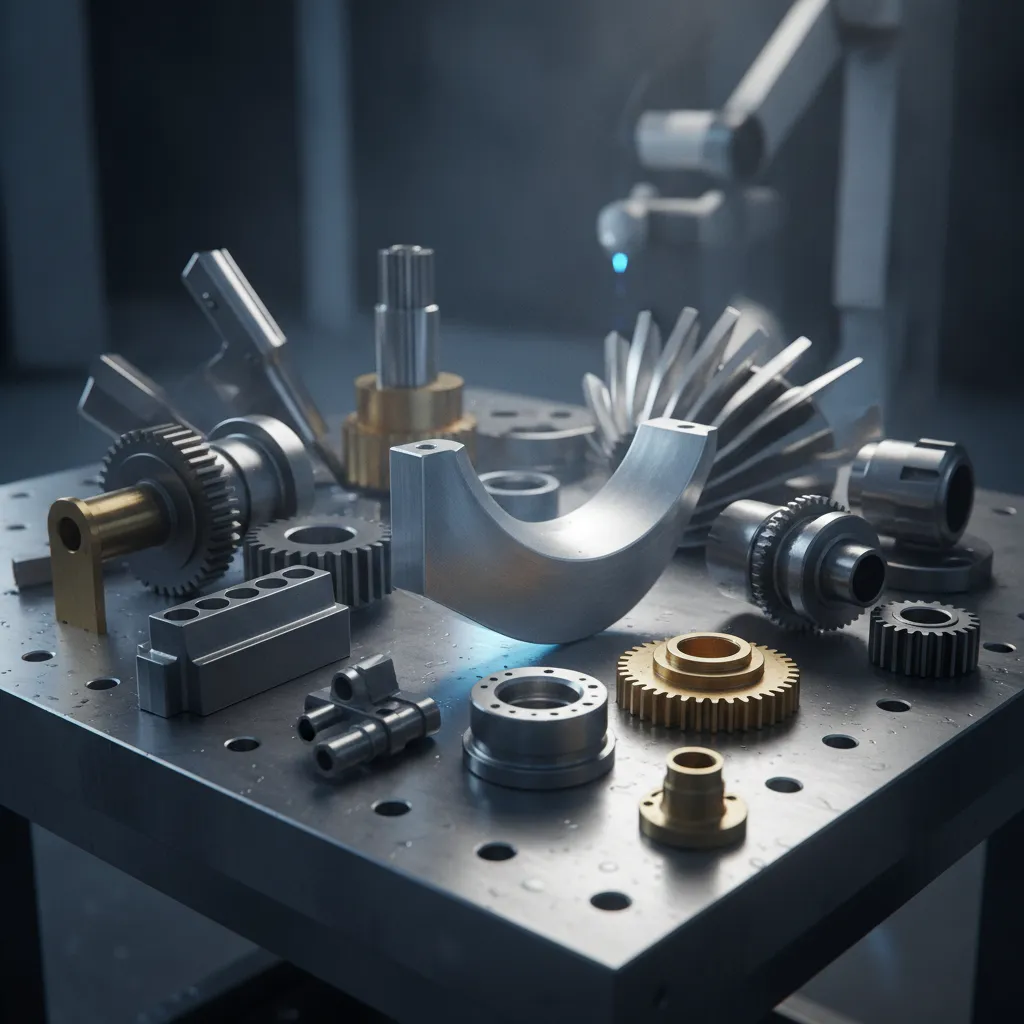
What CNC Machining Parts Are and How the Process Works
CNC machining is a subtractive manufacturing process: computer-controlled cutting tools remove material from solid stock, guided by G-code instructions.
That distinction matters when choosing a production method. While 3D printing builds geometry layer by layer, CNC machining cuts away everything that isn’t the part, a method that delivers superior mechanical strength and tighter dimensional tolerances than additive processes can achieve at equivalent cost for most metals.
“CNC machining remains the gold standard for functional metal prototypes because it produces parts with the same material properties as production components — something additive manufacturing simply cannot replicate for most structural applications.” — Dr. John Hart, Professor of Mechanical Engineering, MIT
The Four Operations Buyers Encounter Most
Most CNC machining parts fall under one of four processes:
- CNC milling (3-, 4-, and 5-axis): Uses rotating cutters to machine flat surfaces, pockets, and complex contours, 5-axis milling handles undercuts and compound angles in a single setup.
- CNC turning/lathe work: Rotates the workpiece against a stationary tool; ideal for cylindrical parts like shafts, bushings, and threaded fasteners.
- EDM (Electrical Discharge Machining): Erodes material with electrical sparks, the right choice for hardened tool steels and intricate cavities that cutting tools cannot reach.
- Grinding: Removes fine amounts of material with abrasive wheels to achieve surface finishes and tolerances tighter than standard milling allows.
For a visual overview of how these operations work in practice, see this CNC machining process walkthrough on YouTube.
Key Capabilities and Limitations of CNC Machining
Standard achievable tolerance for general cnc machining parts is ±0.005 in (±0.127 mm); precision work reaches ±0.001 in, concrete benchmarks to use when evaluating supplier quotes.
Minimum wall thickness runs approximately 0.5 mm for metals and 1.5 mm for plastics. Maximum part size depends on the machine, large-format mills typically accommodate parts up to 2,000 mm in length.
The production workflow follows four steps: upload a CAD file, receive an automated DFM (design for manufacturability) analysis, proceed to machining, then inspection and shipping. Providers like Protolabs quote turnaround in as fast as one day for straightforward geometries.
How CNC Machining Compares to Sheet Metal Fabrication
Sheet metal fabrication cuts and bends flat stock, it excels at enclosures, brackets, and high-volume structural panels where material cost and speed matter most. CNC machining, by contrast, produces parts from solid billets, making it the better fit for tight-tolerance functional components, complex 3D geometry, and materials like titanium or engineering-grade plastics that don’t bend cleanly.
The two processes are complementary, not competing. Many assemblies combine a machined component with a sheet metal housing, understanding where each method starts and stops prevents costly design decisions early in a project.
Materials Available for CNC Machining Parts
CNC machining parts can be produced from dozens of metals, plastics, and specialty materials, the right choice depends on load, temperature, and regulatory requirements.
Metals and Plastics: How Material Choice Affects Part Performance
The most-ordered metals each serve a distinct role. Aluminum 6061 is the most popular option, lightweight, corrosion-resistant, and easy to machine. Aluminum 7075 trades some machinability for aerospace-grade tensile strength, reaching around 83,000 psi. 304 stainless steel suits food-contact and general medical applications, while 316 stainless adds molybdenum for superior chloride resistance in implant-adjacent environments. 4140 alloy steel handles high-stress structural components where fatigue resistance matters. Titanium Grade 5 (Ti-6Al-4V) is the standard for orthopedic implants and aerospace brackets where weight and biocompatibility both count.
Common engineering plastics cover a wide performance band. ABS works well for general prototyping. Delrin (POM) offers low friction for gears and sliding mechanical parts. PEEK withstands continuous temperatures above 250°C, making it a go-to for medical and aerospace assemblies. Nylon resists wear in dynamic load applications. Polycarbonate provides optical clarity for lenses and light-pipe components.
Material hardness directly drives per-part cost. Soft aluminum machines 3–5× faster than stainless steel, which means shorter cycle times and lower tooling wear, a measurable difference on any production run.
A practical selection rule: match your material to three factors, operating temperature, load type (static vs. dynamic), and the applicable regulatory standard (FDA for medical, RoHS for electronics, AS9100 for aerospace). According to the American Society of Mechanical Engineers (ASME), material selection is one of the most consequential decisions in any precision machining project, directly affecting dimensional stability, fatigue life, and long-term performance.
“Choosing the wrong material for a CNC machined component is one of the most expensive mistakes an engineer can make — not because of raw material cost, but because of the downstream rework, field failures, and regulatory non-compliance it can trigger.” — Nancy Diaz-Elsayed, Assistant Professor of Industrial Engineering, University of South Florida
Specialty Materials Available Through CNC Machining Networks
Inconel, copper, brass, and G10 fiberglass are available but typically require network suppliers rather than standard in-house machines. Inconel resists oxidation above 1,000°C, making it essential for turbine components. Brass and copper suit electrical connectors and heat exchangers. G10 fiberglass is common in PCB fixture plates and insulating structural parts. Sourcing these through a supplier network adds lead time, so factor that into your project schedule from the start.
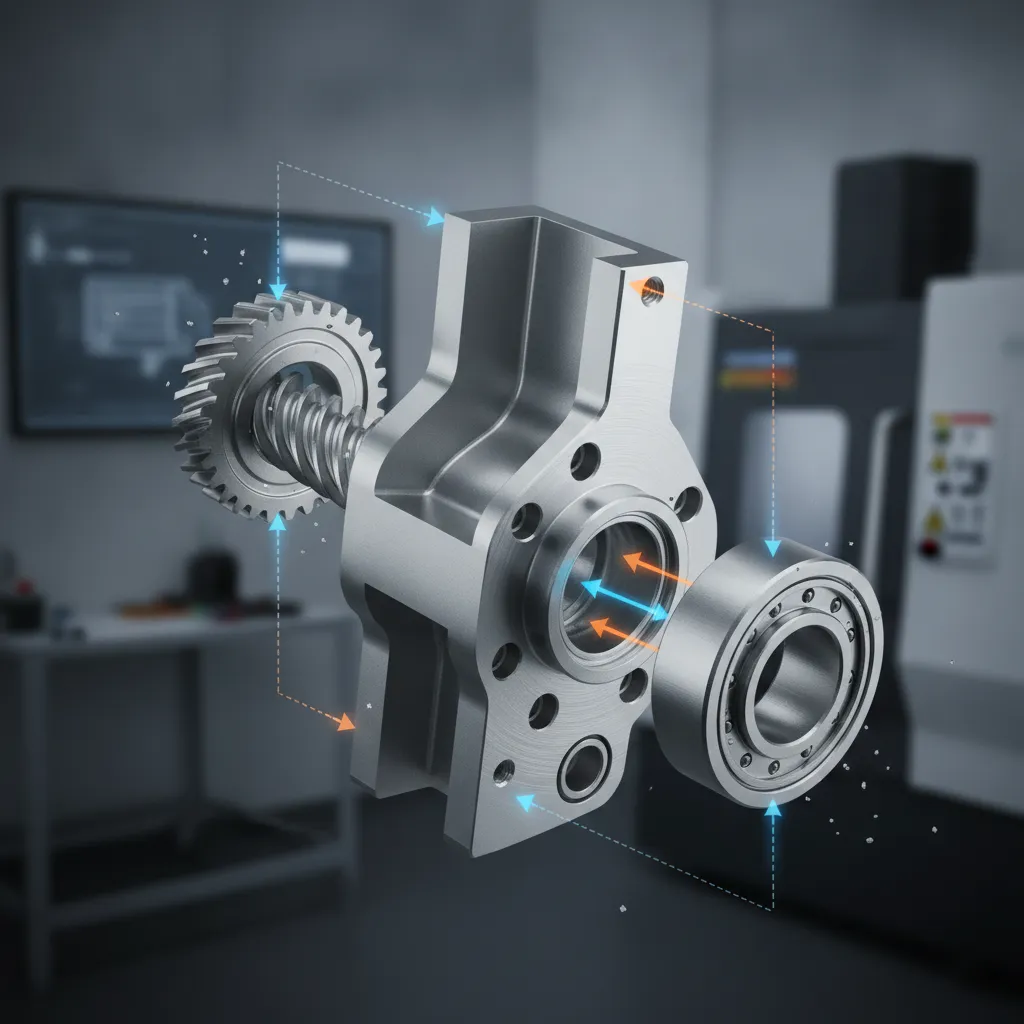
How Much CNC Machining Parts Cost and What Drives the Price
CNC machining parts range from roughly $10 to over $500 per piece, depending on material, complexity, tolerances, and order volume.
Cost Breakdown by Material Type and Complexity Level
Material is the first price variable. Aluminum runs approximately $2–$4 per pound in raw stock, making it the most affordable metal choice for machined parts. Titanium costs $30–$60 per pound, and that difference compounds once you factor in slower cutting speeds and accelerated tool wear.
Simple aluminum parts, a bracket with a few drilled holes and standard ±0.005″ tolerances, typically start at $10–$30 each at low volume. Complex 5-axis stainless steel components with tight geometries can exceed $500 each. These are starting points, not fixed prices; your specific geometry determines the actual figure.
Machining time is the second major driver. Each additional setup, repositioning the part on the machine, adds labor cost and cycle time. A part requiring three setups costs significantly more than one completed in a single fixture.
Surface finishing adds a predictable line item. Anodizing typically adds $5–$30 per part; hard chrome plating costs more. Tighter tolerances, say ±0.001″ versus ±0.005″, also increase cost because they require slower feeds, more passes, and additional inspection time.
The single biggest cost-reduction lever is design for manufacturability (DFM). Eliminating unnecessary tight tolerances and avoiding deep, narrow pockets can cut machining time by 20–40%, without changing the part’s functional performance.
Minimum Order Quantities and Volume Discounts in CNC Machining
Most online CNC services carry no formal minimum order quantity, platforms like Protolabs and JLCCNC let buyers order a single part. But per-unit price drops 30–60% when moving from 1 to 50 units, because setup costs get spread across more pieces.
Instant-quote platforms publish prices online and return a figure in minutes. Traditional job shops require an RFQ process with a 3–5 day turnaround. Buyers trading quote speed for a manual process may find savings on high-volume runs, but they pay with time upfront.
How Long It Takes to Get CNC Machined Parts Delivered
Turnaround for CNC machined parts ranges from 1 business day to 3+ weeks, depending on the provider, part complexity, and shipping destination.
Turnaround Time Comparison Across Major CNC Machining Providers
Protolabs offers expedited machining in as fast as 1 business day, making it the fastest option for urgent prototypes. Standard production at JLCCNC runs 3–5 business days, which suits most production orders without a premium rush fee. Xometry and Fictiv typically deliver in 5–10 days, depending on which network shop picks up the job and current shop capacity.
These numbers reflect quote-to-ship time, not quote-to-delivery. A 3-day production window becomes 7–10 days door-to-door for international buyers once customs clearance is factored in. Many buyers plan around production time alone and miss their actual deadlines.
What Factors Influence Lead Times from Quote to Delivery
Five variables consistently stretch lead times beyond the quoted production window:
- Part complexity: 5-axis setups require additional programming time before the first cut begins.
- Material availability: Titanium and Inconel carry longer stock lead times than aluminum or steel.
- Surface finish requirements: Anodizing adds 1–3 days to any order that requires it.
- Order volume: Batches of 50+ parts often need dedicated scheduling slots.
- Shipping destination: International customs adds 3–7 days on top of quoted delivery windows.
Domestically, standard FedEx or UPS ground shipping adds 1–5 days. Expedited air freight is available but can double the shipping cost on heavy metal parts.
Uploading a complete, toleranced CAD file in STEP format, paired with a clear 2D drawing, eliminates most back-and-forth with the supplier and can shave 1–2 days off any order, regardless of provider.
Quality Standards and Certifications to Expect from a CNC Machining Provider
A credible CNC machining parts supplier holds ISO 9001:2015 at minimum, provides inspection documentation with every order, and traces material stock to its origin. According to NIST (National Institute of Standards and Technology), adherence to documented quality management systems is directly correlated with lower defect rates and improved dimensional consistency in precision manufacturing environments.
Tolerance Levels and Surface Finish Options Available
Buyers should receive a First Article Inspection (FAI) report or Certificate of Conformance (CoC) with every production order. For tight-tolerance parts, typically ±0.005 mm or finer, CMM (coordinate measuring machine) reports are standard practice and should be available on request.
Surface finish choice affects both appearance and corrosion resistance. Common options with their Ra values include:
- As-machined: Ra 3.2 µm, lowest cost, tool marks visible
- Bead blasted: Ra 1.6–3.2 µm, uniform matte texture, no directionality
- Anodized Type II or III: adds an oxide layer for corrosion and wear resistance; Type III (hard anodize) suits high-wear applications
- Powder coat: thick decorative and protective layer, wide color range
- Electropolish: removes surface material to reduce Ra below 0.8 µm, common in medical and food-grade parts
How Quality Certifications and Material Sourcing Differ Between Providers
ISO 9001:2015 is the baseline quality management certification, a provider without it is a red flag for production orders. Aerospace buyers should require AS9100D; medical device buyers need ISO 13485. Always verify the certificate expiry date, not just its existence.
Material sourcing transparency separates budget suppliers from premium ones. Reputable providers supply mill certifications that trace raw stock to its origin, a non-negotiable requirement for aerospace and medical applications.
“Traceability is not a bureaucratic checkbox — it is the mechanism that allows engineers to understand exactly why a part failed, and to prevent that failure from recurring in the field.” — William Tandler, Senior Fellow, American Society for Quality (ASQ)
Use this five-point checklist when evaluating any supplier:
- ISO 9001:2015 certificate, confirm it is current, not expired
- In-house CMM inspection, third-party inspection adds lead time and cost
- Material certs available on request, mill certs should arrive with the shipment
- DFM feedback before machining starts, a supplier who flags design issues early saves rework costs
- Clear revision and rework policy, understand who bears cost when a part falls outside tolerance
Frequently Asked Questions
What file formats do CNC machining services accept for quoting?
Most CNC machining services accept STEP (.stp,.step) and IGES (.igs) files as the standard 3D formats for quoting and production. STEP files are preferred because they preserve geometry, tolerances, and material data reliably. Some suppliers also accept STL, DXF (for 2D drawings), and native CAD files from SolidWorks or Fusion 360. Always include a 2D drawing PDF alongside your 3D file if your part has critical tolerances, thread callouts, or surface finish requirements that the model alone cannot communicate.
Can you order a single CNC machined part, or is there a minimum order quantity?
Most CNC machining suppliers accept orders for a single part, with no minimum order quantity required. Online services like Protolabs and JLCCNC are specifically built for low-volume and prototype runs. The unit price for a single part will be higher than volume pricing because setup costs are spread across fewer pieces, ordering 10 or more units typically drops the per-part cost significantly.
What is the difference between CNC milling and CNC turning, and which do I need?
CNC milling cuts material from a stationary workpiece using a rotating multi-point tool, while CNC turning rotates the workpiece against a stationary cutting tool. Use milling for prismatic parts with flat faces, pockets, slots, and complex contours. Use turning for cylindrical or round parts, shafts, bushings, and threaded rods. Many parts require both: a CNC lathe with live tooling can combine turning and milling in one setup, reducing handling time and improving concentricity on complex geometries.
How do I reduce the cost of my CNC machined parts without sacrificing quality?
Simplifying your design is the fastest way to cut CNC machining costs without lowering part quality. Avoid deep, narrow pockets, sharp internal corners, and non-standard thread sizes, each adds tool changes and cycle time. Relax tolerances on non-critical features to ±0.1 mm where function allows, since tight tolerances require slower feeds and additional inspection. Ordering in batches of 10 or more, choosing a machinable alloy like 6061 aluminum over exotic alloys, and eliminating unnecessary surface finishes also reduce cost measurably.
How do I know if my design is ready for CNC machining?
Your design is ready for CNC machining when you have a complete STEP file with all critical dimensions toleranced, a 2D drawing that calls out threads, surface finishes, and any GD&T requirements, and a clear material specification. Before submitting, check that wall thicknesses meet minimums (0.5 mm for metals, 1.5 mm for plastics), internal corners include a radius that matches standard end mill sizes, and no features require tool access from more than the axes your chosen process supports. Running your file through a supplier’s DFM tool before ordering catches the majority of costly design issues.
Conclusion
Selecting the right CNC machining parts strategy comes down to three decisions: choosing the correct process (milling, turning, or multi-axis) for your geometry, specifying only the tolerances your design actually requires, and picking a material that balances machinability against the mechanical demands of the application. Aluminum 6061 remains the default starting point for most prototype and production runs, move to stainless or titanium only when load, corrosion, or temperature data justifies the added cost.
As a concrete next step, export your CAD model as a STEP file, attach a 2D PDF that calls out your critical tolerances, and request quotes from at least two suppliers. Comparing lead times and DFM feedback side by side gives you real data to make a sourcing decision, not just a price.
Recommended Articles
Explore more from our content library:
