

Industrial fasteners are mechanical components, bolts, screws, nuts, washers, rivets, and pins, that join two or more parts together, either permanently or temporarily. They are the backbone of manufacturing, construction, aerospace, automotive, and electronics assembly. Choosing the right fastener means matching material, grade, thread specification, and standard (ISO, ANSI, DIN) to the load, environment, and compliance requirements of your application.
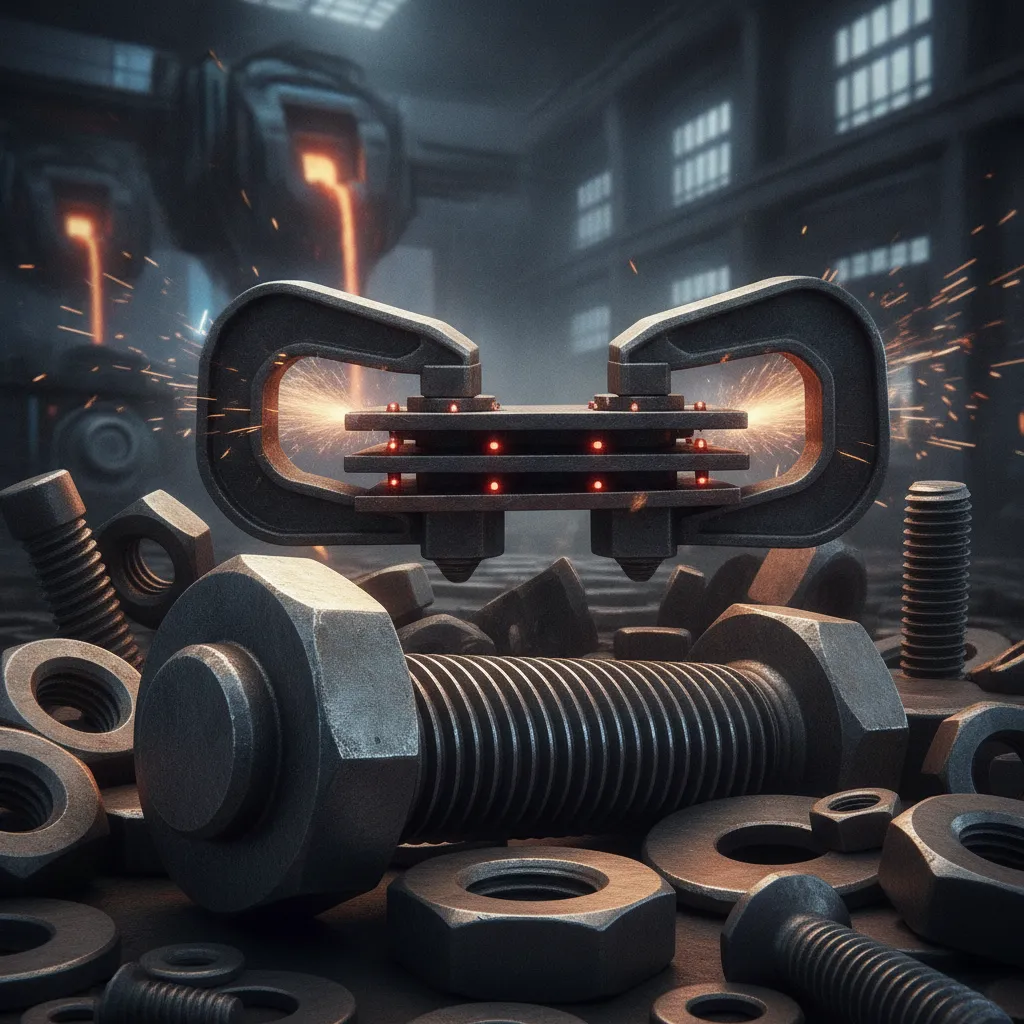
What Industrial Fasteners Are and What They Actually Do
Industrial fasteners are mechanical joining components engineered to maintain joint integrity under tensile, shear, or compressive loads, not merely to “hold parts together.” According to the American Society of Mechanical Engineers (ASME), proper fastener specification is one of the most critical factors in ensuring structural reliability across engineered assemblies.
That distinction matters. A bolt resisting shear across a structural beam behaves very differently from a rivet bearing tensile pull in an aircraft panel. The load type determines the fastener category, material grade, and installation method, get any of those wrong and the joint fails.
Fasteners split into two functional groups: permanent types (rivets, weld studs) that require destructive removal, and removable types (bolts, screws, nuts) that allow disassembly without damaging the joined materials.
“The selection of industrial fasteners is never a trivial decision. Every variable — material, grade, thread form, and coating — directly affects joint performance and long-term safety.” — Dr. Raymond Pearson, Senior Mechanical Engineer, ASME Technical Division
The six fastener categories: screws, bolts, nuts, washers, rivets, and pins
Each of the six core categories of industrial fasteners serves a distinct mechanical role:
- Screws thread directly into a material or tapped hole, creating their own mating thread to resist axial pull-out.
- Bolts pass through a clearance hole and clamp materials together when torqued against a nut, generating clamping force across the joint.
- Nuts mate with bolt threads to distribute clamping load across a bearing surface and resist loosening under vibration.
- Washers spread load over a wider area, protect surface finishes, and prevent fastener embedment into softer substrates.
- Rivets deform permanently on installation to create a fixed, shear-resistant joint, common where welding is impractical.
- Pins locate or lock components in precise alignment, resisting shear loads between mating parts without generating clamping force.
Online catalogs like Fastener SuperStore list more than 45,000 SKUs across these six categories, which reflects just how many size, thread, material, and drive-style combinations real applications demand.
Which industries rely on industrial fasteners and why
Aerospace specifies Mil-Spec fasteners on every structural joint, titanium and A286 alloy grades are standard because weight and fatigue life are non-negotiable. Automotive OEM lines consume industrial fasteners by the millions per shift, where torque consistency directly affects warranty claims. Structural construction depends on ASTM-graded bolts for moment connections in steel frames. Electronics PCB assembly uses micro-screws and standoffs to mount boards without cracking substrate. Heavy equipment manufacturing relies on high-tensile bolts, Grade 8 or ISO 10.9, to withstand constant shock loading in excavators, cranes, and mining machinery.
The global industrial fastener market exceeded $90 billion in 2023, which means material and grade decisions carry real financial and safety consequences, not just engineering preferences.
The Main Types of Industrial Fasteners and When to Use Each
Industrial fasteners split into two primary families, threaded and non-threaded, with specialty hardware covering a third distinct group for precision and structural applications. Suppliers such as Industrial Fasteners & Supply stock all three families across a wide range of grades and materials.
Threaded vs. non-threaded fasteners: key differences
The most common point of buyer confusion is the bolt-versus-screw distinction. A bolt passes through an unthreaded hole and clamps with a nut; a screw threads directly into the base material. Both are threaded fasteners, but they are not interchangeable in design.
Non-threaded fasteners, rivets, pins, and retaining rings, work differently. They deform, snap, or press into position rather than rotating into place. The practical decision rule is straightforward: if the joint needs disassembly for maintenance, specify a threaded fastener. If the connection is permanent and subject to high vibration, a rivet or lock pin holds more reliably because there is no thread to loosen.
Classification systems vary by standards body. ANSI B18 uses a broader breakdown than ISO 4000-series groupings, ANSI recognizes seven fastener categories where ISO typically works within four to five. Knowing which system your drawing references prevents costly specification errors.
Mil-Spec fasteners form a separate category entirely. Defense and aerospace programs require them under standards such as MS, NAS, and AN series. Even when a commercial fastener matches the dimensions of a Mil-Spec part, the two are not interchangeable, material traceability, testing documentation, and surface treatment requirements differ.
“In aerospace and defense, the documentation behind industrial fasteners is just as important as the fastener itself. A part without a traceable cert is effectively unusable on a regulated assembly line.” — Linda Hartwell, Quality Assurance Director, Aerospace Fastener Manufacturers Association
Specialty fasteners: spacers, standoffs, retaining rings, and anchors
Spacers and standoffs are standard hardware in PCB and electronics enclosure assembly, where they maintain precise board-to-board or board-to-chassis clearance. A misspecified standoff height of even 0.5 mm can cause thermal or mechanical interference in a dense enclosure.
Retaining rings, also called snap rings, seat in a machined groove on a shaft or inside a bore to prevent axial movement. Motors and gearboxes rely on them to keep bearings and gears in position without welding or threading. Concrete anchors serve a different environment entirely: structural and civil applications where a fastener must transfer load into masonry or poured concrete, such as anchor bolts for steel column base plates. According to ASTM International, anchor bolt specifications for structural applications must conform to ASTM F1554 to ensure adequate tensile and yield strength in concrete embedment scenarios.
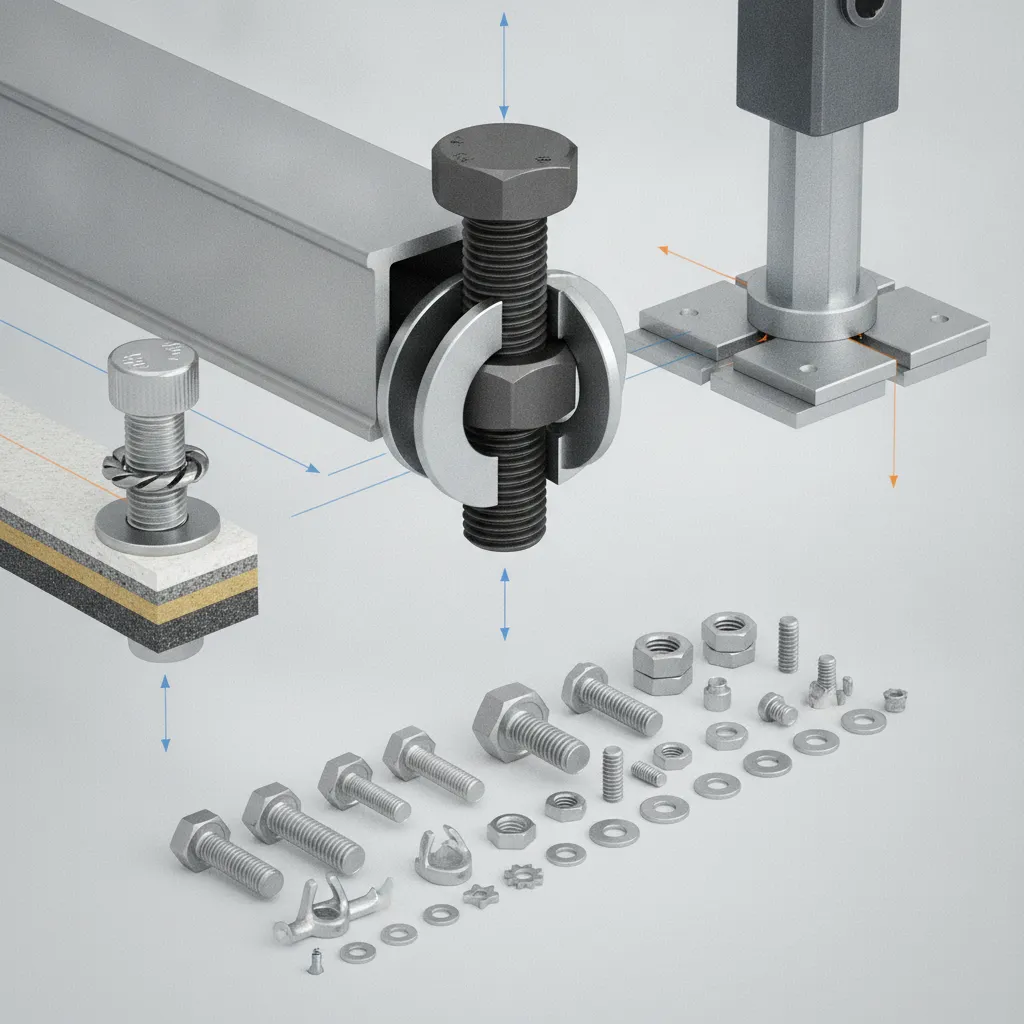
How to Choose the Right Fastener Material and Grade
Material and grade selection for industrial fasteners comes down to three variables: the load the joint must carry, the environment it operates in, and the certification the end market requires.
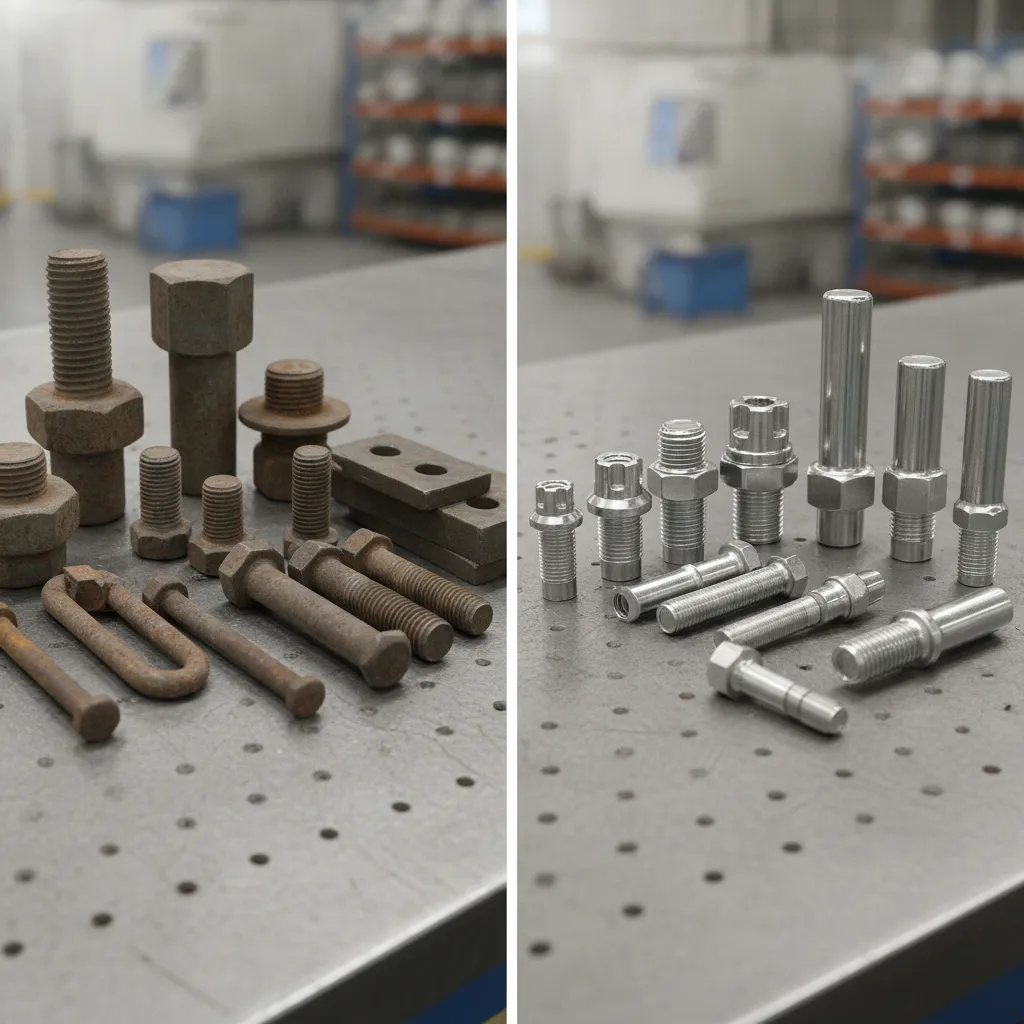
Stainless Steel vs. Galvanized vs. Carbon Steel Fasteners
Stainless steel splits into two dominant grades for fastener applications. Type 304 handles indoor and mild outdoor environments well, covering the majority of general manufacturing and food-service equipment. Type 316 adds molybdenum to the alloy, which significantly raises resistance to chlorides and acids, making it the correct choice for marine hardware, chemical processing lines, and FDA-regulated food production. Expect to pay a 20–40% cost premium for 316 over 304.
Galvanized carbon steel occupies the middle ground between bare steel and stainless. Hot-dip galvanizing deposits 45–85 microns of zinc coating onto the fastener surface, providing durable corrosion protection at a fraction of stainless pricing. It is the standard choice for outdoor structural and construction applications, bridge decking, utility poles, and timber framing, where stainless steel would be cost-prohibitive without adding meaningful performance benefit.
Carbon steel grades define tensile strength and proof load in precise tiers. The SAE system uses Grade 2, 5, and 8 for imperial fasteners; the ISO metric equivalent runs 8.8, 10.9, and 12.9. Grade 8 and ISO 12.9 fasteners are required in high-stress automotive suspension joints and heavy equipment connections where joint failure carries safety consequences. Large industrial distributors such as Grainger stock the full range of carbon steel grades alongside stainless and specialty alloy options.
Fastener Quality Grades and Certifications by Industry
Each regulated industry adds its own certification layer on top of material grade. Aerospace procurement requires AS9100-certified industrial fasteners with full material traceability. Medical device assembly commonly specifies ASTM F899 stainless to ensure biocompatibility and corrosion performance. Structural bolts in construction must meet ASTM A325 or A490, the two standards that govern proof load and installation torque for steel-to-steel connections.
Under-specifying is not a minor engineering oversight. Installing a Grade 2 bolt where Grade 8 is required creates a code violation and a direct liability exposure, the joint may pass visual inspection and still fail under design load.
Key Fastener Specifications and Standards You Need to Know
Industrial fasteners are governed by four major standards, ISO, ANSI/ASME, DIN, and Mil-Spec, each controlling different dimensions, materials, and markets.
ISO, ANSI, DIN, and Mil-Spec: What Each Standard Covers
ISO standards define metric fastener geometry worldwide. ISO 4014 covers hex bolt dimensions; ISO 4032 covers hex nuts. These are the default specs in European and Asian supply chains, but they are not directly interchangeable with ANSI/ASME B18 inch-series fasteners, even when nominal sizes appear close. Thread pitch, head geometry, and tolerance classes differ enough to cause assembly failures if the wrong standard is mixed in.
ANSI/ASME B18 governs the full range of inch-series fastener dimensions across North American manufacturing and construction. The sub-specs matter: B18.2.1 applies to hex bolts, while B18.6.3 covers machine screws. Specifying the wrong sub-standard when placing a purchase order is a common and costly error.
DIN standards, published by Deutsches Institut für Normung, predate ISO and many have since been superseded by ISO equivalents. Still, German-engineered equipment frequently references DIN numbers in original documentation, and MRO (maintenance, repair, and operations) teams working on legacy machinery encounter active DIN specs regularly.
Mil-Spec fasteners, designated under MIL-DTL, MS, or NAS series, go further than any commercial standard. They specify not just dimensions but material traceability, testing protocols, and packaging requirements. U.S. defense and aerospace procurement mandates these specs precisely because commercial equivalents leave those controls undefined. The National Institute of Standards and Technology (NIST) provides reference documentation on measurement standards and traceability requirements that underpin Mil-Spec compliance programs.
How Fastener Specifications Affect Compliance in Regulated Industries
In aerospace, medical device manufacturing, and nuclear applications, a fastener’s specification number is only part of the requirement. Every fastener must arrive with a traceable cert document, typically a material test report (MTR) or certificate of conformance (CoC), that links the part to its heat lot, chemistry results, and mechanical test data.
Without that documentation, the fastener cannot be used in a regulated assembly, regardless of how it measures. A single non-conforming or undocumented fastener can halt a production line during a quality audit or trigger a full lot rejection. Procurement teams in these industries treat the cert package as inseparable from the part itself.
How to Select, Size, and Source Fasteners for Your Application
Getting fastener selection right comes down to four sizing variables, two thread choices, and three procurement questions, skip any of them and you risk joint failure or supply delays.
Fastener sizing criteria: diameter, thread pitch, grip length, and head style
Work through these four variables in order for every new application:
- Nominal diameter: Match to the load requirement and the tapped hole or nut specified in your design. Don’t upsize arbitrarily, it changes clearance hole geometry and torque specs.
- Thread pitch, coarse vs. fine: Coarse thread (UNC or metric coarse) assembles faster and tolerates vibration better, making it the default for structural and high-cycle joints. Fine thread (UNF or metric fine) delivers higher tensile strength per diameter and finer adjustment precision, use it for precision assemblies, thin-walled materials, or applications where controlled preload matters. Match the choice to the application, not to what your team has always ordered.
- Grip length: This equals the total thickness of the material stack being clamped, excluding the nut. Getting grip length wrong is the most common field error in industrial fasteners work, a fastener that’s too short threads into the clamped material; one that’s too long leaves the joint under-clamped. Measure the stack, then select accordingly.
- Head style: Hex heads suit open-access torquing with a wrench; socket heads work in recessed or tight-clearance locations; flat heads countersink flush for aerodynamic or aesthetic surfaces; pan heads distribute load over a wider bearing area on softer substrates.
Bulk pricing, lead times, and supplier inventory: what to ask before you buy
Most distributors break pricing at 100, 500, and 2,500 pieces. Buying one tier up typically saves 15–35% per unit. For MRO operations running consistent volume, blanket purchase orders with scheduled releases cut both unit price and administrative lead time, negotiate them annually.
Lead time depends entirely on what you’re ordering. Standard commercial industrial fasteners, Grade 5, Grade 8, 304 stainless, common inch and metric sizes, ship same-day or next-day from any stocking distributor. Mil-Spec, titanium, Inconel, or non-standard thread fasteners can run 4–16 weeks. Build that window into your project schedule, not your expedite budget.
When vetting a supplier of industrial fasteners, confirm three things before placing a safety-critical order: they issue a Certificate of Conformance (CoC) and Material Test Report (MTR) for every lot; they carry product liability insurance; and they can trace each lot back to the originating mill. A lower price from a non-traceable source is a compliance risk and a safety liability, no cost saving justifies that exposure.
“Sourcing industrial fasteners from unverified suppliers is one of the leading causes of field failures in structural and mechanical assemblies. Traceability is not optional — it is the foundation of a defensible quality program.” — James Kowalski, Director of Supply Chain Integrity, Industrial Fastener Institute
Frequently Asked Questions
What is the difference between a bolt and a screw?
A bolt requires a nut to clamp two parts together, while a screw threads directly into a material or a pre-tapped hole. Bolts are designed for through-hole assemblies where both ends are accessible. Screws rely on thread engagement with the base material itself, making them the right choice when only one side of a joint is reachable.
When should I use metric fasteners versus inch-series fasteners?
Use metric fasteners when your design follows ISO standards or when the end product ships to markets outside the United States. Inch-series (Unified National) fasteners remain standard in North American industrial equipment and legacy machinery. Mixing the two thread systems in a single assembly risks cross-threading and joint failure, so match the fastener standard to the dominant standard of the surrounding components.
What does fastener grade mean and why does it matter?
Fastener grade describes the mechanical strength of the material, specifically tensile strength, yield strength, and proof load. SAE Grade 5 steel bolts carry a minimum tensile strength of 120,000 psi; Grade 8 bolts reach 150,000 psi. Specifying the wrong grade in a load-bearing joint can cause fastener failure under stress, which is why structural and safety-critical drawings always call out grade explicitly.
Are stainless steel fasteners always better than galvanized for outdoor use?
Stainless steel is not always the better choice, it depends on the environment and the mating materials. Stainless (typically 304 or 316 alloy) resists rust well in marine and high-humidity conditions, but it can gall during installation and costs significantly more than hot-dip galvanized steel. Galvanized fasteners perform reliably in most outdoor construction applications and are the standard choice where budget and volume matter.
How do I know if a fastener supplier is reliable for safety-critical applications?
A reliable supplier for safety-critical industrial fasteners holds traceable material certifications, typically mill test reports, and complies with relevant standards such as ASTM, ISO, or AS9100 for aerospace. Ask whether they source from certified manufacturers, maintain lot traceability, and can provide dimensional inspection reports on request. Suppliers with documented quality processes and 24-hour emergency service capabilities are a stronger choice than distributors who cannot produce paperwork on demand.
Conclusion
Choosing the right industrial fasteners comes down to three decisions made before you place an order: material for the environment, grade for the load, and thread standard for the assembly. Getting any one of those wrong adds cost downstream, whether through corrosion, joint failure, or incompatible replacement parts.
If your application involves precision-machined components, cold-forged parts, or sheet metal assemblies, the fastener specification belongs in the design review, not as an afterthought at procurement. Start by pulling the load requirements and environmental exposure data for your joint, then match those numbers to a grade and material before selecting a supplier. That sequence prevents the most common and expensive mistakes when specifying industrial fasteners.
Recommended Articles
Explore more from our content library:
