

Custom fasteners are purpose-built bolts, screws, nuts, and other joining hardware manufactured to specifications that standard off-the-shelf parts cannot meet. You need them when a project demands a non-standard thread pitch, unusual head geometry, a specific alloy, or tight dimensional tolerances that catalog fasteners simply don’t offer. Industries from aerospace and medical devices to heavy construction and automotive rely on custom fasteners to solve assembly challenges that would otherwise compromise safety, performance, or production efficiency. According to industry analysts, the global fastener market is projected to exceed $115 billion by 2030, with custom and engineered fasteners representing one of its fastest-growing segments as manufacturers push for tighter tolerances and application-specific performance.
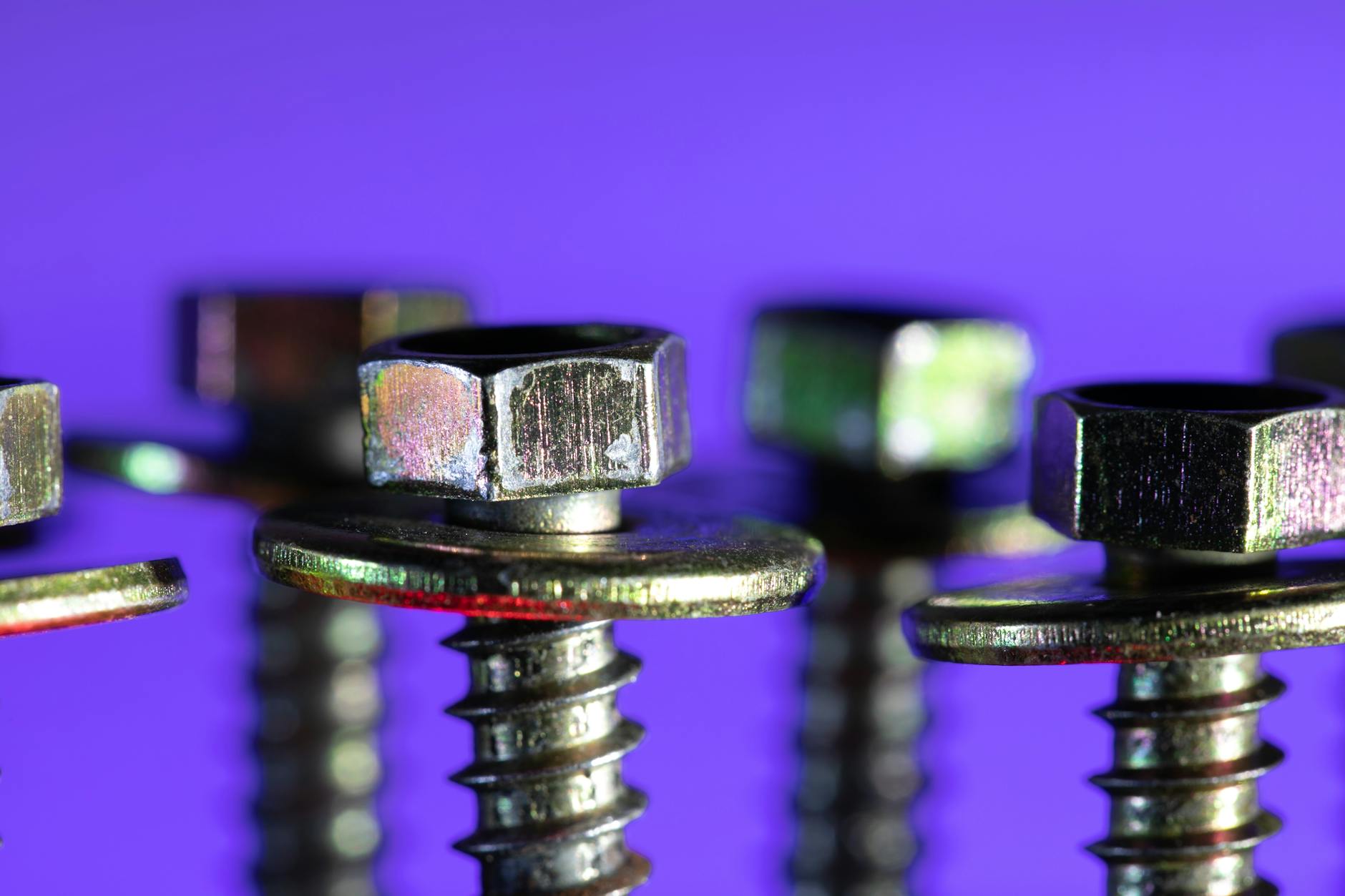
What Are Custom Fasteners and When Do You Need Them?
Custom fasteners are joining components, bolts, screws, studs, nuts, and pins, built to buyer-specified dimensions, materials, or functional features that no standard catalog part covers.
That distinction matters. A custom fastener is not a special order of an existing part. It is a new part, defined by a customer-supplied drawing or specification, that deviates from published dimensional standards in at least one critical parameter.
“When a standard fastener fails to meet the load, geometry, or material requirements of an application, the cost of forcing a workaround almost always exceeds the cost of engineering the right part from the start.” — James Reardon, Senior Applications Engineer, Custom Fastener Manufacturing Division
Standard Fasteners vs. Custom Fasteners: Key Differences
Standard fasteners conform to fixed dimensional systems, ISO, ASME, or DIN, covering thread form, pitch, head style, and material grade. Every hardware distributor stocks them because the dimensions are universal and interchangeable. According to the American Society of Mechanical Engineers (ASME), standardized fastener systems exist precisely to enable interchangeability across global supply chains — but that same standardization is what limits their usefulness in specialized applications.
Custom fasteners break from those standards in at least one parameter: a non-standard thread pitch, a proprietary drive recess, an extended or shortened shank, a head geometry that clears a tight assembly envelope, or a material grade not listed in any catalog. The deviation can be minor, a bolt cut 3 mm longer than any stocked length, or complete, where a fully engineered, multi-feature fastener is produced entirely from a customer drawing. Suppliers such as MW Components and KD Fasteners illustrate the breadth of what custom manufacturing can deliver, from simple length modifications to fully engineered proprietary geometries.
The clearest triggers for going custom include:
- No standard part fits the assembly envelope, the geometry of the joint leaves no room for a catalog head or thread runout.
- Load or corrosion requirements exceed catalog grades, standard Grade 8 or A4 stainless cannot meet the fatigue or chemical-resistance spec.
- Weight reduction is mandatory, titanium or aluminum alloy fasteners replace steel where every gram counts.
- Branding or tamper-resistance requires a proprietary drive, a unique recess prevents field substitution or unauthorized disassembly.
Which Industries Rely on Custom Fasteners Most?
Several industries treat custom fasteners as a standard procurement category rather than an exception.
- Aerospace: Requires certified alloys such as titanium 6Al-4V or Inconel, full material traceability, and compliance with AS9100 quality systems. No off-the-shelf part carries those credentials by default.
- Medical devices: Implant-grade fasteners must use biocompatible materials, typically Ti-6Al-4V ELI or 316L stainless, and hold micro-tolerances measured in microns, not millimeters.
- Automotive OEM: High-volume platforms demand fasteners engineered to specific clamp-load targets, corrosion cycles, and weight budgets that vary by model.
- Defense: Military specifications (MIL-SPEC) often call for materials, coatings, and testing protocols that standard commercial fasteners do not satisfy.
- Marine and heavy industrial equipment: Saltwater exposure and extreme mechanical loads push corrosion and fatigue requirements beyond what standard stainless or carbon steel grades reliably handle.
Materials and Specifications Available for Custom Fasteners
Custom fasteners can be produced in materials ranging from carbon steel to titanium and exotic superalloys, with specifications covering thread form, head style, coating, and grade certification.
Manufacturers work across several primary material families. Carbon steel and alloy steel handle the majority of general industrial applications, high strength, budget-friendly, and widely available. Stainless steel (300 series for corrosion resistance, 400 series for higher strength and moderate corrosion resistance) is the most common upgrade when a carbon steel fastener would corrode in service. Aluminum and brass/copper alloys suit lightweight or electrically conductive applications. At the high end, titanium, Inconel, Monel, and A286 serve aerospace, marine, and high-temperature environments where standard materials fail. The ASTM International standards organization publishes the material and testing specifications that most regulated industries reference when qualifying fastener materials.
“Material selection is where most custom fastener projects either succeed or fail at the design stage. Choosing the wrong alloy for the operating environment is far more costly to correct after production than before it.” — Dr. Patricia Holloway, Metallurgical Consultant, Aerospace Fastener Standards Committee
How Do Stainless Steel, Titanium, and Exotic Alloys Compare in Performance?
Stainless steel covers most corrosion-resistance requirements at a mid-range cost. Titanium delivers a strength-to-weight ratio that no steel grade matches, making it the default choice when mass is a hard constraint, common in aircraft and motorsport assemblies. Inconel and A286 retain mechanical strength above 1,000°F (538°C), where stainless steel begins to lose integrity. The cost-performance trade-off is direct: carbon and alloy steel are budget-friendly, stainless sits in the mid-range, and titanium or exotic superalloys are premium materials justified only when the application demands it.
What Grades and Standards Can Custom Fastener Manufacturers Meet?
Manufacturers can produce custom fasteners to ASTM, SAE, ISO, and military/aerospace specifications, including AS9100 and NASM standards. Grade certification is a procurement requirement in regulated industries such as aerospace, defense, and medical devices, buyers must confirm a supplier can document compliance, not just claim it.
Beyond material and grade, manufacturers control thread form and pitch (including non-standard custom threads), head style, drive type, shank diameter and length, surface finish, and coating, from zinc plating and hot-dip galvanizing to PTFE, anodizing, and passivation. Manufacturers such as Big Bolt demonstrate how broad that specification range can be, covering everything from standard hex configurations to fully custom head geometries in a wide range of alloys.

Lead Times, Order Quantities, and Cost Factors for Custom Fasteners
Lead times for custom fasteners range from a few days for simple modifications to several months for fully engineered parts requiring new tooling or regulatory certification.
What Is the Typical Production Timeline for a Custom Fastener Order?
Part complexity drives the timeline more than any other single variable. A modified standard hex bolt with a non-catalog thread pitch may ship within one to three weeks. A cold-formed fastener in a titanium alloy requiring PPAP documentation and a specialized coating can take eight to sixteen weeks or longer.
Every order moves through a defined sequence of production stages, each of which adds time:
- Design review and drawing approval, the manufacturer confirms dimensions, tolerances, and material callouts before committing resources
- Tooling or die fabrication, required for cold-formed and headed fasteners; this stage alone can account for two to four weeks
- Material procurement, exotic alloys or certified bar stock may carry their own lead times from the mill
- Machining or forming, the core production run
- Heat treatment and surface coating, annealing, case hardening, zinc plating, or specialty finishes such as Magni 565 each add process time
- Inspection and documentation, dimensional reports, material certifications, and traceability records
Providing complete, accurate drawings at the quoting stage is the single biggest factor in avoiding delays. Incomplete prints trigger revision cycles that can add weeks before production even starts.
Rush or expedited production is available from most manufacturers, but it carries a premium-tier cost, typically because it displaces scheduled work or requires overtime on tooling.
Minimum Order Quantities and Volume Considerations
Cold-formed and headed fasteners carry higher minimum order quantities (MOQs) because tooling and die costs must be spread across enough units to be economically viable. CNC-machined custom fasteners can be produced in smaller quantities, sometimes as few as one to ten pieces, but the per-unit cost is higher because there are no amortized tooling savings.
The main qualitative cost drivers are material grade, part complexity, required tolerances, surface treatment type, certification requirements, and order volume. Higher volume moves unit cost toward budget-friendly territory by spreading fixed tooling and setup costs across more parts. A buyer ordering 50,000 cold-formed fasteners will pay substantially less per piece than one ordering 500 of the same part.
How to Choose the Right Custom Fastener Manufacturer
Choose a custom fastener manufacturer by filtering first on certifications, then confirming their capabilities match your material, size, and finish requirements.
What to Look for in a Custom Fastener Supplier’s Quality and Reputation
Start with certifications as a hard filter. ISO 9001 is the baseline for any serious supplier. If your application is aerospace, AS9100 is required. Medical device components demand ISO 13485. A manufacturer without the certification relevant to your industry is not a qualified candidate, move on. The International Organization for Standardization (ISO) maintains publicly accessible information on what each certification requires, which is useful when evaluating supplier claims.
Confirm their capability range matches your part. Not every custom fastener manufacturer works with exotic alloys like Inconel or titanium, and not all handle micro-sized threads or non-standard head forms. Ask specifically about your material grade, thread form, diameter range, and surface finish before requesting a quote.
Require in-house inspection and full traceability. Look for CMM measurement capability, mill certifications on raw material, lot-level traceability, and documented inspection reports. In regulated industries, these records are not optional, they protect you during audits and failure investigations.
Evaluate engineering responsiveness before you commit. A supplier that reviews your drawing, identifies potential manufacturability issues, and proposes improvements is a long-term partner. One that simply accepts your file and quotes it without comment is a transactional vendor.
“The difference between a supplier and a true manufacturing partner shows up the moment you submit a drawing with a potential issue. A partner calls you. A vendor just quotes it.” — Michael Tran, Director of Supply Chain Engineering, Industrial OEM Sector
Watch for these red flags: vague or unconfirmed lead times, no prototype or sample option before a full production run, inability to supply material certifications, and no documented quality management system. Any one of these signals operational risk worth avoiding.
Real-World Custom Fastener Projects: Examples and Results
Custom fasteners have resolved engineering problems across aerospace, marine, medical, and industrial sectors where standard catalog parts simply could not perform.
How Custom Fasteners Have Solved Specific Industry Challenges
Aerospace, Titanium bolt with non-standard thread pitch: A manufacturer needed a titanium bolt in a specific alloy and length combination with a drilled shank for safety wiring. No catalog part matched all three requirements. The alternative, an adapter, added weight and introduced a potential failure point. A custom-manufactured bolt eliminated both problems in a single part.
Marine/Offshore, Duplex stainless in a saltwater splash zone: Standard 316 stainless steel fasteners corroded within one season of exposure to a saltwater splash zone. Switching to custom Duplex stainless fasteners with a targeted protective coating extended service life significantly and cut maintenance downtime across the installation cycle.
Medical devices, Micro-screws for an implantable device: An implantable device required micro-screws in a biocompatible titanium alloy held to tolerances tighter than any available catalog part. Custom manufacturing to ISO 13485 standards delivered full dimensional traceability and the batch-to-batch consistency that regulatory approval demanded.
Industrial equipment, Flange bolt in a non-standard length: A heavy machinery OEM redesigned a housing that required a high-strength flange bolt in a length no standard supplier stocked. Field technicians had been performing a modification step during assembly, one that caused recurring errors. A custom part matched the housing geometry exactly and removed that step entirely.
In each case, the pattern is the same: a standard fastener created a constraint, in weight, corrosion resistance, dimensional precision, or assembly fit, and a custom fastener removed it.

Frequently Asked Questions
Can I order custom fasteners in small quantities, or is there a high minimum order?
Minimum order quantities vary by manufacturer and process, cold forging typically requires higher volumes, while CNC machining suits short runs. Some manufacturers handle runs from a few hundred pieces up to tens of thousands. If your project is in the prototype or startup phase, ask specifically about low-volume pricing and whether a PPAP or first-article inspection is available before committing to full production quantities.
How do I submit a drawing or specification to a custom fastener manufacturer?
Send a dimensioned 2D print or 3D CAD file, formats like STEP, DXF, or PDF are widely accepted. Include thread standard (UNC, UNF, metric), material grade, surface finish, and any applicable certifications such as RoHS or ASTM. The more complete your print, the faster a manufacturer can return an accurate quote. Manufacturers that work “print to part” will build exactly to your submitted specification, so precision in the drawing directly affects part accuracy.
What is the difference between cold-formed and CNC-machined custom fasteners?
Cold forming shapes metal at room temperature using dies, producing fasteners with superior grain structure and minimal material waste, best suited for high-volume, standard-geometry parts. CNC machining cuts material away from bar stock, allowing complex geometries, tight tolerances, and short runs that cold forming cannot economically produce. Many manufacturers combine both: cold form the blank, then machine secondary features such as cross-holes or custom drive recesses.
Do custom fasteners come with material certifications and inspection documentation?
Reputable manufacturers supply material certifications (mill certs), dimensional inspection reports, and plating or coating compliance documents as standard practice. Regulated industries, aerospace, medical, automotive, typically require full traceability back to the raw material heat lot. Confirm documentation requirements before placing an order, since adding certifications after the fact is difficult and sometimes impossible.
How do I know if my application truly requires a custom fastener or if a standard part can be adapted?
Start by mapping your application’s hard requirements: thread form, material grade, dimensional envelope, load rating, and any regulatory or certification constraints. If a standard catalog fastener satisfies every one of those parameters, it is almost always the faster and more cost-effective choice. If even one parameter falls outside what any catalog part offers, a custom fastener is warranted. Consulting directly with a manufacturer’s engineering team at the design stage, before tooling is committed, is the most reliable way to make that determination accurately.
Conclusion
The right custom fastener starts with a complete print, the correct manufacturing process for your volume and geometry, and a supplier who can document every step from raw material to finished part. If your application demands tight tolerances or a non-standard material, CNC machining gives you the precision; if you need high-volume consistency, cold forging is the more efficient path.
As a concrete next step, prepare a dimensioned drawing with thread standard, material grade, and surface finish called out, then request quotes from at least two manufacturers simultaneously so you can compare lead times and documentation capabilities side by side before committing.
Recommended Articles
Explore more from our content library:
