

Machine parts are the individual components that make up a machine, enabling it to perform specific functions. The main types include structural elements (frames, housings, brackets), mechanical elements (gears, bearings, shafts, couplings), and fasteners (bolts, screws, pins). Together, these parts transfer force, support loads, and control motion. Selecting the right part depends on application type, material compatibility, and adherence to standards like ISO and DIN. According to Wikipedia’s overview of machine elements, these components form the fundamental building blocks of every mechanical system.
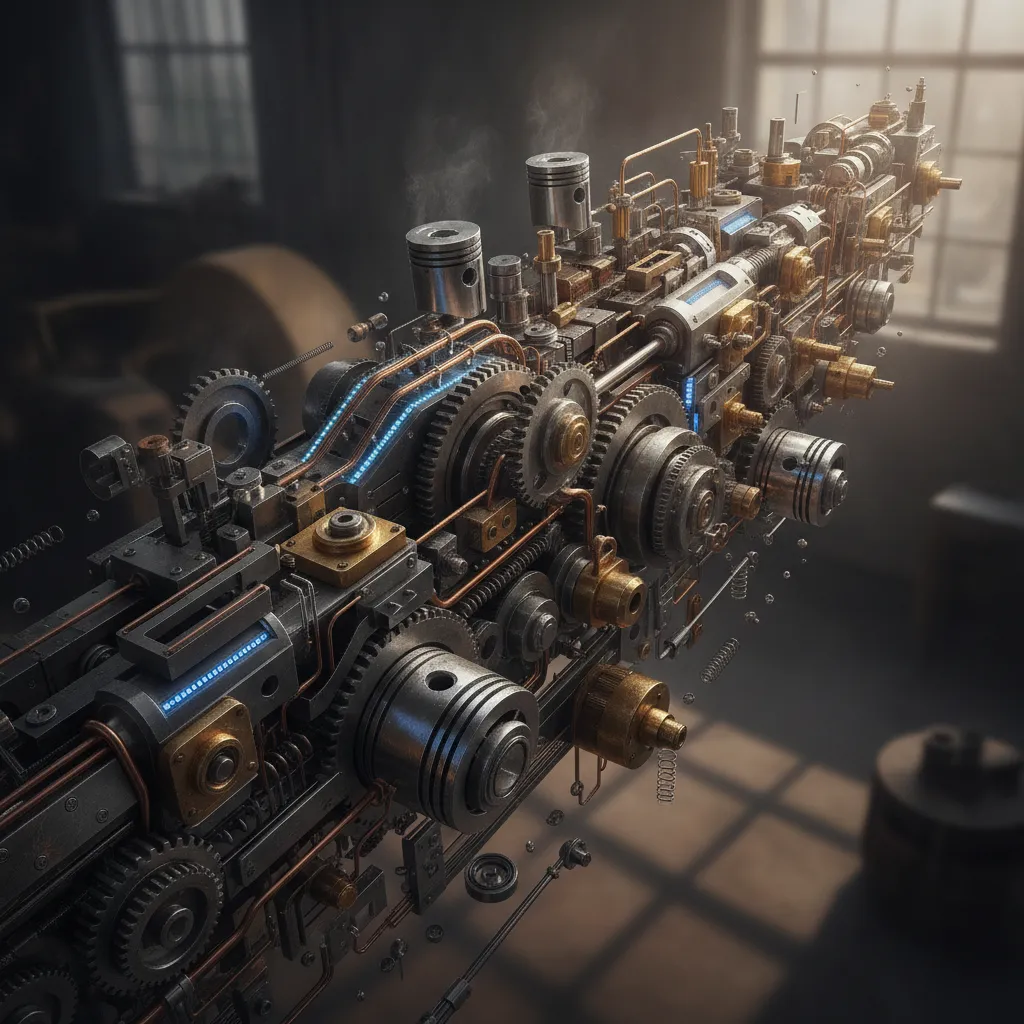
What Are Machine Parts and What Are the Main Types?
A machine part is a discrete component that performs one specific mechanical function within a larger assembly, distinct from sub-systems or complete assemblies.
That distinction matters in practice. A gearbox is an assembly. The individual gears, shafts, seals, and bearings inside it are machine parts. Each part can be specified, sourced, inspected, and replaced independently. Sub-systems cannot.
Indispensable Components for Industrial Manufacturing
Machine parts fall into three core categories:
- Structural elements, frames, housings, bases, and brackets that carry and distribute load without moving
- Mechanical elements, gears, bearings, shafts, couplings, and springs that transmit force or control motion
- Fasteners and connectors, bolts, pins, and keys that join components and maintain alignment under load
Among these, bearings, gears, shafts, and seals account for the majority of unplanned machine downtime when they fail. These four component families are the first places maintenance engineers look when a machine stops performing to spec. For a broad catalog of available components, MachineToolProducts.com offers an extensive range of machine parts organized by type and application.
Complex assemblies such as couplings and ball bearings also qualify as machine parts because they function as the smallest construction unit that fulfills a single defined purpose.
“The reliability of any mechanical system ultimately depends on the precision and quality of its individual components — a single undersized bearing or mismatched fastener can cascade into full system failure.” — Dr. Robert C. Juvinall, Professor of Mechanical Engineering, University of Michigan
Machine Part Standards You Should Know: ISO and DIN
ISO and DIN are the two dominant standards bodies governing machine part dimensions, tolerances, and material grades across global manufacturing.
ISO 286 defines the system of fits and tolerances that determines whether a shaft and bore will form a clearance, transition, or interference fit. DIN 931 specifies the geometry and thread pitch for partially threaded hex bolts. Both standards exist so that machine parts from different suppliers remain interchangeable, but only when the correct grade and tolerance class are matched. A Grade 8.8 bolt is not interchangeable with a Grade 10.9 bolt, even if the thread dimensions are identical.
Specifying the wrong tolerance class is one of the most common and costly sourcing errors in precision manufacturing. Always confirm both the nominal dimension and the ISO or DIN grade before ordering replacement machine parts.
How Structural and Mechanical Elements Differ in Machine Design
Structural elements bear load; mechanical elements move force, and every machine part belongs to one category, though both must work as one system.
What Role Do Structural Elements Play Versus Mechanical Elements?
Structural elements hold a machine’s shape under static and dynamic loads without converting motion. Frames, columns, beds, and housings, typically cast from gray iron or built from welded steel, absorb vibration and resist deflection so that moving parts stay in alignment.
Mechanical elements transmit, convert, or control motion and force. A gear pair, for example, converts input torque and shaft speed into a different output ratio. A rolling-element bearing reduces friction between a rotating shaft and its housing, allowing continuous rotation with minimal energy loss.
Material selection reflects each role. Structural parts prioritize stiffness and damping, cast iron and steel weldments excel here. Mechanical parts prioritize hardness, fatigue resistance, and surface finish, which is why engineers specify alloy steels and case-hardened surfaces for gears, shafts, and bearing races.
How Machine Parts Work Together as a System
Neither category functions independently. A shaft misaligned by just 0.1 mm can increase bearing wear by up to 50%, which shows directly how structural rigidity determines mechanical element lifespan.
A conveyor system makes this concrete. The welded steel frame holds every component in fixed position, that is its only job. The drive shaft, sprockets, and bearings then move product down the line. Remove structural precision, and the mechanical elements fail prematurely regardless of their own quality. Suppliers such as JW Winco offer standardized machine parts designed to work within precisely defined system tolerances.
“In mechanical design, no part exists in isolation. The performance envelope of every component is defined by the system it operates within — tolerances, loads, and environmental conditions must all be considered together.” — Shigley, J.E. & Mischke, C.R., Authors of Mechanical Engineering Design, McGraw-Hill
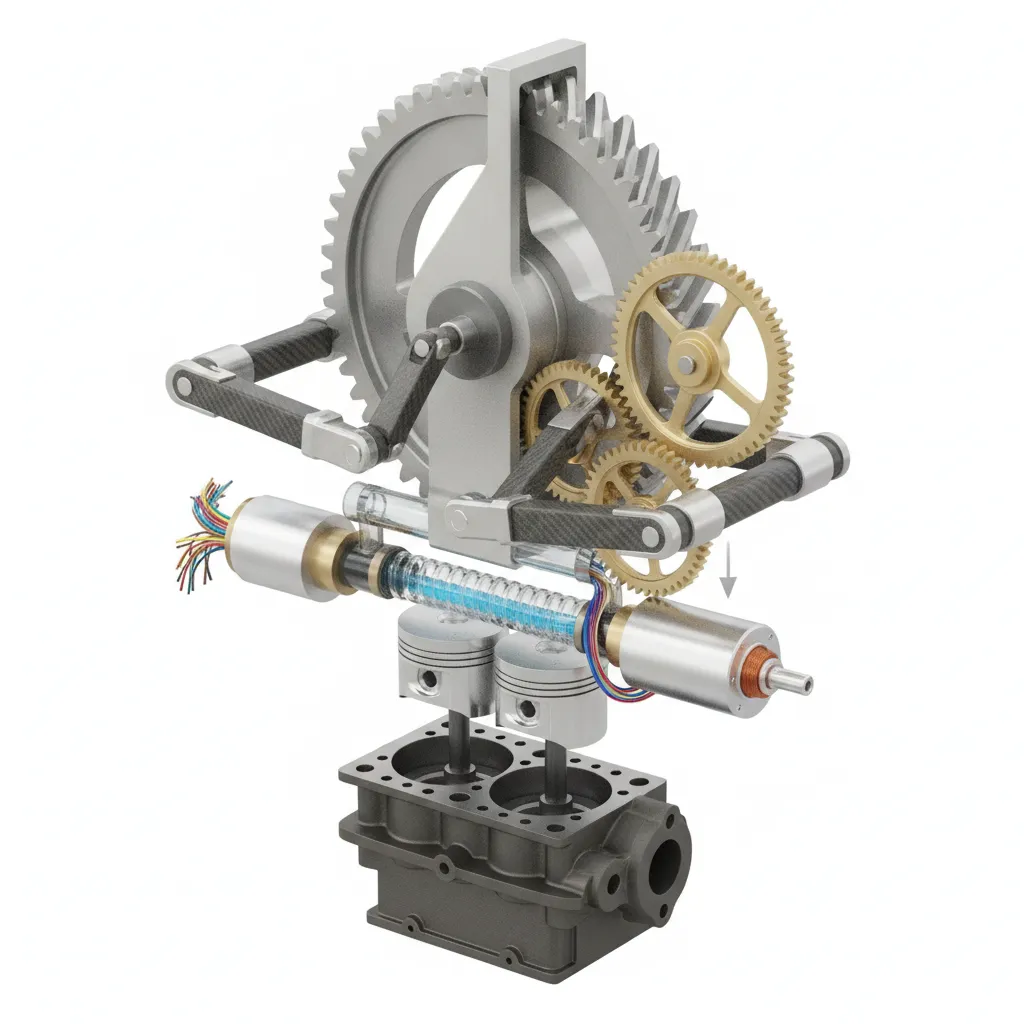
How to Select the Right Machine Part for Your Equipment
Select machine parts by defining load, speed, and environment first, those three variables eliminate most catalog mismatches before you review a single datasheet.
Start with operating load. Distinguish between static load (constant force, like a clamped fixture) and dynamic load (cycling force, like a rotating shaft under bending). Then confirm your RPM range and duty cycle, a bearing rated for 3,000 RPM at 40% duty cycle will fail prematurely running continuous shifts at 2,800 RPM. Nail these three numbers before opening any supplier catalog.
How Machine Parts Differ Across Automotive, Industrial, and Packaging Applications
Application type shapes every material and geometry decision. Automotive machine parts face high-cycle fatigue and thermal cycling, engine components may see 10,000+ heat cycles annually, so alloy steels with controlled heat treatment are standard. Industrial machinery parts prioritize load capacity and contamination resistance; sealed bearings and hardened guideways are common choices in heavy fabrication environments. Packaging machinery parts add a third constraint: food-safe materials (FDA-compliant polymers, 316L stainless steel) and fast changeover design, because downtime on a packaging line costs more per minute than the part itself.
Compatibility and Interchangeability Standards for Machine Parts
ISO metric fits govern how a shaft seats in a bore. An H7/p6 fit produces an interference (press) fit; H7/k6 produces a transition fit. Choosing the wrong tolerance class either leaves a loose assembly that vibrates apart or creates a press fit impossible to achieve without specialized tooling, both outcomes mean scrapped parts and unplanned downtime. For a deeper technical reference on how these standards are defined, the Wikipedia article on machine elements provides a useful overview of classification systems used across the industry.
Material pairing matters just as much as dimensional tolerances. Stainless steel fasteners threaded into aluminum housings in wet environments create a galvanic cell, aluminum corrodes preferentially. Specify compatible material pairings or apply an isolating coating such as Teflon-based thread sealant or anodized bore surfaces.
Before placing any order, work through this checklist in sequence:
- Load rating, static and dynamic, in Newtons or lbf
- Speed/RPM, peak and continuous operating range
- Operating environment, temperature range, moisture exposure, chemical contact
- Dimensional standard, ISO, DIN, or ANSI, with tolerance class specified
- Supplier lead time and stock availability, a perfect part on a 16-week lead time may require a qualified alternative
OEM vs. Aftermarket Machine Parts: Key Differences and Cost Considerations
OEM parts guarantee specification compliance and preserve warranties, but cost 20–40% more, aftermarket quality varies enough to make supplier selection the real decision.
OEM machine parts are manufactured to the original equipment maker’s exact specification, often by the same supplier that built the machine. That precision comes at a price premium, and the trade-off is straightforward: you pay more, but the part fits perfectly and keeps your manufacturer warranty intact.
Aftermarket parts are produced by third-party manufacturers designed to match OEM specs. Quality ranges widely across that category. Tier-1 aftermarket suppliers, SKF and NSK for bearings are the standard example, routinely match OEM quality at lower cost. Low-cost imports, by contrast, may not meet tolerance specifications, and the difference rarely shows up until a component fails mid-run.
Cost-Benefit Analysis: OEM vs. Aftermarket ROI
The right choice depends on where the part sits in your machine’s failure hierarchy. For high-criticality components, main spindle bearings, hydraulic seals on presses, OEM or tier-1 aftermarket is the justified call. Unplanned downtime on a production line costs far more than the price difference between suppliers.
For low-criticality consumables like standard fasteners and wear pads, generic aftermarket reduces cost without meaningful risk. Applying the same OEM-only rule across every part category is where procurement budgets get wasted.
One firm boundary: using non-OEM parts on equipment still under manufacturer warranty can void that coverage. Confirm with the OEM before switching suppliers on any machine inside its warranty period.
How to Ensure Compatibility When Switching Suppliers
Always verify part number cross-references, dimensional drawings, and material certifications before substituting any component. A 0.02 mm difference in bearing inner diameter, well within the variation between a tier-1 and a low-cost import, is enough to cause premature failure under load.
Request full material certifications and inspection reports from any new supplier. A manufacturer that can’t produce dimensional drawings on request is a supplier worth avoiding.
“Procurement decisions on critical machine parts should never be driven by unit price alone. The true cost of a component includes installation labor, downtime risk, and the downstream consequences of premature failure.” — Terry Wireman, Author of Maintenance Management and Regulatory Compliance Strategies
How to Maintain Machine Parts and Prevent Common Failures
Most machine part failures are predictable, and preventable, with the right inspection intervals, lubrication practices, and alignment checks.
Most Common Machine Part Failures and How to Troubleshoot Them
Four failure modes account for the majority of unplanned downtime in mechanical systems: bearing fatigue (spalling), gear tooth wear, shaft misalignment, and seal degradation. Each produces a distinct symptom pattern that points to the root cause before a part fails completely.
- Bearing spalling, produces a rough, crackling noise that increases with shaft speed. Run your hand along the bearing housing; abnormal heat indicates overloading or lubrication failure, not just wear.
- Gear tooth wear, presents as rhythmic noise locked to shaft RPM. Use a stethoscope or vibration analyzer to isolate the source before disassembly; pitting on tooth flanks confirms the diagnosis visually.
- Shaft misalignment, generates high-frequency vibration and accelerated coupling wear. Laser alignment tools detect misalignment to within 0.001 mm and pay back their cost in extended bearing and coupling life within months of first use.
- Seal degradation, shows as weeping or active leakage, often accompanied by oil contamination in adjacent components. Replace seals at the first sign of weeping, not after a visible drip develops.
Lubrication is the single highest-impact maintenance action across all four categories, 80% of bearing failures trace back to lubrication problems, whether insufficient grease, wrong grade, or contaminated supply.
Maintenance Schedules for Different Machine Parts
Consistent intervals, not reactive repairs, are what extend the service life of machine parts across a production environment.
| Part Type | Task | Interval |
|---|---|---|
| Bearings (deep groove ball, light duty) | Re-grease | Every 2,000 operating hours |
| Fasteners | Torque check | Every 500 hours or after any vibration event |
| Seals | Leakage inspection | Monthly; replace at first sign of weeping |
| Gears | Oil analysis | Every 1,000 hours |
| Gears | Visual inspection for pitting | Every 3,000 hours |
| Shafts and couplings | Alignment check | At installation and after every major repair |
Treat oil analysis results as leading indicators, not lagging ones, particle counts rising between the 1,000-hour samples tell you a gear is degrading weeks before noise or vibration becomes obvious.
Frequently Asked Questions
What machine part standards should I reference when ordering replacement parts?
Reference ISO, DIN, or ANSI standards depending on your machine’s origin and your region’s manufacturing norms. ISO standards apply broadly across international supply chains, while DIN governs German-engineered equipment and ANSI covers North American specifications. Always cross-check the original equipment manufacturer’s (OEM) documentation first, it will specify the applicable standard, tolerance class, and material grade. Ordering outside the specified standard, even by a small dimensional margin, can cause fit failures or accelerated wear in precision assemblies.
Can I mix metric and imperial machine parts in the same assembly?
Mixing metric and imperial parts in the same assembly is possible but carries real risk of thread stripping, misalignment, and premature failure. Fastener threads are not interchangeable, an M10 bolt and a 3/8-inch bolt are close in diameter but have different thread pitches. If your design requires both systems, use adapter fittings rated for the load and document every interface clearly. Most precision manufacturers recommend standardizing on one system per assembly to reduce maintenance errors.
How do I know when a machine part needs replacement versus repair?
Replace a part when dimensional wear exceeds the OEM’s tolerance band or when a crack, spall, or fatigue fracture is confirmed, repair rarely restores original mechanical properties in those cases. Repair is viable for surface damage like minor scoring or corrosion where material can be added back through welding, plating, or grinding without compromising the base geometry. A practical rule: if the cost of repair exceeds 60% of a new part’s cost, replacement is usually the better economic choice.
What materials are most common for machine parts in high-temperature environments?
Inconel alloys, titanium, and tool steels such as H13 are the most common choices for machine parts operating above 500°C. Inconel 625 and 718 retain tensile strength at temperatures where standard stainless steel softens significantly. For moderate heat ranges (200–500°C), hardened alloy steels with thermal barrier coatings perform well at lower cost. Ceramic components are used in extreme cases, above 1,000°C, where metals lose structural integrity entirely.
Where can I source standardized machine parts for industrial equipment?
Standardized machine parts are available through specialist industrial distributors, OEM spare parts programs, and online catalogs. For off-the-shelf components such as bearings, fasteners, shafts, and couplings, suppliers like JW Winco and MachineToolProducts.com maintain broad inventories organized by standard and specification. Always confirm that catalog parts match your required ISO, DIN, or ANSI tolerance class before ordering, and request material certifications for any safety-critical components.
Conclusion
this approach are not interchangeable commodities, material selection, dimensional tolerancing, and manufacturing process each determine whether a component performs for five years or five months. The clearest takeaway from this guide: specify your operating environment first, then select material and process, not the other way around. Second, standardize on one measurement system per assembly and document every interface to prevent costly maintenance errors downstream.
As a concrete next step, pull the OEM documentation for your highest-wear component, confirm its applicable standard (ISO, DIN, or ANSI), and request a material certification with your next order. That single habit closes the gap between a part that fits on paper and one that performs under load.
Recommended Articles
Explore more from our content library:
