

Custom metal work is the process of designing and fabricating metal components, structures, or decorative pieces built to a client’s exact specifications, rather than pulled from a standard catalog. It covers everything from structural steel frames and industrial brackets to handcrafted gates, furniture, and signage. The right fabrication method, material, and shop depend on your project’s load requirements, finish expectations, and budget.
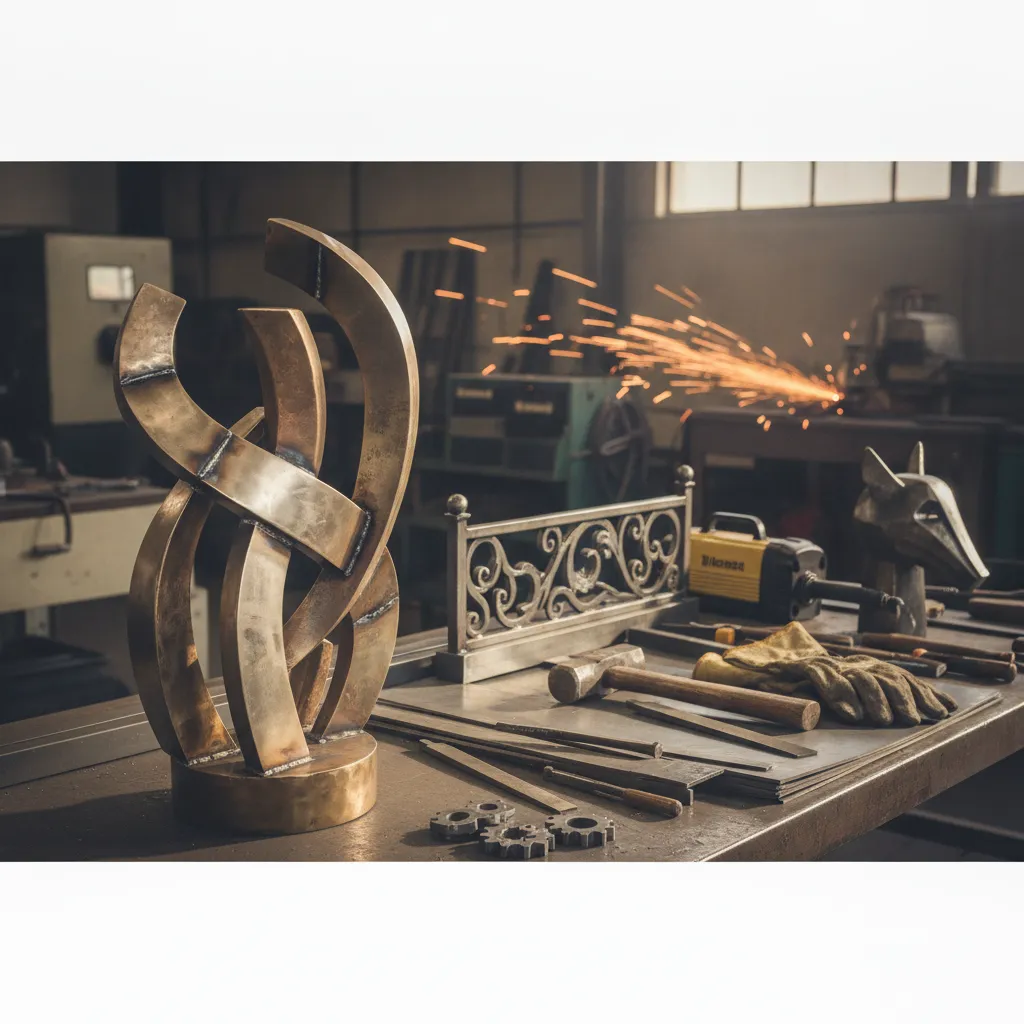
What Custom Metal Work Is and the Projects It Covers
Spec-driven fabrication means every dimension, alloy, and surface finish is chosen for a specific end use, not pulled from a stock catalog. That is the defining characteristic of bespoke metalwork.
That distinction matters in practice. A standard steel bracket ships in fixed sizes with generic tolerances. A custom bracket is drawn to your load spec, cut to your exact hole pattern, and finished to match your assembly environment, whether that’s a powder-coated interior fixture or a hot-dip galvanized outdoor mount.
Custom work spans both one-off orders and small production runs, which means it serves individual homeowners, architects specifying a building’s facade, and industrial buyers sourcing precision tooling, often from the same shop. According to Quality Metal Works, the ability to serve both residential and industrial clients from a single facility is one of the hallmarks of a full-service fabrication shop.
Examples of Custom Metal Work Projects and Transformations
Project categories break into four broad groups: structural components (frames, brackets, staircases, catwalks), architectural elements (gates, railings, canopies, curtain wall supports), decorative and artistic pieces (wall art, furniture, branded signage), and industrial parts (enclosures, machine guards, fixtures, and tooling).
A few concrete transformations show what that means on the shop floor:
- Flat plate stock → branded exterior sign. A 4 × 8 ft sheet of 12-gauge mild steel is laser-cut to a logo profile, deburred, and powder-coated in a brand-specified RAL color before mounting to a building facade.
- Raw steel tube → custom staircase railing. Square HSS tubing is cut, mitered, and welded to an architect’s drawing, then ground smooth and finished with a satin clear coat.
- Billet aluminum → precision machine fixture. A solid aluminum block is CNC-machined to ±0.005 in. tolerances, producing a repeatable holding fixture for a production line.
What Makes Handcrafted Metal Work Different from Mass-Produced Alternatives
Mass-produced metal parts are designed for the broadest possible application, tolerances are loose, finishes are generic, and geometry is fixed. Bespoke fabrication inverts that logic entirely.
Four factors separate bespoke fabrication from off-the-shelf alternatives:
- Tighter tolerances. A custom CNC-machined part can hold ±0.001 in.; a catalog stamping may only guarantee ±0.015 in.
- One-off tooling. Fixtures, jigs, and forming dies are built specifically for the part, not adapted from a universal setup.
- Direct client collaboration. The fabricator works from your drawings or co-develops them, material grade, wall thickness, and finish are all negotiated before a single cut is made.
- Finish quality control. Surface treatment, whether electroplating, anodizing, or hand-applied patina, is specified per part, not applied as a blanket production default.
That level of control is what makes custom metal work the default choice when fit, function, or appearance cannot be compromised.
“Precision fabrication is not just about cutting metal to size — it’s about understanding the end-use environment so thoroughly that every material and process decision serves the finished part’s performance.” — James Thornton, Senior Fabrication Engineer, American Welding Society
How Different Metal Fabrication Methods Compare for Custom Projects
No single fabrication method suits every project. CNC machining, welding, and laser cutting each solve a different problem.
CNC Machining, Manual Welding, and Laser Cutting: Key Differences
CNC machining removes material from a solid block using computer-controlled cutting tools. It excels when tolerances must be tighter than ±0.005 inches, think hydraulic fittings, aerospace brackets, or any part where dimensional variation causes assembly failure. The tradeoff is setup time: programming a new part takes hours, so CNC machining pays off most on repeat runs of 10 or more identical pieces.
Manual welding joins metal sections using heat and filler material. It handles complex three-dimensional geometry that no machine can replicate in a single operation, and it’s the right choice when joints must carry structural load. A fabricator can weld a custom staircase railing or a load-bearing equipment frame in configurations no CNC tool path could reach.
Laser cutting uses a focused beam to slice through flat sheet metal with clean, burr-free edges. It wins on intricate 2D shapes, decorative panels, gaskets, mounting plates, in material under 1 inch thick. Cycle times are fast, and the cut quality rarely needs secondary finishing.
Two supporting methods fill gaps the three above leave. Plasma cutting handles thicker plate (often 1–3 inches) where laser power falls short. Press-brake forming bends laser-cut or plasma-cut blanks into channels, brackets, and enclosures, it’s almost always the next step after flat cutting.
Which Fabrication Method Fits Your Project Type
Most real custom projects combine two or more methods. A typical enclosure starts as a laser-cut blank, moves to a press brake for bending, and finishes at a welding station for corner joints. Treating these as separate choices misses how fabrication shops actually sequence work.
Method choice also drives cost and lead time directly. CNC machining carries higher per-part cost but tighter tolerances; laser cutting is faster and cheaper for flat profiles but can’t produce three-dimensional geometry alone. The pricing section below breaks down what each method adds to a typical project budget.
How to Choose the Right Metal Material for Your Application
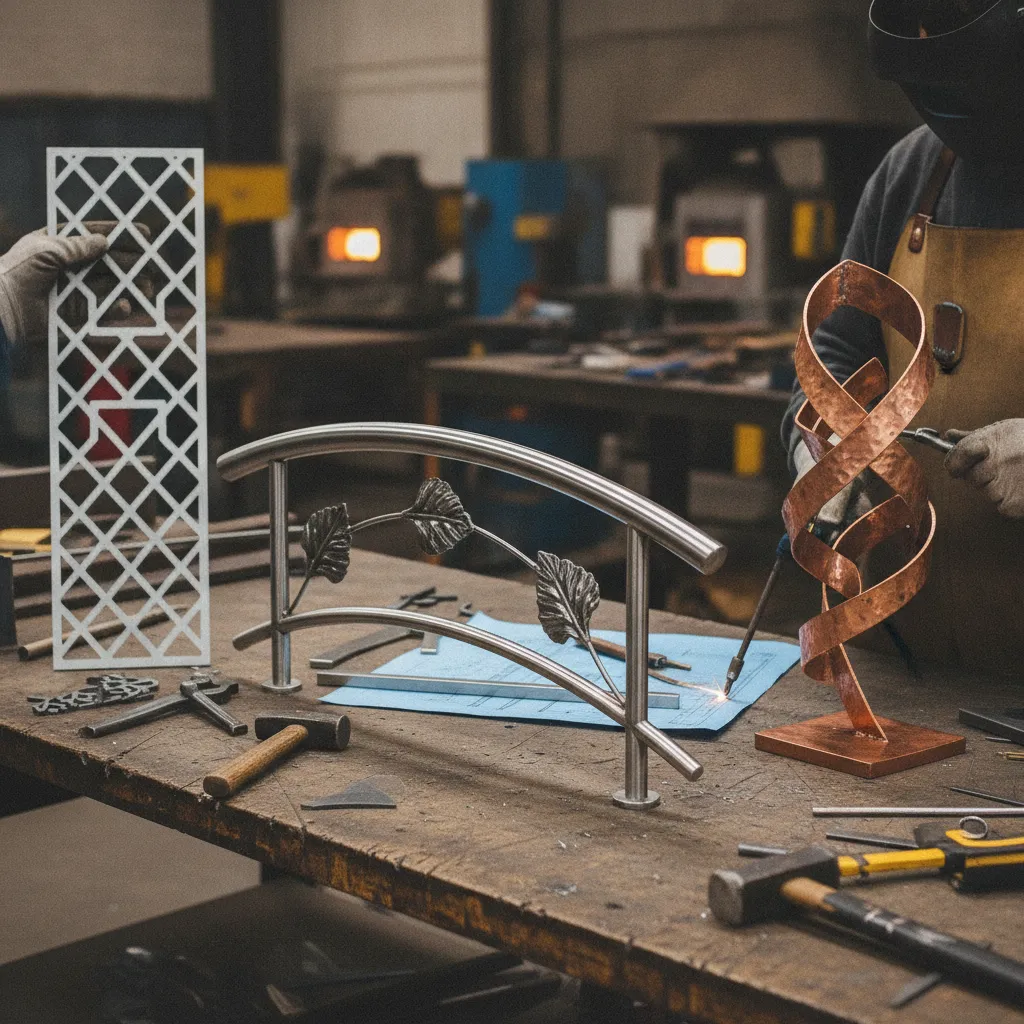
Material selection in metal fabrication comes down to four factors: environment, load requirements, budget, and the finish you need.
Aluminum vs. Steel vs. Stainless Steel: When to Use Each
Mild steel (carbon steel) costs the least per pound and handles high structural loads well, but it rusts without a protective coating. It is the right call for indoor structural frames, brackets, and any part that will receive a painted or powder-coated finish.
Stainless steel costs more, roughly 3 to 5 times the price of mild steel by weight, but resists corrosion without any surface treatment. Use it for exterior railings, marine hardware, and food-service equipment. A food-service countertop requires 304-grade stainless steel at minimum; that grade meets FDA and NSF surface standards for direct food contact.
Aluminum weighs approximately one-third as much as steel, machines faster, and resists corrosion naturally. It is the preferred material for weight-sensitive assemblies, electronic enclosures, and parts that will receive an anodized finish. The trade-off is weldability, aluminum requires a TIG process and skilled operators, while mild steel tolerates MIG welding with less preparation.
The table below summarizes the four key decision axes:
| Metal | Relative Cost | Weight | Corrosion Resistance | Weldability |
|---|---|---|---|---|
| Mild Steel | Lowest | High | Poor (needs coating) | Easiest |
| Stainless Steel | Highest | High | Excellent | Moderate |
| Aluminum | Mid-range | ~⅓ of steel | Good | Requires TIG |
For specialty applications, copper and brass suit decorative accents and electrical components where conductivity matters. Corten steel, a weathering-steel alloy, develops a stable rust-like patina that makes it popular for architectural facades and outdoor sculpture, eliminating the need for paint.
Two concrete examples illustrate the stakes of getting this right. An outdoor gate built from bare mild steel will show surface rust within one season in a humid climate; stainless steel or powder-coated mild steel are the correct choices. A food-service countertop fabricated from anything below 304 stainless will fail a health inspection.
Material choice also locks in your finishing options before fabrication begins. Anodizing only bonds to aluminum. Hot-dip galvanizing requires a steel substrate. Electropolishing is standard for stainless. Selecting the wrong base metal late in the design process means scrapping parts and restarting, a cost no production schedule absorbs easily.
“Material selection is the single decision that cascades into every downstream fabrication and finishing step. Get it wrong early and you pay for it at every stage.” — Dr. Linda Okafor, Materials Science Department, Massachusetts Institute of Technology
How Much Custom Metal Work Costs and What Drives the Price
Pricing for custom fabricated metalwork ranges from under $100 for simple laser-cut pieces to $5,000+ for structural commercial fabrication, depending on five key variables.
What Factors Influence the Cost of a Custom Metal Work Project
Five variables determine almost every quote you’ll receive from a fabricator.
- Material type and weight. Stainless steel and aluminum cost more per pound than mild steel. Exotic alloys like titanium or Inconel can multiply raw material costs by 5–10x.
- Fabrication method and machine time. CNC laser cutting and waterjet carry setup fees that make small runs expensive per unit. Press-brake forming and TIG welding are billed by the hour, typically $75–$150/hr at most job shops.
- Design complexity. A flat laser-cut part and a part with 10 bends from the same sheet weigh the same, but the bent part requires significantly more press-brake time, fixturing, and operator attention. Complexity multiplies labor cost faster than material cost.
- Surface finishing. Raw steel ships cheapest. Powder coating adds roughly $1–$3 per square foot but extends outdoor part life by 10–15 years compared to bare metal, making it cost-effective for exterior applications. Paint and polishing sit between those two extremes.
- Order quantity. One-off prototypes carry full setup cost on a single part. A batch of 50 identical parts spreads that setup cost across the run, often cutting per-unit price by 30–60%.
Ballpark ranges help anchor expectations before you call anyone. Simple laser-cut steel signs start around $50–$200. Custom railings typically run $150–$400 per linear foot installed. Structural steel fabrication for commercial projects often carries a $2,000–$5,000 project minimum.
For decorative and artistic metalwork, studios such as Custom Metal Worx offer handcrafted pieces made to client specifications, which can be a useful benchmark for pricing decorative commissions.
How to Estimate Your Budget Before Requesting a Quote
Vague requests produce vague, and often inflated, quotes. Fabricators price uncertainty into their estimates when they lack specifics.
Before contacting a shop, prepare four things: a dimensioned drawing or CAD file, your material and finish specification, your target quantity, and any load-bearing or compliance requirements (OSHA, AWS weld standards, or local building codes). A fabricator who receives all four can return an accurate number within 24–48 hours rather than a rough range with a 40% contingency baked in.
If you don’t have a CAD file, a hand sketch with dimensions and notes on paper is still far better than a verbal description alone.
What Timeline to Expect for a Custom Metal Work Order
A straightforward order typically ships in 2–3 weeks; a complex structural project with specialty finishing runs 6–10 weeks.
Lead Times to Expect at Each Stage of the Process
Custom metal projects move through four distinct stages, each with its own lead time. Understanding where delays occur at each stage lets buyers build realistic procurement schedules.
- Design and approval (1–5 business days): Simple parts with complete drawings clear review in one day. Complex assemblies with multiple revision rounds can consume the full five days. Incomplete drawings are the single most common cause of delays at this stage.
- Material procurement (1–10 business days): Standard carbon steel stock ships from service centers within one to two days. Specialty alloys, large-format plate, or tight-tolerance bar stock can add a full week or more, especially when mill back-orders are in play.
- Fabrication (1–6 weeks): Most custom parts, brackets, enclosures, machined components, complete fabrication in one to three weeks. Complex structural assemblies or architectural metalwork can run four to six weeks, particularly when weld inspection or first-article approval triggers revision cycles.
- Finishing and delivery (4–12 business days): Powder coating adds three to seven business days depending on finishing shop queue depth. Freight adds one to five days on top of that, based on whether the shipment moves by parcel carrier or flatbed freight.
Buyers on a hard deadline, an installation date, a construction milestone, or a product launch, should build a 20% schedule buffer into their procurement plan. A project estimated at five weeks should be ordered with a six-week window.
Rush production is available at most fabrication shops. Most can compress timelines by 30–50% by prioritizing the job in their queue, but expect a surcharge of 15–30% on the fabrication cost. Confirm rush terms in writing before committing, since finishing subcontractors and freight carriers apply their own surcharges independently.
Frequently Asked Questions
Can I order custom metal work as a one-off piece, or do fabricators require a minimum quantity?
Most fabricators accept single-piece orders, though unit pricing is higher without volume to offset setup costs. CNC machining and sheet metal shops routinely quote one-off prototypes, setup fees typically run $50–$300 depending on complexity. Cold forging and die-casting processes, by contrast, require tooling amortized across larger runs, often 500 to 5,000 pieces minimum. Always confirm minimum order quantities before submitting a request for quote.
What file format should I send to a custom metal fabricator, do I need a CAD drawing?
A 3D CAD file in STEP (.stp) or IGES (.igs) format is the standard for CNC machining and sheet metal work. DXF files work for 2D laser-cut profiles. If you have no CAD file, a detailed sketch with critical dimensions and tolerances lets a fabricator build one for you, expect a drafting fee of $75–$250 for simple parts. PDF drawings alone are rarely sufficient for production.
What surface finishes are available for custom metal work, and which holds up best outdoors?
Common finishes include powder coating, anodizing, electroplating, hot-dip galvanizing, and brushed or polished mechanical finishes. For outdoor exposure, hot-dip galvanizing and powder coating offer the strongest corrosion resistance, galvanized steel can last 50+ years in moderate environments according to the American Galvanizers Association. Anodizing suits aluminum well outdoors but is not recommended for steel. The right choice depends on the base metal, expected UV exposure, and aesthetic requirements.
Is custom metal work suitable for both residential and commercial projects?
Custom metal work serves both sectors, residential applications include staircases, gates, furniture frames, and decorative panels, while commercial projects cover structural supports, machinery guards, enclosures, and HVAC components. The fabrication process is the same; specifications, load ratings, and compliance requirements differ. Commercial work often demands documented material certifications and OSHA-compliant designs, so confirm those requirements with your fabricator before the project starts.
How do I verify that a metal fabricator meets industry quality standards?
Ask fabricators for documented certifications such as AWS D1.1 structural welding certification, ISO 9001 quality management registration, or AISC certification for structural steel fabrication. Reputable shops will provide material test reports (MTRs) and dimensional inspection records as standard deliverables. You can also verify welding certifications through the American Welding Society and review OSHA fabrication safety standards at OSHA.gov. Requesting a facility tour or sample part before committing to a full production run is also a sound practice.
Conclusion
Choosing the right custom metal work process comes down to three decisions: material selection based on load and environment, process selection based on volume and tolerance, and finish selection based on exposure and aesthetics. Getting those three aligned before you request a quote saves significant rework time and cost.
If you are sourcing fabricated parts at scale, request material certifications and dimensional inspection reports as standard deliverables, not optional add-ons. For your next step, prepare a STEP file and a one-page specification sheet listing your target material, critical tolerances, finish, and annual volume, then send that package to at least three fabricators to get comparable quotes.
Recommended Articles
Explore more from our content library:
