

Sheet metal stamping is a manufacturing process that uses dies and presses to cut, bend, and shape flat metal sheets into precise parts at high volume. A coil or blank of metal is fed into a stamping press, where tooling applies force to form the desired geometry in one or more strokes. It is widely used in automotive, aerospace, and electronics manufacturing because it delivers consistent, tight-tolerance parts at lower per-unit cost as production volumes scale.
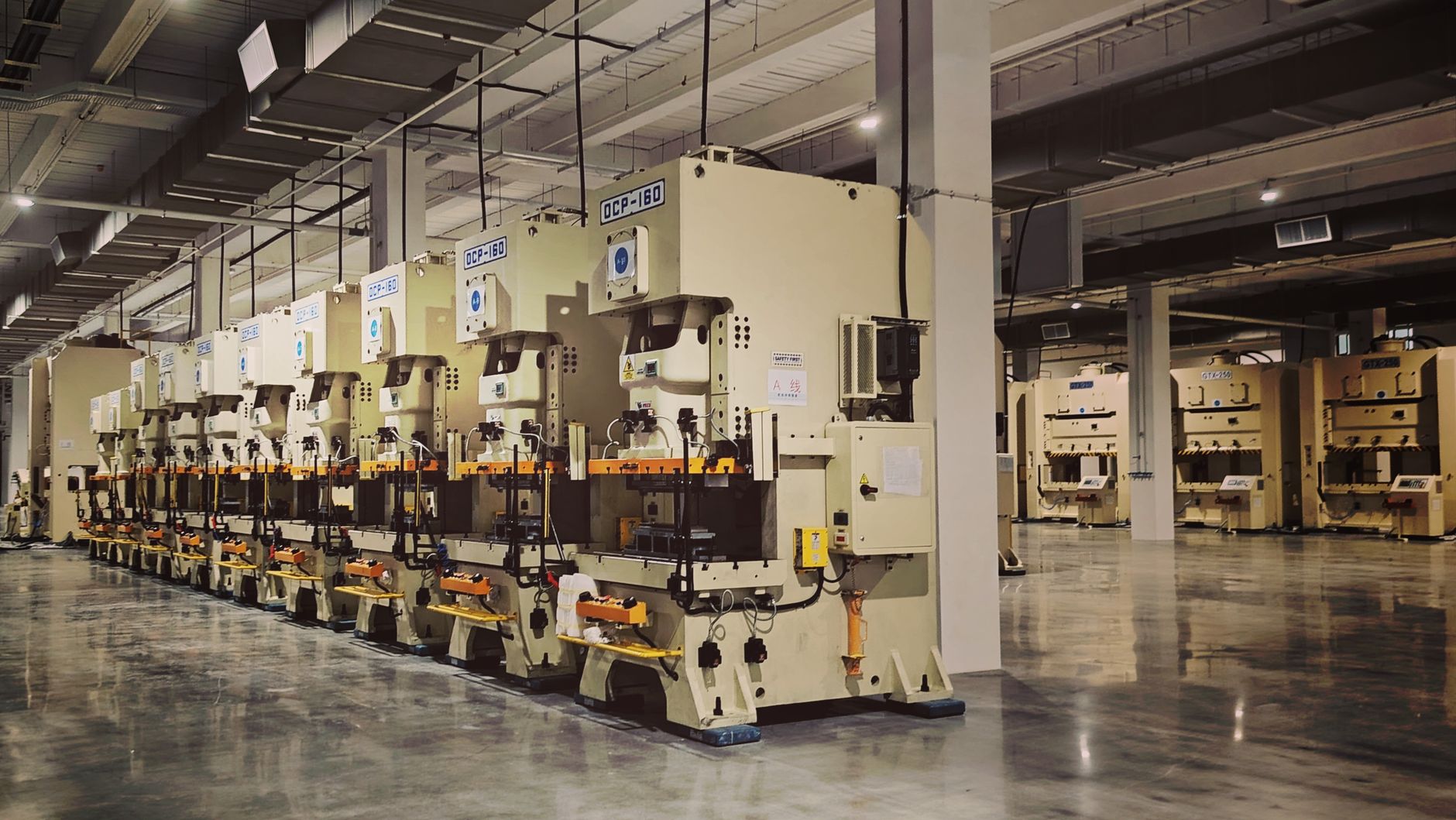
What Is Sheet Metal Stamping and How Does It Work?
Sheet metal stamping is a cold-forming process: a punch presses metal against a die at room temperature, shaping it without applied heat. For a detailed overview of the fundamentals, see What Is Metal Stamping? at ESI Engineering.
That distinction from hot-forming methods matters. Because the metal stays at ambient temperature, it work-hardens during forming, the grain structure compresses and realigns, increasing tensile strength without any secondary heat treatment. That built-in strength gain is a primary reason stamping is the preferred method for structural brackets, chassis components, and load-bearing hardware.
Hand-operated bench presses and simple punch sets can stamp thin-gauge sheet for prototypes or DIY projects, but precision and repeatability at production scale require industrial tooling with controlled, calibrated tonnage. A hobby press cannot hold the tolerances a stamped automotive bracket demands.
What happens inside the press during each stroke?
The press cycle follows a fixed sequence. A metal coil or pre-cut blank feeds into the die set and aligns to locating pins. The ram descends, driving the punch into the die cavity, this is where the metal deforms: it stretches, shears, bends, or draws depending on the die geometry. The ram retracts, and the finished part ejects downward or is stripped from the punch face. Scrap skeletons and slugs exit the press on a separate path.
Progressive dies complete multiple operations, blanking, piercing, bending, and drawing, across a series of stations in a single pass through the press. Each station performs one operation, so by the time the strip exits the final station, the part is complete. Single-stage dies, by contrast, perform one operation per stroke and require the operator to reposition or transfer the part between presses for subsequent operations.
Common stamping defects and how they form
Most defects trace back to three causes: incorrect die clearance, insufficient lubrication, or material variation. Burrs appear on sheared edges when die clearance is too large, leaving a ragged lip of metal that was pulled rather than cleanly cut. Springback occurs after bending, the metal partially recovers its original shape once press force releases, which is why dies are engineered to overbend by a calculated angle. Wrinkling and tearing are opposite failures: wrinkling happens when compressive stress exceeds the metal’s ability to flow smoothly, while tearing results from tensile stress that exceeds the material’s ductility, typically in deep-draw operations.
Catching these defects early depends on consistent incoming material specs and regular die maintenance, worn punch edges and contaminated lubricant are the most common root causes in production environments.
The Main Types of Sheet Metal Stamping Processes
Sheet metal stamping uses six primary techniques, blanking, piercing, bending, deep drawing, progressive, and transfer stamping, each suited to different part geometries and volumes.
What Are the Four Types of Metal Stamping?
Blanking cuts the outer profile of a part from flat sheet stock, producing a finished blank that becomes the workpiece for subsequent operations. The removed piece is the product; the surrounding material is scrap.
Piercing punches interior holes or slots into a blank. Unlike blanking, the punched-out slug is the waste and the sheet with holes is the part.
Bending forms the metal along a straight axis to create angles, channels, or flanges without removing material. A press brake or die set applies force until the metal deforms past its yield point and holds the new angle.
Deep drawing pulls flat sheet into a die cavity using a punch, forming enclosed shapes, cups, cans, housings, where the depth of the draw equals or exceeds the part’s diameter. Wall thickness remains largely consistent because the metal flows rather than stretches.
Fine blanking is a precision variant worth noting separately. It adds a counter-pressure plate and a V-ring that clamps the material before the punch descends, producing shear-cut edges with near-zero rollover and minimal burring, a functional requirement in gears, medical implants, and safety-critical brackets.
In progressive stamping, a metal strip advances through a sequence of stations inside a single die set, completing one or more operations per press stroke. The part stays connected to the carrier strip until the final station ejects it, making this method ideal for high-volume, small-to-medium components where cycle time and material yield are the dominant cost drivers.
In transfer stamping, individual blanks are separated first and then moved between separate die stations by mechanical fingers or transfer bars. This allows larger, more complex parts, ones that can’t stay on a carrier strip, to be repositioned or flipped between operations.
How Stamping Techniques Differ Across Automotive, Aerospace, and Medical Industries
Automotive body panels require large, deep draws over complex contours. Transfer dies and tandem press lines handle these parts because the blank size exceeds what a progressive strip can carry.
Aerospace brackets are typically small, tight-tolerance components produced in moderate volumes. Progressive dies suit them well, multiple features form in a single pass, reducing handling and maintaining dimensional consistency across long production runs.
Medical device components, surgical instrument housings, implant plates, connector shields, often specify fine blanking. Burr-free edges are a functional requirement, not just an aesthetic one, because sharp edges create contamination and assembly risks in sterile environments.

Sheet Metal Stamping vs. Other Manufacturing Methods
Sheet metal stamping outperforms CNC machining, injection molding, and 3D printing on per-part cost at high volumes, but each method holds clear advantages at lower volumes or for specific geometries.
Stamping vs. CNC machining: CNC removes material from a solid billet, which suits complex 3D geometries and low-volume runs where tooling investment is hard to justify. Stamping forms thin-walled flat or shaped parts far faster and at a lower per-part cost once tooling is amortized, but it cannot match CNC’s ability to cut deep pockets, threads, or tight-tolerance 3D profiles in a single setup.
Stamping vs. injection molding: Injection molding produces plastic parts with complex internal features in a single shot. When a design requires metal, for conductivity, tensile strength, or heat resistance, stamping is the natural answer. Material properties, not shape alone, drive that choice.
Stamping vs. 3D printing: Additive manufacturing requires no tooling, which makes it ideal for prototypes and low-volume complex geometries. Stamping cannot match that flexibility at small quantities. At production scale, though, stamping delivers far higher throughput and more consistent surface finish than any additive process currently available.
How do cost models vary by stamping technique and production volume?
Tooling is a fixed upfront investment, and at low volumes that cost sits heavily on each unit, placing stamping in a premium-tier position relative to CNC or 3D printing. As volume climbs, the tooling cost spreads across thousands or millions of parts, and stamping becomes budget-friendly per unit. For a broader look at how stamping services are scoped and priced by volume tier, Xometry’s Metal Stamping Services overview provides useful context.
Stamping also has honest geometric limits. It cannot produce thick-section 3D forms, internal undercuts, or very large structural components. Designs requiring those features belong with casting, forging, or CNC, not a stamping press.
Materials and Thicknesses Suited to Metal Stamping
Low-carbon steel, aluminum, stainless steel, copper, brass, and titanium all stamp well, each chosen based on mechanical, electrical, or environmental requirements.
How thick can you stamp sheet metal?
Sheet metal stamping handles stock from thin foil gauges up to several millimeters of structural plate. The upper limit is set by press tonnage and die strength, not by any inherent ceiling in the process itself.
Thicker stock demands significantly more forming force and accelerates die wear. Fabricators working with structural-grade plate typically specify higher-tonnage presses and schedule more frequent die maintenance to maintain dimensional accuracy.
Material ductility, measured as elongation percentage, determines how aggressively a blank can be drawn or bent before cracking. Higher elongation allows tighter bend radii and deeper draws. Low-carbon steel, for example, offers good elongation, which is why it remains a default choice for deep-draw applications such as automotive body panels.
Springback is a related concern. Harder alloys, high-strength steel and certain aluminum grades, return partially toward their original shape after bending. Tooling engineers compensate by overbending the die geometry or scheduling secondary sizing operations, making material selection a direct input to die design.
Which metals are best suited for different stamping applications?
Each material brings a distinct set of trade-offs:
- Low-carbon steel: High formability and low cost make it the most widely stamped metal across automotive and appliance manufacturing.
- Stainless steel: Corrosion resistance suits food-processing and medical hardware, but its work-hardening rate is harder on tooling and shortens die life.
- Aluminum alloys: The strength-to-weight ratio makes aluminum standard in aerospace and consumer electronics enclosures; formability varies by alloy series.
- Copper and brass: Electrical and thermal conductivity make these metals the default choice for connector pins, terminals, and heat-transfer components.
- Titanium: Aerospace-grade strength with excellent corrosion resistance, but titanium requires higher press tonnage and specialized tooling, raising per-part cost considerably.
When selecting a material, evaluate mechanical strength requirements, the corrosion environment, any conductivity needs, post-process compatibility (plating, anodizing, welding), and total production cost, including scrap rate driven by forming difficulty.
Tools, Equipment, and Quality Controls for Metal Stamping
Sheet metal stamping relies on two press types, precision-built dies, and layered inspection systems to produce accurate parts at volume.
What dies and tooling does metal stamping require?
Stamping presses fall into two categories. Mechanical presses use a flywheel to store and release energy at high speed, making them well-suited to progressive die operations where cycle time drives output. Hydraulic presses apply adjustable force throughout the entire stroke, which gives them an advantage in deep drawing and when working thicker or harder materials that need sustained, controlled pressure.
Die construction determines both part accuracy and tool longevity. A standard die assembly combines the following components:
- Punch: The male tool that contacts and deforms the metal blank on each press stroke.
- Die plate: The female cavity that receives the punch and defines the finished part geometry.
- Stripper plate: Releases the blank from the punch face after each stroke, preventing the part from lifting with the ram.
- Guide pillars: Keep the punch and die plate in precise alignment throughout the stroke, maintaining dimensional accuracy across the production run.
Die material is chosen based on production volume and the abrasiveness of the stamped metal. Tool steel handles most mid-volume applications, while carbide inserts extend tool life significantly in high-volume or abrasive-material runs. Harder materials cost more upfront but reduce per-part tooling cost over long production runs.
How are tight tolerances maintained in stamping production?
Four mechanisms work together to hold dimensions. Precision-ground die components set the baseline. Consistent lubrication reduces friction and heat buildup that would otherwise cause dimensional drift. Controlled blank-holding force prevents wrinkling in deep-drawn parts and tearing at tight radii. In-die sensors detect mis-feeds and stop the press before a bad stroke completes.
Common defects each have a traceable root cause. Burrs form when die clearance wears beyond tolerance, the fix is regrinding or replacing the die edge. Springback occurs when the metal rebounds after bending; engineers compensate by overbending the part beyond the target angle. Wrinkling in deep-drawn shells points to insufficient blank-holder pressure. Cracking signals that the material’s ductility limit has been exceeded or the bend radius is too tight for the alloy.
Statistical process control (SPC) monitors dimensional measurements across a production run and flags drift before it generates scrap. First-article inspection (FAI) validates that the initial parts from a new or modified die meet every drawing specification before full production begins, catching die-alignment or setup errors at the lowest possible cost.

Frequently Asked Questions
How do I stamp sheet metal at home?
Basic home sheet metal stamping uses a bench vise, hand stamps, and a steel block to press simple shapes or markings into soft metals like aluminum or copper. You can buy letter and design stamps from metalworking suppliers and strike them with a hammer against annealed sheet stock. This approach suits decorative work and small hobby projects. It cannot replicate the dimensional accuracy, repeatability, or forming complexity that industrial stamping presses and hardened tool-steel dies produce. For a step-by-step walkthrough of a DIY approach, see this DIY Metal Stamping guide on Instructables.
What is the difference between stamping and pressing in metal fabrication?
Stamping and pressing describe the same fundamental process, a press drives a die into sheet metal to form a shape, but “stamping” typically implies a complete production workflow that may combine blanking, punching, bending, and drawing in a single or progressive die setup. “Pressing” is the broader mechanical action. In practice, fabricators use both terms interchangeably, though stamping more often signals a high-volume, die-based production context.
How does production volume affect which stamping process is right for my part?
Low volumes favor soft tooling or single-station dies because upfront tooling cost stays manageable; high volumes justify progressive or transfer dies that amortize tooling expense across thousands or millions of parts. As a general rule, progressive die stamping becomes cost-effective once run quantities reach the tens of thousands. For prototype or short-run work, laser cutting or fine blanking with soft dies often delivers better economics than investing in hardened progressive tooling.
What tolerances can sheet metal stamping reliably achieve?
Well-maintained stamping dies on a calibrated press can hold linear tolerances in the range of ±0.1 mm to ±0.25 mm for most production parts, with fine blanking capable of tighter results on critical edges. Actual achievable tolerance depends on material thickness, die condition, press tonnage consistency, and part geometry. Complex draws or thin-gauge materials narrow the process window, so tolerance targets should be confirmed with your tooling engineer before die design is finalized.
What surface finishing options are available after sheet metal stamping?
Stamped parts commonly receive secondary finishing to improve corrosion resistance, appearance, or functional performance. Typical options include zinc or nickel electroplating for corrosion protection, powder coating or wet painting for color and surface durability, anodizing for aluminum components, and passivation for stainless steel parts. Deburring, either vibratory or manual, is often performed before finishing to remove any residual edge sharpness. The choice of finish depends on the end-use environment, regulatory requirements, and whether the part must mate with other components in a tight assembly.
Conclusion
Sheet metal stamping rewards early investment in three decisions: choosing the right process type for your geometry, selecting a material whose formability matches your draw depth and tolerance targets, and designing for the die from the start, not as an afterthought. Getting those three things right cuts tooling iterations and scrap rates before a single production part ships.
If you are moving a part from design to production, start by requesting a Design for Manufacturability review from your fabrication partner. Bring your CAD file, target tolerances, and projected annual volume, those three inputs let a tooling engineer recommend the correct die type and flag formability risks before you commit to tooling spend.
Recommended Articles
Explore more from our content library:
