
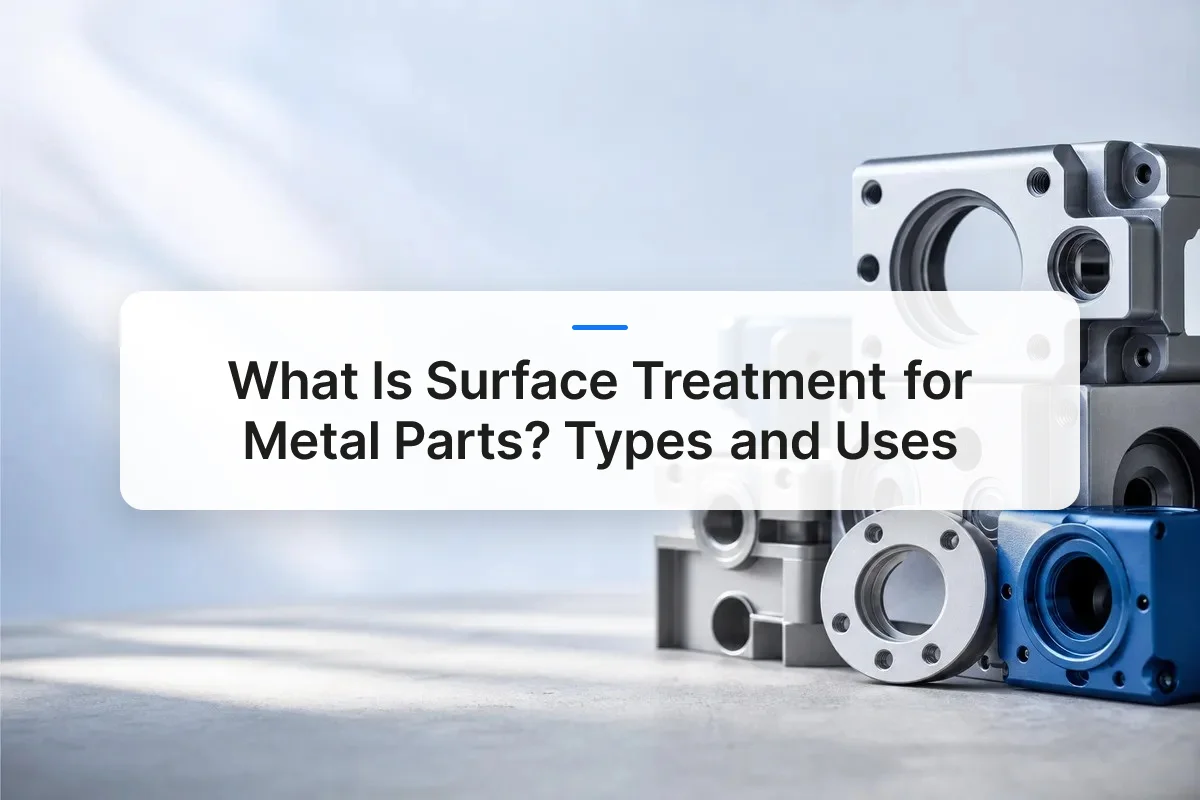
Understanding surface treatment metal parts is essential. Surface treatment for metal parts is any process applied to a component’s exterior to change its properties without altering the base material’s bulk characteristics, improving corrosion resistance, wear resistance, appearance, or adhesion for coatings. Common methods include electroplating, anodizing, passivation, powder coating, and mechanical finishes like sandblasting or polishing. In precision manufacturing, the right treatment extends part lifespan, meets industry specifications (automotive, aerospace, medical), and prevents costly field failures caused by corrosion or wear.
What Is Surface Treatment for Metal Parts and Why Does It Matter in Precision Manufacturing?
Surface treatment for metal parts covers any post-machining process that modifies a component’s exterior layer, chemically, mechanically, or electrochemically, while leaving the base material’s bulk properties untouched.
A machined bracket or a forged bracket both leave their forming process with a surface that is functionally raw. It may have microscopic tool marks, exposed grain boundaries, or an oxide layer that formed the moment hot metal met air. None of that is a defect exactly, it is just untreated metal, and untreated metal has a shelf life. Surface treatment closes that gap between “correctly shaped part” and “part that survives its intended service life.”
How Do Surface Treatments Improve Product Quality and Performance in Industrial Applications?
Most treatments work through one of three mechanisms: building a barrier layer, changing surface hardness, or altering surface energy so coatings bond properly.
A barrier layer, like the chromium oxide film formed during passivation, or a zinc coating applied by electroplating, physically blocks moisture and oxygen from reaching the base metal, which is what actually causes corrosion. Hardness-focused treatments change the outer few microns of a part so it resists abrasion and fatigue cracking without making the whole component brittle. Adhesion-focused treatments, such as surface roughening before powder coating, increase the surface energy so paint or polymer coatings grip rather than peel. Bare metal left untreated stays vulnerable on all three counts: moisture and dissolved salts drive corrosion, unmodified surfaces wear faster under friction, and smooth as-machined surfaces often reject coatings that would otherwise protect them. This is the core reason surface treatment metal parts programs exist in any shop shipping components into automotive, aerospace, or medical environments, the field failure modes are predictable, and treatment addresses them directly.
What Role Does Surface Treatment Play in the Full Manufacturing Workflow at a Precision Shop?
Surface treatment sits between machining or forming and final assembly, typically as its own inspected step rather than an afterthought.
In a typical precision machining or sheet metal fabrication sequence, parts go from CNC milling or stamping into cleaning, then into whatever treatment the print specifies, anodizing, passivation, plating, and only then into assembly or packaging for shipment. Treating surface treatment metal parts as a distinct quality-control checkpoint, with its own inspection criteria (coating thickness, adhesion testing, salt-spray results), catches problems before they reach a customer rather than after a part fails in service.
One distinction worth making clearly: surface treatment is not the same as heat treatment. Heat treatment (annealing, quenching, tempering) changes the metal’s internal grain structure and bulk mechanical properties, such as hardness or ductility, throughout the part. Surface treatment only changes the outer layer. A part can go through both, heat treated for strength, then surface treated for corrosion resistance, and manufacturing specs frequently call for exactly that combination.
What Are the Main Surface Treatment Methods for Metal Parts?
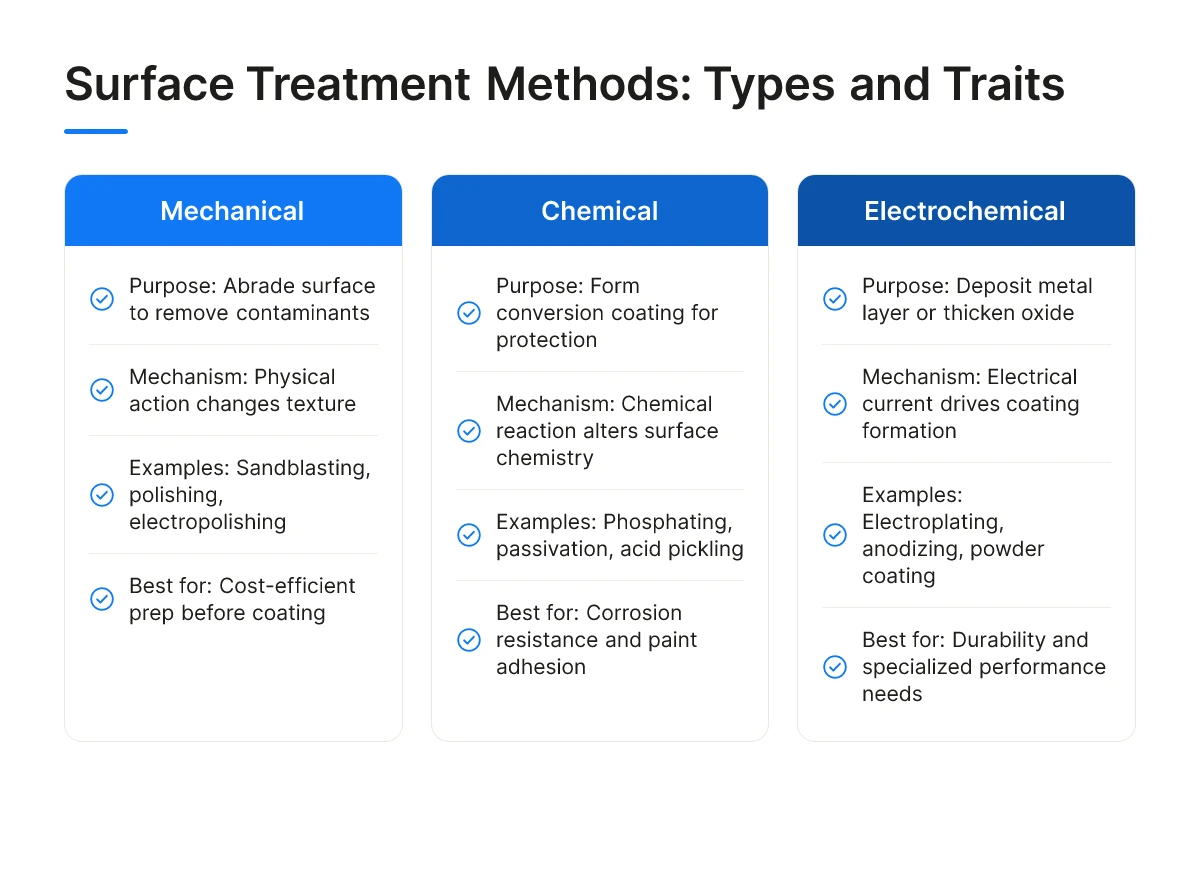
Surface treatment metal parts processes fall into three families: mechanical, chemical, and electrochemical/coating, each changing the surface through a different mechanism rather than a different goal.
Mechanical methods physically alter the surface. Sandblasting, bead blasting, polishing, and electropolishing remove material, smooth texture, or strip contaminants through abrasion or controlled material removal. Chemical methods react with the surface to form a new compound layer, phosphating, passivation, etching, and acid pickling all change surface chemistry rather than surface shape. Electrochemical and coating processes add or grow a layer entirely: electroplating, electroless plating, anodizing, and powder coating build a new surface on top of or from the base metal.
Grouping this way matters more than a flat list because it tells you what a process can and cannot do. A mechanical process cannot improve corrosion resistance the way a chemical conversion coating can, and no amount of chemical treatment will fix a rough, pitted surface the way blasting or polishing will.
Which Surface Treatment Processes Work Best for Steel Versus Aluminum and Other Metals?
Steel generally pairs with phosphating, passivation, or plating, while aluminum is the one metal suited to anodizing, and both benefit from blasting or powder coating depending on the end use.
Anodizing is worth isolating because it only works this way on aluminum. It’s an electrochemical process that thickens the metal’s own natural oxide layer rather than depositing a foreign material. That’s a fundamentally different mechanism from plating, where electroplating or electroless plating deposits an actual layer of a different metal, zinc, nickel, or chrome, for example, onto the base part. Anodizing grows a layer from the substrate itself; plating adds one on top.
Stainless steel has its own specialist process: passivation. Rather than adding any coating, passivation removes free iron and other contaminants left on the surface from machining, so the chromium oxide layer that gives stainless steel its corrosion resistance can form uninterrupted. Skip passivation on a machined stainless part and embedded iron particles can rust even though the bulk material won’t.
What Is the Difference Between Mechanical Treatments Like Sandblasting and Chemical Treatments Like Phosphating?
Sandblasting abrades the surface to change texture or clean it, while phosphating reacts with the surface to form a conversion coating that changes its chemistry.
Sandblasting fires abrasive media at a part to knock off scale, rust, or old coatings and leave a uniform, textured profile, nothing new is added, material is only removed or roughened. Phosphating works the opposite way: it’s a chemical reaction that converts the outer layer of the metal into a phosphate crystal structure, which improves corrosion resistance and gives paint or powder coating something to grip.
These two categories are rarely used in isolation. Acid pickling is standard before plating to strip oxide scale so the deposited metal bonds properly. Blasting is a common precursor to powder coating, since a roughened, contaminant-free surface holds the coating far better than a smooth or greasy one. Anyone specifying surface treatment metal parts requirements should think in sequences, clean or abrade first, convert or coat second, not single standalone steps.
How Do You Choose the Right Surface Treatment for Your Metal Parts and Application?
Match the treatment to four factors in order: base metal, operating environment, mechanical tolerances, and downstream assembly steps like welding or painting. Get this sequence backward, and you risk selecting a finish that looks right on paper but fails in the field or blocks the next manufacturing step.
Start with the substrate. Aluminum, stainless steel, and carbon steel each respond differently to plating, anodizing, or chemical conversion coatings, so the base metal narrows the field before anything else does. Next comes the environment: parts exposed to salt spray, chemical washdown, abrasive contact, or sterile handling all need different protective properties. A part destined for a cosmetic housing has different priorities than one buried inside an engine bay. Finally, factor in what happens after treatment, if the part gets welded, bonded, or painted downstream, the surface treatment has to support that step rather than interfere with it.
What Surface Treatment Specifications Do Automotive, Aerospace, and Medical Device Industries Require?
Each industry weights the decision factors differently, and that ranking should drive the specification. Automotive programs typically prioritize corrosion resistance and cost-efficiency at volume, a bracket or fastener produced in the hundreds of thousands needs a finish that scales economically, like zinc plating or e-coating, without sacrificing salt-spray performance. Aerospace components shift the priority toward fatigue performance and traceability, since a coating that alters surface stress or lacks documented lot control can compromise a part under cyclic loading. Medical devices push biocompatibility and cleanability to the top of the list, often requiring passivation or electropolishing that removes free iron and creates a surface that withstands repeated sterilization cycles.
None of these priorities are exclusive to one sector, a medical bracket might also need corrosion resistance, and an automotive sensor housing might need biocompatible surfaces if it’s cabin-facing. The point is to rank the requirements for your specific application before comparing treatment options, not after.
How Do Durability, Longevity, and Performance Benchmarks Differ Across Treatment Methods?
Treatments vary widely in how long they protect a part and how much wear they tolerate before failing. A thin decorative plating may hold up fine on a low-contact enclosure but wear through quickly on a part subject to repeated friction, while a thicker hard-anodized or nitrided surface holds up longer under abrasive or high-cycle conditions. Corrosion resistance follows a similar pattern, some coatings offer short-term protection suited to indoor, controlled environments, while others are engineered for prolonged outdoor or chemical exposure. Rather than chasing a single “best” treatment, compare expected wear cycles and exposure conditions against the part’s service life and maintenance schedule.
Coating thickness also affects fit. On precision-machined parts with tight tolerances, even a few microns of buildup from plating or coating can shift a bore diameter or thread engagement out of spec. Tolerance stack-up needs to account for the treatment layer, not just the as-machined dimension, a mismatch here is a common and avoidable cause of rejected parts. This is why choosing surface treatment metal parts processes works best as a design-stage decision rather than a post-production fix. Bringing a treatment provider into design for manufacturability (DFM) discussions early lets machining tolerances, coating thickness, and masking requirements get coordinated before the first production run, rather than discovered during final inspection.
What Quality, Durability, and Performance Benefits Do Different Surface Treatments Deliver?
Surface treatment for metal parts delivers five measurable benefits: corrosion resistance, wear resistance, improved fatigue life, better coating adhesion, and consistent cosmetic appearance across a production run.
Corrosion resistance is the most cited benefit, and for good reason, a plated or passivated part resists rust and chemical attack far longer than bare metal exposed to moisture or industrial atmospheres. Wear and abrasion resistance matters most for parts that see repeated contact or friction, such as gears, shafts, and fasteners; hard chrome plating and nitriding both add surface hardness without changing the underlying alloy. Fatigue life improves when treatments like shot peening introduce compressive residual stress at the surface, delaying crack initiation under cyclic loading. Coating and paint adhesion depends on surface prep, a properly cleaned and profiled surface holds a topcoat far longer than one treated as an afterthought. Cosmetic consistency, meanwhile, is what customers notice first, even when it has no functional role.
What Are Common Surface Treatment Failures and How Can Quality Control Prevent Them?
Most surface treatment failures trace back to process control gaps, not the treatment chemistry itself. Coating delamination is usually a surface prep problem, oil, oxide, or contamination left on the substrate prevents the coating from bonding, and the finish peels or flakes under stress. Flash rust shows up when parts sit too long between acid pickling and the next process step, letting exposed steel oxidize before plating or painting can seal it. Uneven plating thickness often comes from poor rack or fixture design, where parts hang too close together and shield each other from even current distribution in the tank. Blistering happens when contaminants or trapped moisture get sealed under a coating and later expand with heat or humidity, pushing the finish up from beneath.
Quality control catches these failures before parts ship. Adhesion testing (cross-hatch or pull-off methods) confirms a coating bonds to spec. Salt spray testing exposes samples to controlled corrosive conditions to estimate real-world service life. Thickness measurement, using magnetic or eddy-current gauges, confirms plating or coating falls within tolerance across the part, not just at one measurement point. Visual inspection under defined, consistent lighting catches cosmetic defects that inconsistent lighting conditions would miss entirely.
How Do You Compare Cost-Benefit and Total Cost of Ownership Across Different Treatment Options?
The cheapest treatment upfront is not always the cheapest over a part’s service life. A budget-friendly coating that needs rework after failed adhesion testing, or a plating process that requires field replacement after early corrosion, costs more in total than a premium treatment applied correctly the first time. Total cost of ownership accounts for rework rate, warranty claims, and field failures, not just the per-part treatment cost on a quote.
This is why batch-to-batch consistency matters more in precision manufacturing than in general fabrication. A precision-machined part paired with an inconsistent surface treatment metal parts process introduces variability that undermines the tight tolerances achieved upstream. Manufacturers running surface treatment metal parts programs at scale build in the QC checkpoints above precisely to keep that variability out of the finished product.
What Environmental, Regulatory, and Cost Factors Should Guide Surface Treatment Decisions?
Regulatory compliance and process cost now shape surface treatment metal parts decisions as much as corrosion resistance or appearance, a coating that fails an audit or blows a budget defeats its purpose regardless of performance.
How Do RoHS, REACH, and Other Regulations Affect Your Choice of Surface Treatment?
RoHS restricts hazardous substances in manufactured products, including hexavalent chromium, a compound long used in chromate conversion coatings and decorative chrome plating for its corrosion resistance and low cost. REACH, the European Union’s chemical management framework, requires manufacturers and suppliers to register, disclose, and in some cases justify continued use of specific chemical substances involved in production processes, including plating baths and pretreatment chemistries.
Both rules have pushed the industry away from older hexavalent chromium processes toward trivalent chromium plating and other reformulated chemistries that deliver comparable corrosion protection without the same regulatory exposure. This shift matters beyond Europe: many global buyers now specify RoHS or REACH compliance as a baseline contract requirement, regardless of where the parts ship. A supplier still running legacy hexavalent processes without a transition plan represents a compliance risk for any buyer selling into regulated markets.
What Is the Environmental Impact and Sustainability Profile of Different Surface Treatment Processes?
Wet chemical processes, plating, pickling, chemical conversion coatings, generate wastewater that requires treatment before discharge, and that treatment burden adds cost, equipment, and regulatory oversight to a manufacturer’s operation. Dry or lower-effluent processes, such as powder coating and many mechanical finishes like shot peening or vibratory tumbling, produce less liquid waste and generally carry a lighter environmental compliance load. Neither category is universally “greener”, plating baths can often be treated and partially recycled, while powder coating overspray still requires capture and disposal, but the effluent profile is a real difference worth asking suppliers about directly.
How Should You Think About Cost Without Guessing at Numbers?
Cost tiers track process complexity and cycle time more reliably than they track any single fixed price list. Mechanical finishes, tumbling, blasting, basic polishing, sit at the budget-friendly end because they require minimal chemistry and short cycle times. Plating and anodizing fall into a mid-range tier, reflecting bath chemistry, rinse stages, and quality control steps. Specialized coatings, aerospace-grade anodizing with tight masking tolerances, multi-layer plating stacks, or processes requiring extensive documentation and traceability, land in the premium tier because each added step multiplies handling time and inspection cost.
Rather than assuming a supplier’s process meets current regulations, ask directly for certificates of conformance, material safety data sheets, and documentation of any recent chemistry changes. This is a five-minute request that prevents a shipment from getting held at a customer’s incoming inspection months later.
Frequently Asked Questions
Can surface treatment be applied to parts after they’re already in service?
Some treatments work on used parts, but results depend heavily on prior wear and existing coatings. Cleaning, re-plating, or recoating can restore corrosion protection on parts pulled from service, provided the base metal hasn’t pitted or cracked. Heavily worn or contaminated surfaces usually need machining or grit-blasting first to expose clean substrate, which adds cost and may alter final dimensions.
Does surface treatment affect the dimensional tolerances of precision-machined parts?
Yes, most treatments add or remove material at the micron to millimeter scale, so tolerances need to account for it upfront. Plating and coating processes typically add thin layers (a few microns to tens of microns), while treatments like passivation remove very little. Engineers should specify pre-treatment dimensions and communicate the finish thickness to machinists so final parts meet print tolerances after processing.
How do you know if a metal part even needs surface treatment?
A part needs surface treatment if it faces corrosion risk, wear, friction, or has appearance and conformance requirements it can’t meet as machined. Stainless steel 304 parts in mild environments often skip treatment entirely. Consider the operating environment, contact with other materials, and any industry or customer specifications before deciding.
Can multiple surface treatments be combined on the same part?
Yes, combining treatments is common when a single process can’t meet every requirement for corrosion resistance, wear, and appearance. A typical sequence might include cleaning or blasting, then phosphating for adhesion, followed by powder coating or plating for final protection and finish. Order matters: each step must prepare the surface correctly for the one that follows, and incompatible chemistries can cause adhesion failures or corrosion cells if sequenced poorly. Engineers usually validate combined processes with samples before full production runs.
Conclusion
Surface treatment decisions come down to three things: matching the process to the part’s actual operating environment, accounting for added or removed material in your tolerance stack, and validating any combined treatments before committing to full production. Skipping that validation step is where most costly rework starts. Before your next production run, pull the print for one part currently causing corrosion or wear complaints and map its environment against the treatment options covered here, that single review often reveals whether you’re over-specifying an expensive process or under-protecting a part that needs one.
Recommended Articles
Explore more from our content library:
