
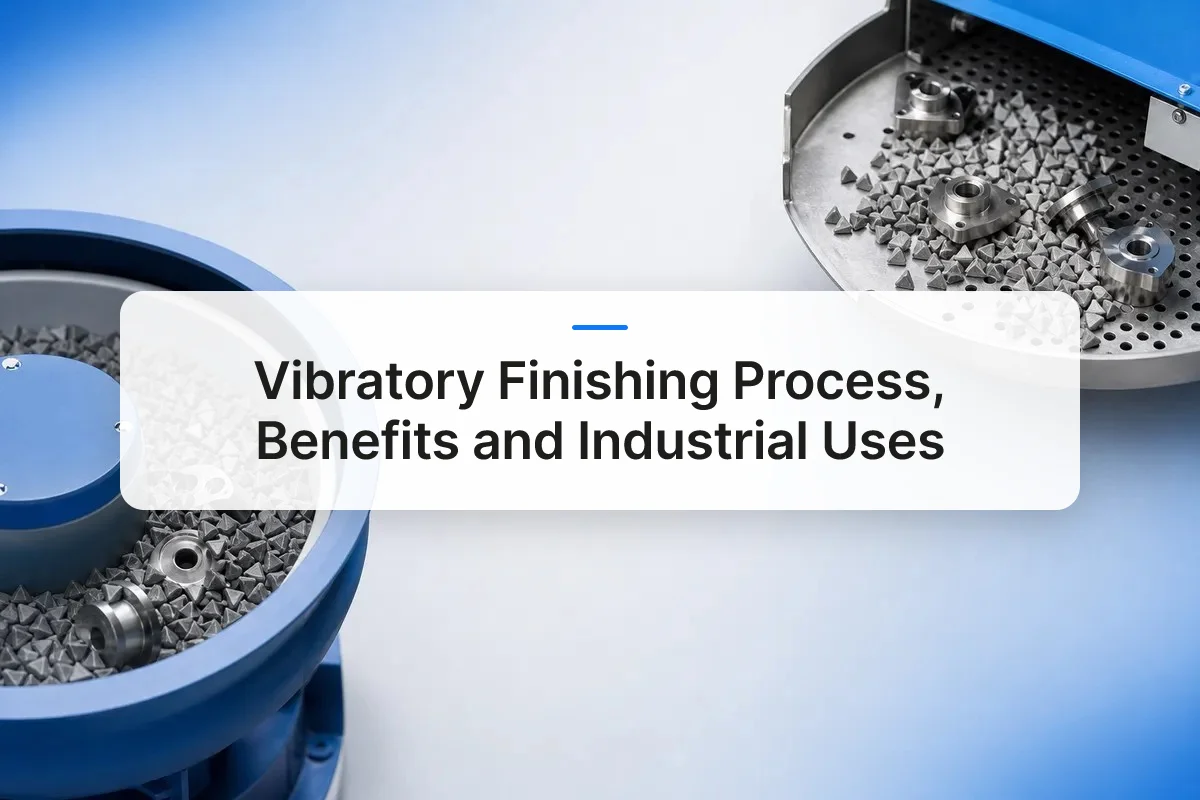
Understanding vibratory finishing process is essential. Vibratory finishing is a mass finishing process that uses a vibrating bowl or tub filled with abrasive media, compound, and water to deburr, clean, radius, and polish parts in bulk. The vibration keeps parts and media in constant contact, wearing away burrs and surface imperfections evenly across every piece in the load. Manufacturers use it to improve part quality and cut manual finishing labor, especially for precision components with tight tolerances or complex geometries that need consistent, repeatable surface results.
What Is Vibratory Finishing and How Does It Work as a Surface Treatment Method?
An electric motor with an offset weight drives a bowl or tub to vibrate at high frequency, forcing parts and abrasive media to roll and slide against each other continuously. That constant, low-amplitude motion is what separates the vibratory finishing process from simpler tumbling methods, and it’s what makes the finish so even across a full batch of parts.
Inside the tub, media grains slip past every surface of a part, including pockets, slots, and blind holes, abrading high spots, burrs, and machining marks at a controlled, gradual rate. Because the whole mass moves together rather than cascading down like rocks in a rotating drum, contact pressure stays low and distributed. That’s why the vibratory finishing process is the default choice when a shop needs uniform edge break and surface texture across thousands of identical parts, not just a handful of hand-deburred samples.
What Are the Key Differences Between Vibratory Finishing and Tumble Finishing?
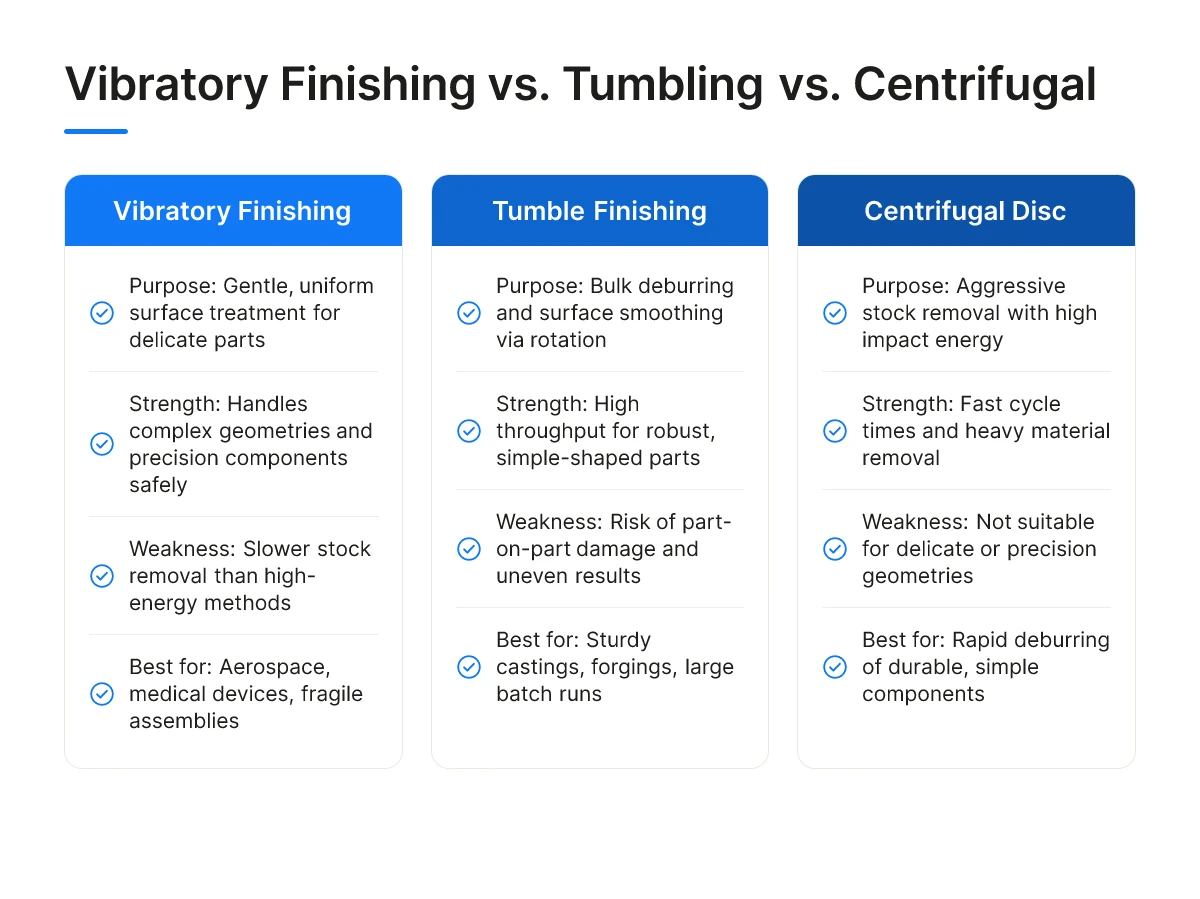
Vibratory finishing relies on vibration to move media against parts, while tumble (barrel) finishing relies on rotation to cascade media down onto parts in a tumbling action.
That mechanical difference matters. Tumbling’s cascading action generates more aggressive impact, which works fine on rugged castings but can chip, bend, or peen thin-walled and delicate components. Vibratory motion is gentler and more contained, and it reaches internal features and blind holes that a rotating barrel often can’t touch.
What Materials and Part Geometries Can Be Processed With Vibratory Finishing?
Vibratory finishing handles metals, plastics, and even some composites, and it suits parts ranging from small precision pins to mid-size housings with complex, multi-featured geometries.
Thin sheet metal brackets, threaded fasteners, stamped components, and machined parts with tight tolerances all respond well because the process doesn’t rely on heavy impact to do its work. Parts that would nick or tangle in a rotating barrel, long slender shafts, delicate stampings, parts with fine edges, tend to hold up better under vibratory action. This is also why the process pairs naturally with precision machining and cold forging operations, where a single dent or scratch can send an otherwise good part to scrap.
Compound and water aren’t incidental additions, they carry most of the process’s real work. Water suspends the abrasive slurry and flushes away swarf, metal fines, and spent media particles so they don’t redeposit on part surfaces. Compound adjusts pH, controls foam, and either accelerates or slows the cutting rate depending on the finish target, from an aggressive descaling cycle down to a fine burnishing pass that adds shine without removing much material. Get that chemistry wrong and even the right media and cycle time won’t produce a repeatable finish.
How Does Vibratory Finishing Compare to Tumbling and Other Mass Finishing Processes?
Vibratory finishing uses gentler, more controlled contact than barrel tumbling, which makes it the better default for precision and fragile parts, while centrifugal methods win on aggressive stock removal.
Both are mass finishing methods that abrade parts using media, water, and compound in a shared container, but the mechanics differ in ways that matter for part quality. In barrel or tumble finishing, parts and media roll over each other under gravity inside a rotating drum, creating a cascading action. That cascade builds up impact energy, which is efficient for heavy deburring but risky for delicate geometries, since parts can nick or peen against each other under their own weight.
Vibratory finishing instead agitates a shallow tub of media and parts with a controlled, high-frequency vibration. Contact is more distributed and lower-impact, and because the process runs in an open tub, an operator can watch the surface develop and pull parts as soon as the finish is right. This also lets vibratory equipment reach internal features like holes and recesses that a rotating barrel struggles with, which matters for parts with cored holes, threads, or tight internal radii.
When Should You Choose Vibratory Finishing Over Alternative Finishing Methods?
Choose vibratory finishing when parts are thin-walled, precision-machined, or have complex internal geometry that can’t tolerate heavy impact contact.
Part fragility is the first filter. Delicate stampings, cold-forged components with tight tolerances, and small precision-machined parts do better in a vibratory tub than a tumbling barrel. Surface finish requirements matter too, burnishing to a bright, uniform finish is easier to control in a vibratory process than in high-impact tumbling. Batch size and geometry complexity round out the decision: vibratory bowls and tubs handle mixed batches of irregular shapes well, since media flows around each part rather than depending on gravity-driven rolling.
How Do Cycle Times and Production Rates Compare Across Different Finishing Techniques?
Cycle times vary by equipment scale and media aggressiveness rather than by a fixed rule, so throughput depends on matching the machine to the job.
Barrel tumbling often runs longer cycles because its lower-frequency cascading action removes material more slowly per pass, though it can process large volumes with minimal supervision. Vibratory equipment generally cycles faster for light deburring and burnishing work, and continuous-flow vibratory systems can support higher-volume production runs than batch barrels. Centrifugal disc and centrifugal barrel finishers apply much higher energy through rapid rotation, cutting stock removal time dramatically for aggressive deburring or radiusing, but that same energy increases the risk of surface damage on soft or thin-walled parts, which is exactly where the vibratory finishing process regains the advantage.
The practical takeaway: match energy level to part tolerance first, then optimize for cycle time within that constraint.
What Types of Media and Equipment Are Used in Vibratory Finishing Operations?
Equipment choice comes down to two configurations, round bowl and tub/trough vibrators, while media selection determines cutting speed, surface texture, and how well the process reaches tight geometry.
Equipment Configurations
Round bowl vibrators move parts and media in a spiral pattern along the bowl’s circumference, which naturally separates workpieces from media near the discharge point. That makes them a common choice for continuous or semi-continuous operations processing high volumes of small to mid-size parts.
Tub (or trough) vibrators use a straight, open trough shape instead of a bowl. They’re better suited to longer or larger parts, brackets, shafts, housings, because the linear cavity gives components more room without wedging against curved walls. Tub units also tend to allow easier visual monitoring mid-cycle, since the operator can view the full length of the trough rather than just a bowl cross-section.
How Do Different Media Types Affect Finishing Outcomes and Material Compatibility?
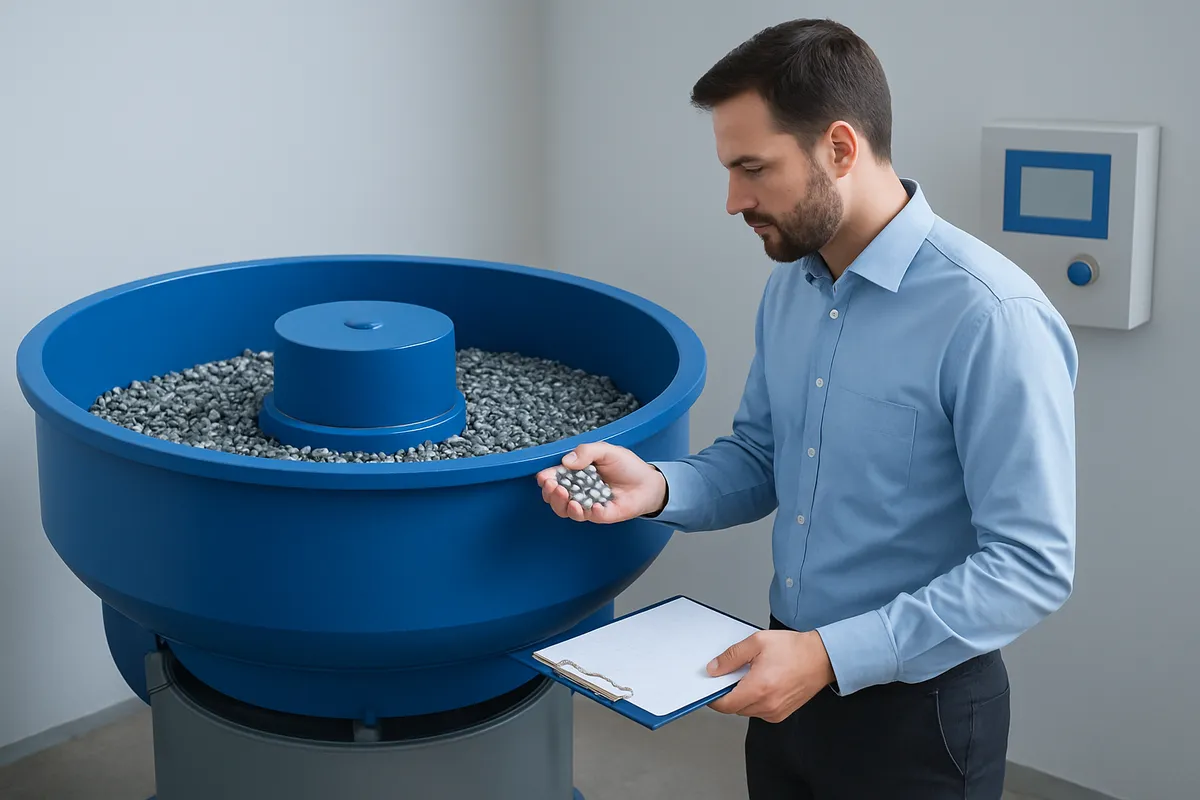
Media falls into four broad categories, ceramic, plastic, steel, and organic, and each trades off cutting speed against surface gentleness. Ceramic media is dense and aggressive, suited to heavy deburring and radiusing on ferrous parts and hardened steel. Plastic media cuts more slowly and gently, making it the default for softer metals like aluminum, brass, and zinc die castings where aggressive stock removal would round edges or dish thin sections. Steel media doesn’t cut at all, it burnishes, compressing the surface to produce a bright, work-hardened finish without material removal. Organic media (corn cob, walnut shell) is the softest option, typically reserved for drying, polishing, or applying wax and buffing compounds after the primary cutting stage.
Material compatibility follows a simple rule: match media hardness and aggressiveness to the part’s hardness. Softer base metals need softer or slower-cutting media to avoid over-erosion or embedding. Media size and shape also govern access, cones and angle-cut pieces reach into slots and cross-holes that round or triangular media can’t, so parts with blind holes, internal threads, or deep recesses need a media geometry deliberately selected for that access.
What Troubleshooting Steps Address Common Issues Like Media Degradation and Uneven Results?
Media degradation shows up as slowing cut rates or inconsistent finish, usually the sign that abrasive grains have worn smooth and the batch needs replacement or top-off. Media lodging inside part cavities points to a media-to-cavity size mismatch; switching to a smaller preformed shape usually resolves it. Uneven finishing across a batch often traces back to overloading the machine or poor part-to-media ratio, which restricts the free movement any vibratory finishing process depends on for consistent contact.
Compound Selection
Liquid or powder compounds work alongside media to control rust inhibition, degreasing, and cutting rate. Alkaline compounds boost cleaning and cutting action, while acidic or rust-inhibiting formulations protect ferrous parts between finishing and the next production step, a detail that matters as much as media choice in the overall outcome.
How Can Vibratory Finishing Improve Part Quality and Production Efficiency in Precision Manufacturing?
Vibratory finishing improves part quality by replacing inconsistent hand deburring with a repeatable, automated process that treats every part in a batch the same way. That consistency shows up directly in tolerance control, fatigue performance, and how much skilled labor a shop needs for finishing work.
Consistency Over Manual Deburring
Manual deburring depends on an operator’s hand pressure, tool angle, and attention level, which shifts from part to part and shift to shift. A vibratory finishing process runs the same media, compound, and cycle time across an entire batch, so part 1 and part 500 come out with nearly identical edge conditions. For precision machining shops running tight-tolerance components, that uniformity matters more than raw speed, it’s what lets quality control sign off on a batch instead of inspecting every piece individually.
Quality Mechanisms Behind the Process
Three mechanisms drive the quality gains. First, edge break uniformity: media contacts every accessible edge at a consistent rate, avoiding the over-radiusing or missed burrs common with hand tools. Second, surface roughness reduction: abrasive or burnishing media lowers Ra values and closes microscopic surface irregularities that would otherwise trap contaminants or initiate cracks. Third, compressive stress from burnishing media improves fatigue life and helps coatings or platings adhere better, since a smoother, more uniform substrate gives coatings fewer high points to fail from first.
Freeing Labor and Shortening Cycles
Batch processing means one operator can load a vibratory bowl with dozens or hundreds of parts and let the equipment run unattended while attending to other machines. That shift moves skilled labor away from repetitive manual deburring and toward higher-value tasks like setup, inspection, or programming, shortening the overall production cycle even though the finishing step itself takes a defined run time.
What Real-World Applications of Vibratory Finishing Exist in Aerospace, Medical Device, and Automotive Manufacturing?
Aerospace, medical device, and automotive manufacturers use vibratory finishing because their parts face fatigue loading, biocompatibility rules, or high-volume tolerance stacks that manual finishing can’t reliably meet. Aerospace fasteners and structural components need uniform edge breaks and stress-relieved surfaces to survive cyclic loading. Medical implants and surgical instruments require smooth, contaminant-free surfaces before passivation or sterilization. Automotive transmission and engine components need burr-free, consistent surfaces at high volumes without adding labor cost per part.
How Does Vibratory Finishing Integrate Into a Complete Surface Treatment Workflow?
Vibratory finishing typically sits between machining and downstream surface treatments like coating, plating, or passivation. Parts come off a CNC machine or cold forging line with burrs and machining marks, move through the vibratory finishing process to clean and prepare the surface, then proceed to passivation, anodizing, or inspection with a substrate that accepts those treatments evenly. Manufacturers offering machining, surface finishing, and inspection under one roof can sequence these steps without part hand-offs between vendors, which reduces the risk of surface contamination or damage between processing stages.
What Are the Cost and ROI Considerations When Implementing a Vibratory Finishing Process?
Cost depends on four drivers: equipment size and configuration, media and compound consumption, wastewater handling, and the labor hours a vibratory finishing process replaces or offsets.
Equipment configuration is the largest line item. A single open-tub vibratory bowl for small brackets costs far less to buy and run than a multi-stage system with separation, drying, and water recycling built in. Media and compound consumption is ongoing rather than one-time, abrasive ceramic or plastic media wears down and needs replenishment, and compounds for cleaning or burnishing get consumed with every cycle. Wastewater handling adds cost if local discharge rules require settling tanks, filtration, or contracted disposal, and it’s worth pricing this into a project before committing to a wet process over a dry one.
Labor offset is where the payback usually shows up. Manual deburring with hand tools or bench grinders ties up skilled labor on repetitive work that a batch process can handle unattended.
How Do You Calculate the Cost-Benefit Analysis and Return on Investment for Vibratory Finishing Equipment?
Compare the fully loaded cost of current manual finishing labor against equipment investment, consumables, and the value of reduced rework and scrap.
Start with what manual finishing actually costs today: hours per batch, wage rates, and any overtime or bottleneck delays it creates upstream. Then estimate what a vibratory finishing process would cost to run, media, compound, water treatment or disposal, and the reduced (not eliminated) labor to load, unload, and inspect batches. The gap between those two numbers, spread over the expected life of the equipment, is the core of the payback calculation. Rework and scrap reduction often gets left out of this math, but it shouldn’t, parts damaged by inconsistent hand deburring or missed burrs that fail downstream inspection carry real cost that a repeatable process avoids.
What Factors Influence Equipment Sizing and Production Capacity Planning?
Equipment size should match part volume, batch frequency, and the cycle time each load needs to hit a consistent finish.
Undersized equipment forces more batches per shift and creates bottlenecks; oversized equipment sits underutilized and ties up capital that could go elsewhere. Sizing decisions should account for peak production periods, not just average volume, and for how much cycle time varies between light deburring and heavier radiusing or burnishing work. Equipment options generally fall into three tiers: budget-friendly units suited to lower volumes or single-shift operations, mid-range systems with more automation and media separation for growing production lines, and premium or enterprise-grade systems built for continuous, high-volume runs with integrated water treatment and monitoring. Matching the tier to actual throughput needs, rather than buying the largest available system, keeps the investment proportional to the return.
Faster, more consistent cycles compound the ROI case over time. A properly sized vibratory finishing process reduces the variability that leads to scrap, shortens the path from machining to shipment, and lowers the rework costs that erode margin on precision parts.
Frequently Asked Questions
Can vibratory finishing damage delicate or thin-walled parts?
Yes, if media, amplitude, or cycle time are mismatched to the part, but the risk is manageable with the right setup. Thin-walled or fragile components need low-amplitude equipment, softer plastic or ceramic media, and shorter cycles with frequent inspection. Part-on-part contact, not the media itself, causes most damage, so separation or barrier compounds often solve the problem.
How long does a typical vibratory finishing cycle take?
Most cycles run between 30 minutes and 4 hours, depending on the finish required and the starting condition of the part. Light deburring or descaling finishes faster, while heavy burrs, radiusing, or mirror-like burnishing on hardened metal can extend runtime well beyond that range.
Is vibratory finishing suitable for plastic or non-metal parts?
Yes, vibratory finishing works on many plastics, composites, and even some ceramics, not just metal. The key is matching media hardness and cycle aggressiveness to the substrate, plastics generally need softer plastic or organic media and shorter cycles to avoid melting from friction heat or surface pitting.
How do you know when finishing media needs to be replaced?
Replace media when it loses its cutting edges, shrinks below a usable size, or stops producing a consistent finish across a batch. Operators typically track media wear by weight loss per cycle and by visual inspection of shape degradation, then top off or fully replace media on a set schedule.
Does vibratory finishing require special wastewater disposal handling?
Yes, wet vibratory finishing generates compound-laden runoff that usually needs filtration, settling, or treatment before discharge. The exact requirements depend on local and federal wastewater regulations and the compounds used, so many shops install closed-loop water recycling systems to cut both discharge volume and compound costs while staying compliant.
Conclusion
Vibratory finishing earns its place in precision manufacturing because it solves a problem tumbling and manual deburring can’t: consistent, controlled surface improvement on batches of parts with tight tolerances or internal features. Getting good results depends on three choices, matching media to the substrate, tuning amplitude and cycle time to part fragility, and monitoring media wear so quality doesn’t drift between batches.
Before your next production run, pull the specs on your most failure-prone part and map them against media type, cycle time, and compound, that single review usually surfaces the fix.
Recommended Articles
Explore more from our content library:
